
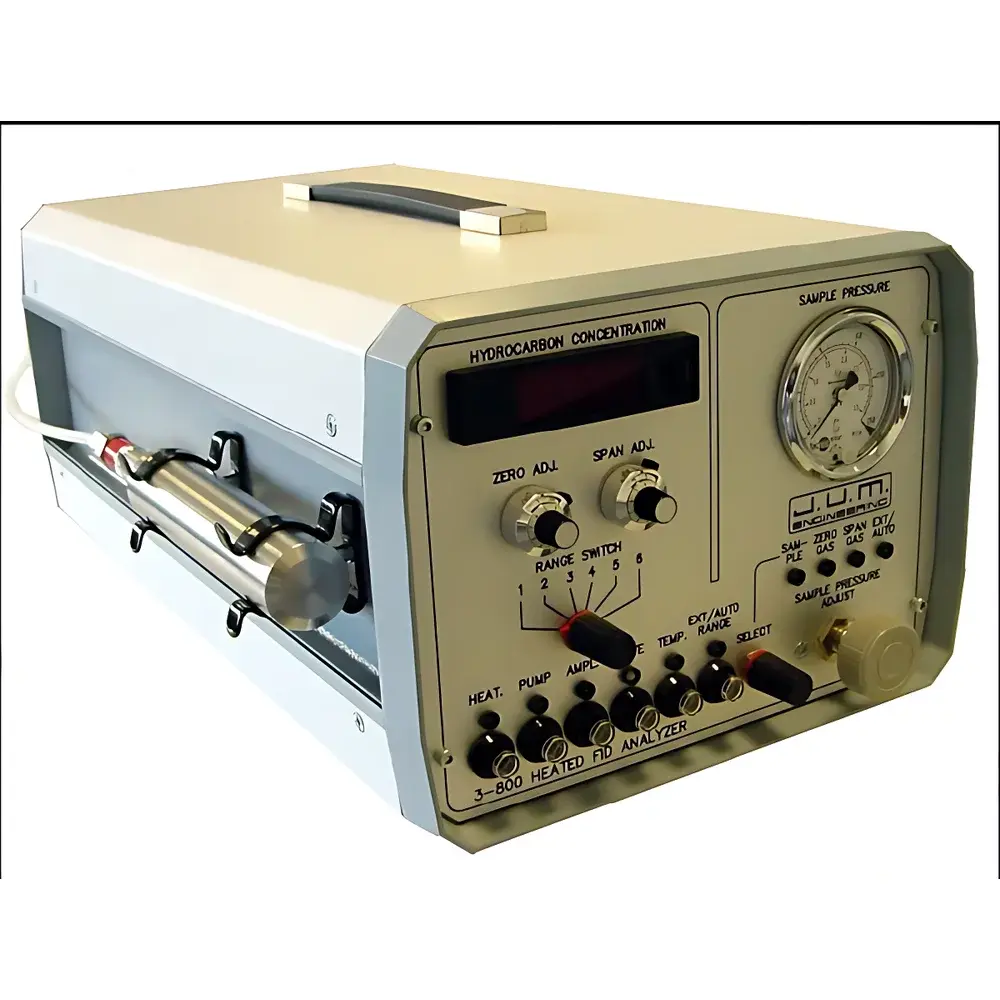
J.U.M. 3-200 Portable Non-Methane Hydrocarbons (NMHC) Analyzer
| Brand | J.U.M. |
|---|---|
| Origin | Germany |
| Model | 3-200 |
| Detection Principle | Flame Ionization Detection (FID) |
| Measurement Range | 0–10 to 0–100,000 ppm (selectable full-scale ranges) |
| Sensitivity | ≤1 ppm CH₄ full-scale |
| Response Time (T₉₀) | ≤0.2 s |
| Oven Temperature | 190 °C |
| Carrier/Air Supply | Integrated zero-air generator |
| Compliance | EN 12619, EN 13526, EPA Method 25A, EPA Method 503, 2nd/13th/17th BImSchV |
Overview
The J.U.M. 3-200 Portable Non-Methane Hydrocarbons (NMHC) Analyzer is a field-deployable, FID-based gas analyzer engineered for high-precision quantification of total hydrocarbons (THC) and methane (CH₄) in ambient air, stack emissions, and process streams. It operates on the fundamental principle of flame ionization detection—where organic compounds are pyrolyzed in a hydrogen–air flame, generating ions proportional to carbon mass flow. Methane concentration is measured directly; NMHC is derived by subtracting methane from total hydrocarbons using an integrated catalytic methanizer or dual-channel differential measurement architecture (configuration-dependent). Designed for regulatory-grade compliance, the instrument meets the stringent metrological requirements of European emission directives (2nd, 13th, and 17th BImSchV), harmonized standards EN 12619 (stack monitoring) and EN 13526 (performance criteria for FID analyzers), as well as U.S. EPA Methods 25A (THC/NMHC in stationary sources) and Method 503 (calibration and verification protocols). Its compact, ruggedized chassis supports operation in mobile laboratories, fence-line monitoring setups, and on-site industrial audits without external power or gas cylinders.
Key Features
- Integrated heated sample path and reaction chamber maintained at 190 °C to prevent condensation of higher molecular weight hydrocarbons (e.g., C₈–C₁₂ aliphatics and aromatics), ensuring quantitative recovery and minimizing memory effects.
- Self-contained zero-air supply system eliminates dependency on external compressed air or bottled calibration gases during routine operation.
- Multi-range measurement capability with six selectable full-scale spans (0–10, 0–100, 0–1,000, 0–10,000, 0–100,000 ppm C₁-equivalent), configurable via front-panel interface or remote command protocol.
- Sub-second response time (T₉₀ ≤ 0.2 s) enables real-time tracking of transient emission events, such as engine start-up cycles or catalyst light-off profiles.
- Rugged aluminum housing rated IP54 for dust and splash resistance; operational temperature range: −10 °C to +50 °C; battery-operated mode supports ≥4 hours continuous analysis.
- Factory-calibrated with NIST-traceable methane standards; linear dynamic range exceeds 10⁵, verified per EN 13526 Annex A.
Sample Compatibility & Compliance
The 3-200 accepts gaseous samples across a broad matrix: ambient air, flue gas (with optional particulate filtration and moisture removal), synthetic air, nitrogen, and argon-based carrier streams. It is validated for use with sample dew points up to 10 °C when operated within its heated pathway specification. The analyzer complies with GLP-aligned data integrity requirements—including audit-trail-enabled configuration logging, user-access control levels, and timestamped raw signal storage—supporting ISO/IEC 17025-accredited laboratories and EPA-regulated Title V permitting. All firmware and calibration records adhere to 21 CFR Part 11 electronic record and signature guidelines when paired with J.U.M.’s optional SecureLink software suite.
Software & Data Management
Instrument control, data acquisition, and report generation are managed via J.U.M. AnalyzeView™ PC software (Windows 10/11 compatible), which provides real-time chromatogram-free FID signal visualization, automatic zero/span validation logs, and export to CSV, PDF, or XML formats compliant with EMAS and EU ETS reporting templates. Raw analog output (4–20 mA, 0–10 V) and digital interfaces (RS-232, Modbus RTU over RS-485) enable seamless integration into SCADA systems and centralized environmental data management platforms (e.g., Siemens Desigo, Honeywell Experion). Firmware updates are performed via encrypted USB key with SHA-256 signature verification.
Applications
- Regulatory stack testing for VOC abatement systems (thermal oxidizers, RTOs, carbon adsorbers) per TA Luft and IED Annex VI.
- Fence-line monitoring of petrochemical facilities, refineries, and solvent-handling sites under REACH and E-PRTR reporting obligations.
- On-vehicle exhaust characterization during PEMS (Portable Emissions Measurement Systems) campaigns, including cold-start NMHC profiling.
- Catalyst development labs: real-time monitoring of methane slip and unburnt hydrocarbon conversion efficiency in three-way and lean NOₓ traps.
- High-purity gas certification in semiconductor fabrication: detection of sub-ppm hydrocarbon contaminants in bulk nitrogen, argon, and specialty process gases.
- LEL (Lower Explosive Limit) safety monitoring during solvent recovery unit commissioning and maintenance verification.
FAQ
Does the 3-200 require external hydrogen supply for FID operation?
No—the analyzer uses a built-in electrolytic hydrogen generator with PEM cell technology, eliminating the need for pressurized H₂ cylinders.
Can it distinguish between methane and ethane or other individual alkanes?
No—it measures total carbon response; speciation requires coupling with GC separation (e.g., J.U.M. GC-FID systems).
Is field calibration possible without certified gas standards?
Yes—zero calibration can be performed using internal zero-air; span calibration requires traceable CH₄ standard gas per EN 13526 Section 6.3.
What maintenance intervals are recommended for routine operation?
FID jet cleaning every 250 operating hours; ceramic igniter inspection every 1,000 hours; annual full metrological verification recommended.
How is moisture handled in humid sample streams?
An optional Nafion™ dryer module (accessory) is available for continuous sample conditioning; the base unit relies on thermal management to suppress condensation.
Related Products







