
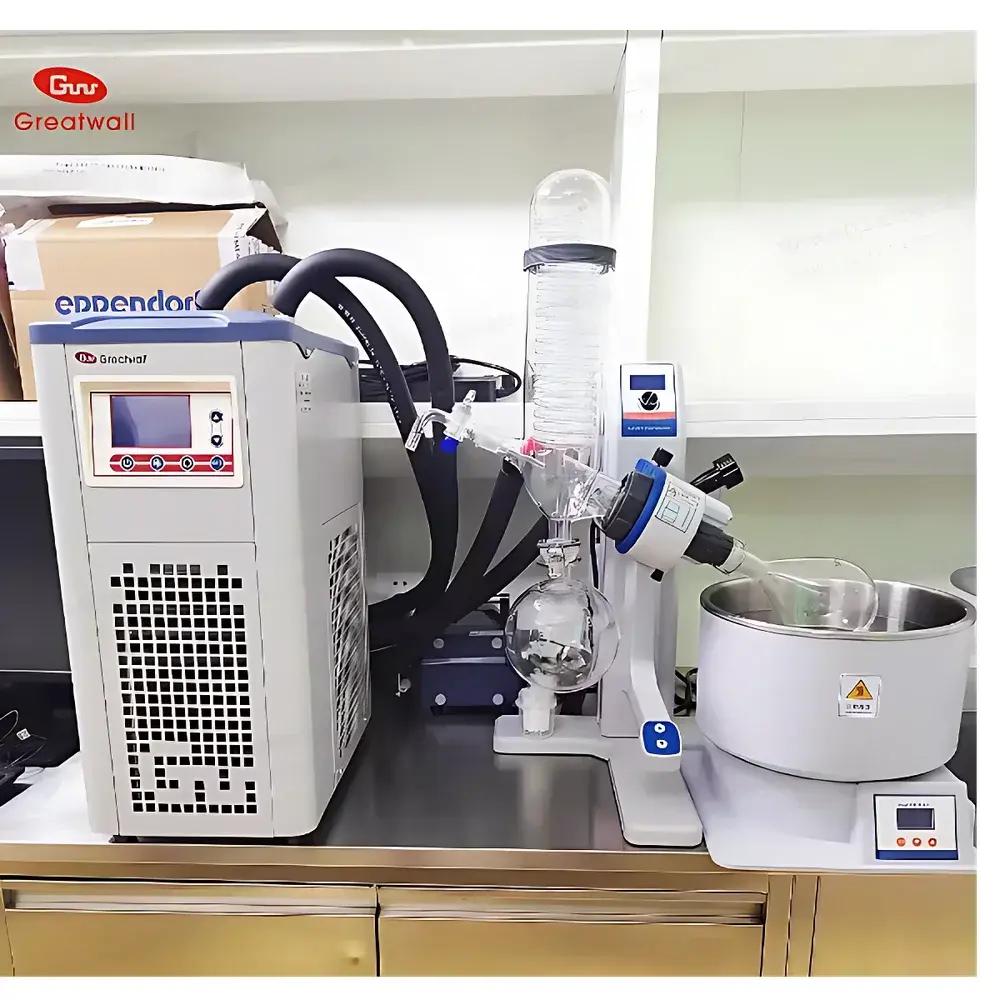
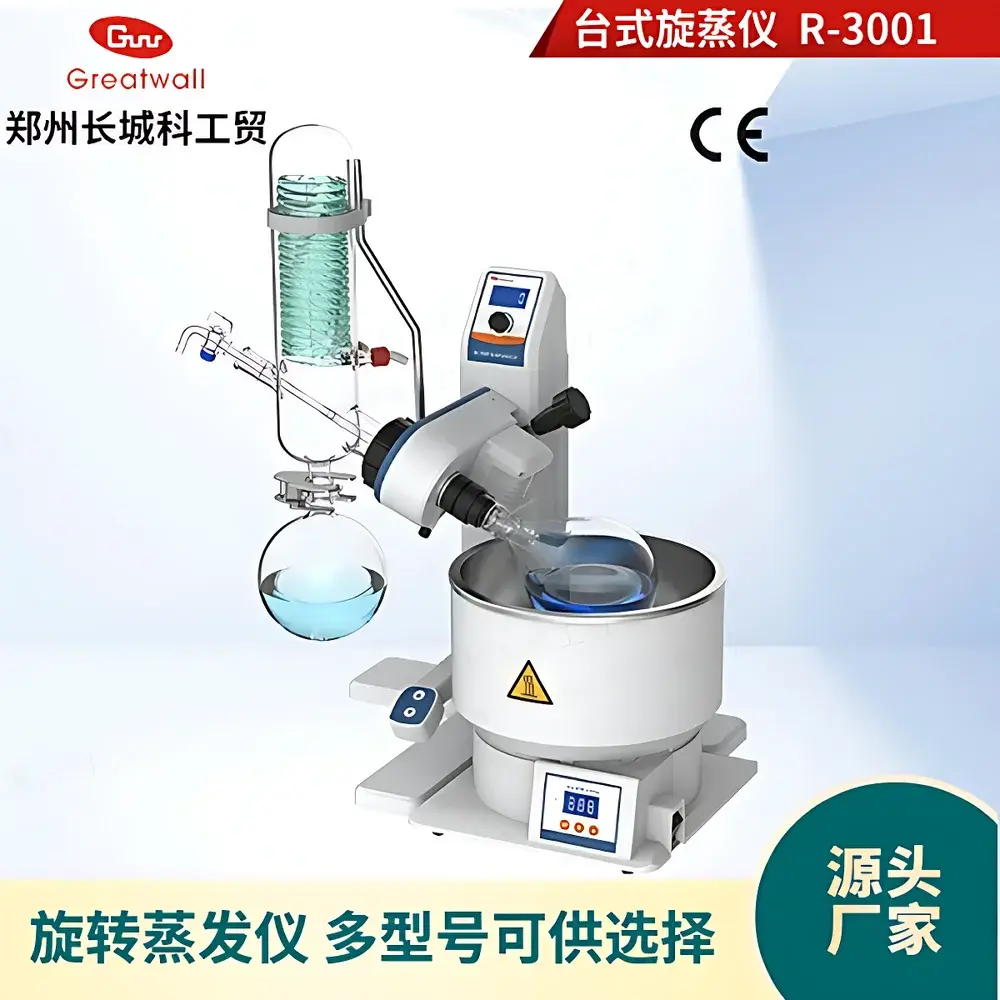
R-3001 Rotary Evaporator by The Great Wall
| Brand | The Great Wall |
|---|---|
| Origin | Henan, China |
| Manufacturer Type | Direct Manufacturer |
| Origin Category | Domestic (China) |
| Model | R-3001 |
| Capacity | 1 L |
| Rotation Speed | 10–280 rpm |
| Temperature Control Range | 5–35 °C |
| Vacuum Pump Compatibility | SHB-III Circulating Water Vacuum Pump (optional, not integrated) |
Overview
The R-3001 Rotary Evaporator by The Great Wall is an engineered solution for efficient, low-temperature solvent removal and sample concentration in research laboratories, quality control environments, and pilot-scale synthesis workflows. Operating on the principle of reduced-pressure distillation, the system leverages controlled rotation, precise bath temperature regulation, and vacuum-assisted vapor pressure reduction to accelerate evaporation while minimizing thermal degradation of heat-sensitive compounds. Designed for integration into standard fume hood setups, the R-3001 features a robust glass condenser assembly, motor-driven rotary joint with sealed bearing construction, and a detachable 1 L evaporation flask—optimized for reproducible recovery of volatile solvents such as ethanol, acetone, dichloromethane, and ethyl acetate. Its operational envelope—spanning 10–280 rpm rotation and a water bath temperature range of 5–35 °C—enables fine-tuned process control across diverse sample viscosities and boiling point profiles.
Key Features
- 1 L high-borosilicate glass evaporation flask with standardized ISO-KF 29.2 ground-glass interface for secure, leak-resistant mounting
- Stepless speed control via digital rheostat, delivering stable rotational output from 10 to 280 rpm with ±2 rpm repeatability
- Water bath heating system with PID-controlled temperature regulation (5–35 °C), ±0.5 °C accuracy at setpoint, and over-temperature cutoff protection
- Integrated vertical condenser (500 mm length, dual-coil design) with external coolant inlet/outlet ports compatible with standard laboratory chillers or tap-water recirculation units
- Motorized lift mechanism with manual override, enabling rapid flask immersion/extraction under vacuum without breaking the seal
- Modular vacuum interface supporting connection to external circulating water vacuum pumps (e.g., SHB-III series) via reinforced silicone tubing and quick-release fittings
- CE-compliant electrical architecture with grounded chassis, thermal fuse protection, and IP20-rated enclosure for laboratory safety compliance
Sample Compatibility & Compliance
The R-3001 accommodates a broad spectrum of organic and aqueous solutions, including reaction mixtures, natural product extracts, polymer solutions, and pharmaceutical intermediates. Its glassware configuration adheres to DIN/ISO 3585 standards for borosilicate glass 3.3, ensuring chemical resistance to common solvents and mild acids/bases. While the unit itself does not carry FDA 21 CFR Part 11 certification (as it is a mechanical process instrument without embedded data logging), its operation supports GLP- and GMP-aligned workflows when paired with validated vacuum sources and temperature calibration records. Users performing ASTM D129 or ISO 6617-compliant solvent recovery protocols may document bath temperature, rotation rate, and vacuum level manually or via external data acquisition systems.
Software & Data Management
The R-3001 operates as a stand-alone analog-digital hybrid instrument without onboard software or network connectivity. All parameter adjustments—including rotation speed and bath temperature—are executed via front-panel rotary encoders and LED displays. For laboratories requiring audit-trail capability, external validation tools (e.g., calibrated digital thermometers, tachometers, and vacuum gauges) are recommended to record operational parameters per batch. When integrated with third-party environmental monitoring systems or LIMS platforms, the R-3001’s consistent mechanical performance enables traceable, repeatable evaporation cycles—particularly valuable in method transfer studies and regulatory submission packages.
Applications
- Concentration of dilute analyte solutions prior to HPLC or GC-MS analysis
- Removal of reaction solvents following Grignard, Suzuki, or esterification reactions
- Recovery and recycling of high-purity solvents in synthetic chemistry labs
- Preparative isolation of thermolabile natural products (e.g., terpenoids, flavonoids) from crude plant extracts
- Lyophilization feedstock preparation where residual solvent content must be reduced below 500 ppm
- Teaching laboratories demonstrating phase equilibria, vapor pressure depression, and Raoult’s law principles
FAQ
Is the R-3001 supplied with a vacuum pump?
No—the R-3001 is a vacuum-requiring instrument and does not include an integrated pump. It is designed for use with external vacuum sources such as the SHB-III circulating water vacuum pump or oil-free diaphragm pumps meeting ≥0.095 MPa (≥680 Torr) ultimate vacuum specifications.
What is the maximum recommended vacuum level for safe operation?
For optimal condensation efficiency and bumping prevention, operating vacuum should be maintained between 10–50 mbar (7.5–37.5 Torr), depending on solvent boiling point and bath temperature setting.
Can the water bath accommodate glycerol or silicone oil as heating media?
No—the R-3001 water bath is engineered exclusively for aqueous operation within 5–35 °C. Use of alternative heat-transfer fluids may compromise temperature sensor accuracy and void warranty coverage.
Does the unit support continuous feed or fractional distillation?
The R-3001 is configured for single-stage batch evaporation. Continuous feed or multi-stage fractionation requires auxiliary equipment (e.g., dropping funnels, Vigreux columns, or dedicated short-path systems) and is not part of the base configuration.
How often should the PTFE sealing components be replaced?
Under normal usage (≤4 hrs/day, ambient lab conditions), rotary joint seals and vacuum hose O-rings should be inspected quarterly and replaced annually—or immediately upon observing vacuum leakage, stiffness, or visible cracking.



