
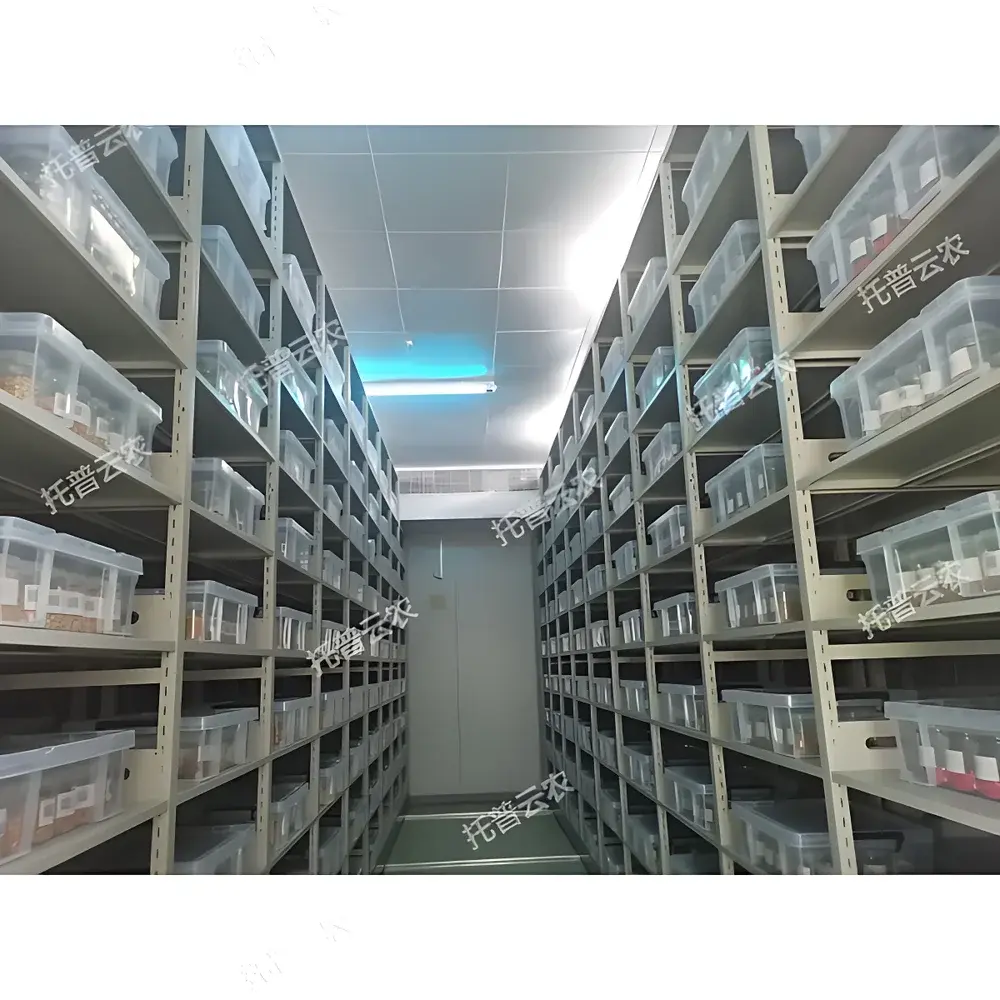
Top Cloud-agri Seed Germplasm Backup Long-Term Storage Vault
| Brand | Top Cloud-agri |
|---|---|
| Origin | Zhejiang, China |
| Manufacturer Type | Direct Producer |
| Product Category | Domestic |
| Model | Seed Germplasm Vault |
| Pricing | Available Upon Request |
| Temperature Range | -18 °C to -15 °C |
| Relative Humidity | ≤40% RH |
| Designated Storage Duration | ≥50 years |
| Redundant Dual-Cooling System | Yes (Primary + Standby Compressors) |
| Insulation Material | B1-class Flame-Retardant Polyurethane Sandwich Panels (Stainless Steel/Color-Coated Steel Cladding) |
| Control System | PLC-Based Central Controller with Full-Color Touchscreen HMI |
| Remote Connectivity | Wi-Fi / 4G / 5G |
| Cloud Platform Integration | Yes |
| Mobile App Management | Yes (Real-time Monitoring, Alarm Push, Parameter Adjustment, Remote Reset) |
| Low-Temperature CCTV | Anti-condensation IP67-rated Camera with Cloud Streaming & Playback |
| Data Compliance Features | Audit Trail Logging, Event Timestamping, Configurable Alarm Thresholds (SMS/Email/App/Sound/Light), Power-Fail Recovery |
Overview
The Top Cloud-agri Seed Germplasm Backup Long-Term Storage Vault is an engineered environmental containment system designed specifically for the secure, stable, and regulatory-compliant preservation of plant genetic resources under cryo-ambient conditions. Operating continuously at -18 °C to -15 °C with controlled relative humidity ≤40% RH, the vault adheres to internationally recognized standards for ex situ conservation—including FAO’s Genebank Standards and the International Treaty on Plant Genetic Resources for Food and Agriculture. Its primary functional mandate is long-term backup storage of national-level seed germplasm collections, ensuring viability retention for ≥50 years while supporting rapid mobilization in response to national emergency requisition protocols. The system employs a dual-refrigeration architecture based on vapor-compression thermodynamics, coupled with precision dew-point control and passive thermal inertia management, to minimize temperature fluctuation (<±0.5 °C) and humidity drift—critical parameters influencing seed metabolic dormancy and membrane integrity.
Key Features
- Dual-Redundant Refrigeration Architecture: Two independent, imported compressors operate in primary/standby mode; automatic switchover occurs within seconds upon fault detection, eliminating downtime and preserving sample integrity during maintenance cycles.
- Zero-Subzero Dehumidification: Dedicated low-temperature desiccant-based dehumidifier maintains ≤40% RH even at -18 °C—preventing ice nucleation on seed surfaces and avoiding hygroscopic degradation pathways.
- B1-Class Thermal Envelope: Six-sided insulated enclosure using high-density polyurethane (≥30 kg/m³) sandwich panels with stainless steel or color-coated steel cladding ensures U-value ≤0.25 W/m²·K and meets Chinese fire safety classification GB 8624–2012 B1 requirements.
- Intelligent Air Distribution: Ceiling-mounted cold air blower with laminar-flow diffuser plate ensures uniform vertical temperature gradient (<0.8 °C deviation across height) and avoids localized frost accumulation near shelving zones.
- Dynamic Entry Barrier: Integrated air curtain system at personnel access points mitigates external thermal/humidity infiltration during door operation, reducing recovery time post-entry by >40% compared to conventional vestibules.
- Resilient Control Ecosystem: Industrial-grade PLC controller with real-time clock, non-volatile memory, and embedded web server enables local HMI interaction and remote supervisory control via encrypted HTTPS endpoints.
Sample Compatibility & Compliance
The vault accommodates standard seed storage containers—including aluminum foil pouches, hermetically sealed glass vials, and multi-layer laminated sachets—compatible with international genebank packaging protocols (e.g., CGIAR Genebank Standards Annex 3). Structural design supports ISO/IEC 17025-aligned environmental monitoring traceability: all sensors (PT100 temperature, capacitive RH) are calibrated per ISO/IEC 17025 requirements and documented with NIST-traceable certificates. Data logging complies with GLP principles: timestamps include UTC offset, records are immutable once written, and audit trails capture user ID, timestamp, action type, and pre/post values for all parameter modifications. The system supports integration into national germplasm information systems (e.g., China National Crop Germplasm Bank Platform) via RESTful API and CSV/JSON export formats.
Software & Data Management
The integrated cloud platform provides role-based access control (RBAC) for administrators, curators, and auditors. All environmental data—including minute-interval temperature/humidity readings, compressor duty cycles, alarm events, and video metadata—are encrypted (AES-256) and retained for ≥10 years. Reporting modules generate ISO 14644-1–style environmental stability summaries, USP –inspired deviation analysis reports, and FAO-mandated annual viability correlation dashboards. Remote video surveillance utilizes ONVIF-compliant streaming with motion-triggered recording, synchronized with environmental alarms. Data exports support CSV, PDF, and XML formats; electronic signatures conform to FDA 21 CFR Part 11 requirements when configured with PKI authentication and biometric login options.
Applications
- National and provincial crop germplasm backup repositories requiring Tier-2 redundancy per FAO Genebank Standards
- Seed health testing laboratories requiring stable pre-conditioning environments prior to germination or pathogen screening assays
- Plant breeding programs maintaining elite parental lines under long-term dormancy protocols
- Biological resource centers fulfilling ISO 20387:2018 accreditation requirements for biological material storage
- Academic research facilities conducting seed longevity modeling (e.g., Ellis & Roberts viability equations)
- Emergency response infrastructure supporting rapid deployment of foundation seed stocks during climate-related agricultural disruptions
FAQ
What is the maximum allowable temperature deviation during compressor maintenance?
Temperature deviation remains within ±0.7 °C during automatic standby-unit activation, verified via continuous validation against reference RTD probes installed at three stratified heights.
Does the system support third-party LIMS integration?
Yes—via standardized HL7 v2.x and ASTM E1384 interfaces; custom middleware development services are available under NDA.
How is sensor calibration traceability maintained?
Each sensor is individually calibrated annually using NIST-traceable dry-well calibrators (±0.05 °C accuracy); calibration certificates are uploaded automatically to the cloud platform and linked to device serial numbers.
Can humidity be monitored independently of temperature control loops?
Yes—the dehumidifier operates on a dedicated PID loop with separate capacitive RH sensor input; humidity setpoint can be adjusted without altering refrigeration staging logic.
Is the mobile app compatible with iOS and Android enterprise MDM frameworks?
Yes—supports Apple DEP and Android Enterprise zero-touch enrollment; app binaries are signed with organization-specific certificates for secure distribution through internal app stores.



