
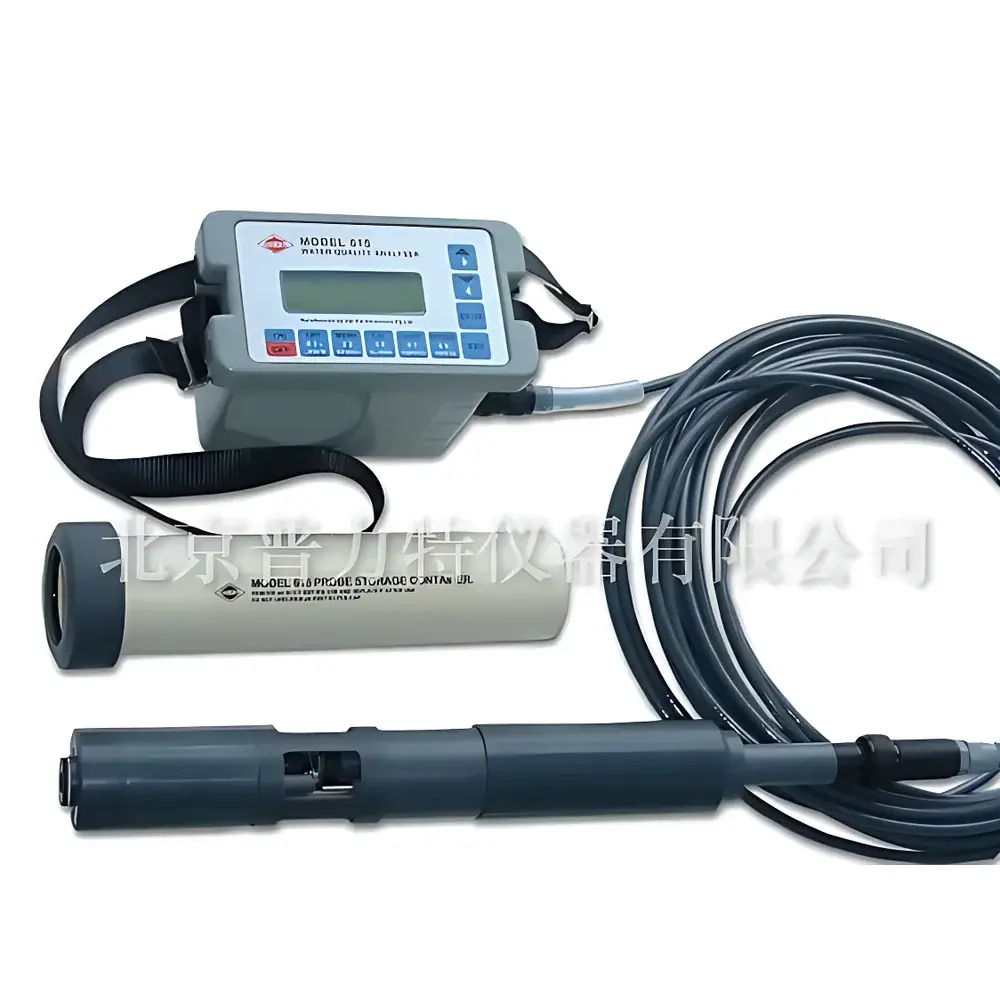
615 Multi-Parameter Water Quality Analyzer – Australian-Made Field-Portable Instrument
| Origin | Australia |
|---|---|
| Manufacturer Type | Authorized Distributor |
| Origin Category | Imported |
| Model | 615 |
| Price Range | USD 6,800–13,600 (FOB) |
| Instrument Type | Portable / Handheld Water Quality Analyzer |
| Measurable Parameters | Temperature, Conductivity, TDS, Salinity, Dissolved Oxygen (DO), Turbidity, pH, ORP, Depth (optional), Chlorophyll-a, Freshwater Cyanobacteria (Phycocyanin), Marine Cyanobacteria (Phycoerythrin) |
Overview
The 615 Multi-Parameter Water Quality Analyzer is a field-deployable, ruggedized environmental monitoring instrument engineered for high-reliability in situ measurements across freshwater, estuarine, and marine environments. Designed and assembled in Australia, the system operates on the principle of multi-sensor electrochemical and optical detection—integrating calibrated solid-state electrodes, galvanic DO cells, dual-wavelength turbidimetric optics, and excitation-emission fluorescence modules for pigment and organic tracer quantification. Its architecture supports simultaneous real-time acquisition of up to 14 core and extended parameters without cross-sensor interference, making it suitable for regulatory compliance monitoring, ecological baseline studies, algal bloom early warning, and wastewater effluent verification under variable ambient conditions.
Key Features
- Rugged IP67-rated housing with corrosion-resistant titanium and marine-grade polymer construction for submersion up to 100 m (with optional depth sensor)
- Integrated 4-line backlit LCD display with intuitive menu navigation and real-time parameter overlay
- Onboard data logging: 2,425 automatic profile records + 840 manual spot measurements, timestamped with GPS coordinates (built-in GNSS receiver)
- Flexible calibration protocols: single-point or two-point calibration for pH, ORP, and conductivity; factory-calibrated optical sensors with user-verifiable reference checks
- Dual communication interfaces: Bluetooth 5.0 (for wireless telemetry to iOS/Android tablets) and USB/RS232 (9600 baud, 8N1) for direct PC synchronization and firmware updates
- Modular auxiliary sensor interface (0–5 V analog input, 12-bit resolution) supporting third-party fluorometers, transmissometers, and custom OEM probes
- Rechargeable NiMH battery pack (8 × C cells) delivering >24 hours continuous operation at 2-minute sampling interval; hot-swappable design enables uninterrupted field deployment
- Comprehensive data tagging: user-defined site IDs, operator codes, and metadata flags for QA/QC traceability
Sample Compatibility & Compliance
The 615 analyzer is validated for use with natural waters—including rivers, lakes, reservoirs, coastal zones, aquaculture ponds, and treated effluents—without sample pre-filtration (except for turbidity >3000 NTU). All electrochemical sensors comply with ISO 7888 (conductivity), ISO 5814 (DO), ISO 7027 (turbidity), and ASTM D1293 (pH). Fluorescence-based modules meet EPA Method 445.0 (chlorophyll-a), EPA Method 446.0 (phycocyanin/phycoerythrin), and fulfill requirements for GLP-compliant data acquisition per 21 CFR Part 11 when used with certified software. The instrument’s data structure supports export in CSV, XML, and EPA-compatible .WQX formats for integration into WQX/WQP, STORET, and national water quality databases.
Software & Data Management
The bundled AquaLog™ Desktop Suite (v4.2+) provides secure data download, spectral visualization, calibration history tracking, and automated report generation (PDF/Excel). Audit trails record all user actions—including calibration events, sensor swaps, and data edits—with immutable timestamps and digital signatures. Cloud synchronization via encrypted HTTPS is available through optional AquaCloud™ subscription, enabling multi-user access control, role-based permissions, and automated alerting for threshold breaches (e.g., DO 15 µg/L). Raw sensor voltages and processed values are stored separately to support retrospective reprocessing using updated algorithms or temperature compensation models.
Applications
- Regulatory monitoring programs under EU WFD, US Clean Water Act Section 303(d), and China’s “Blue Sky & Clear Water” initiative
- Algal bloom forecasting and cyanobacterial toxin risk assessment via parallel phycocyanin/phycoerythrin quantification
- Wastewater treatment plant (WWTP) influent/effluent QA, including nitrification/denitrification process control via ORP-pH coupling analysis
- Aquatic ecosystem health assessments using CDOM-fluorescence indices as proxies for terrestrial DOM loading and photoreactivity
- Marine spatial planning and coral reef resilience studies requiring concurrent salinity, DO, and turbidity profiling
- Emergency response for hydrocarbon spills (oil-in-water) and industrial dye releases (rhodamine/fluorescein tracing)
FAQ
Is the 615 compliant with ISO/IEC 17025 laboratory accreditation requirements for field instrumentation?
Yes—the instrument’s calibration certificate includes uncertainty budgets per ISO/IEC 17025 Annex A.3, and all factory calibrations are traceable to NMI Australia (NMIA) standards.
Can the depth sensor be retrofitted to an existing unit?
Yes—depth measurement capability can be added post-purchase via hardware module installation and firmware update through authorized service centers.
What is the recommended recalibration frequency for optical sensors under continuous field use?
Chlorophyll-a and cyanobacteria sensors require annual verification against certified reference standards; turbidity and CDOM modules should be checked quarterly using formazin or AMCO-AE standards.
Does the system support external power supply during long-term moored deployments?
Yes—via 12 V DC input (5.5 mm barrel jack), enabling integration with solar-charged battery banks and telemetry buoys.
Are raw fluorescence spectra exportable for advanced chemometric analysis?
Yes—full excitation-emission matrix (EEM) data (ex: 300–500 nm, em: 400–700 nm) is accessible via binary dump mode for PARAFAC modeling and humic/fulvic acid differentiation.
Related Products







