
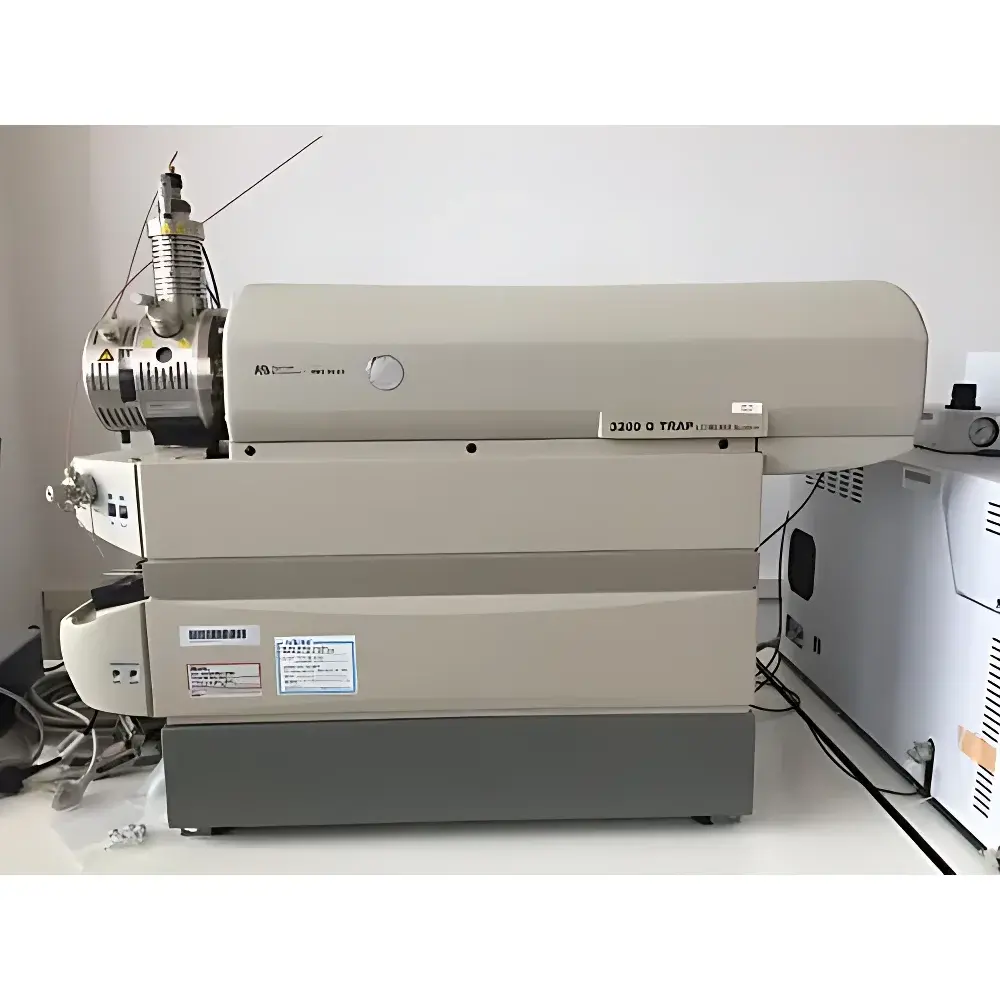
AB SCIEX 3200 Q-TRAP Liquid Chromatography Tandem Mass Spectrometer
| Brand | SCIEX |
|---|---|
| Origin | USA |
| Instrument Type | Triple Quadrupole / Linear Ion Trap Hybrid System |
| Model | 3200 Q-TRAP |
| Mass Range | 5–2,000 m/z (typical operational range) |
| Sensitivity | Sub-pg on-column for small molecules (e.g., <10 fg injected for reserpine S/N ≥ 50:1 in MRM) |
| Resolution | Unit mass resolution in both Q1 and Q3 |
| Accurate Mass Capability | Not applicable (non-high-resolution system) |
Overview
The AB SCIEX 3200 Q-TRAP Liquid Chromatography Tandem Mass Spectrometer is a hybrid mass spectrometry platform engineered for robust quantitative analysis and structural characterization in regulated and discovery-oriented laboratories. Built upon a triple quadrupole (QqQ) architecture integrated with a linear ion trap (LIT), the system enables simultaneous acquisition of targeted quantitation (via Multiple Reaction Monitoring, MRM) and information-rich MS/MS spectra—without hardware reconfiguration or method switching. This dual-capability design leverages the high specificity and reproducibility of QqQ scanning with the enhanced sensitivity and scan speed of the LIT, supporting both scheduled MRM and enhanced product ion (EPI) scans within a single LC run. The instrument is widely deployed in pharmaceutical development, clinical research, food safety testing, environmental monitoring, and forensic toxicology where regulatory compliance, data traceability, and analytical throughput are critical.
Key Features
- Hybrid QqQ/LIT Architecture: Combines the quantitative precision of triple quadrupole technology with the full-scan MS/MS sensitivity and dynamic range of a linear ion trap—enabling qualitative confirmation and quantitative measurement in one injection.
- Turbo V™ Ion Source: A thermally assisted electrospray interface with plug-and-play probe design, optimized for high ionization efficiency across flow rates from 5 µL/min to 2 mL/min; supports rapid polarity switching and minimal carryover.
- Linear Accelerator (LINAC™) Collision Cell: Delivers fast, stable, and reproducible fragmentation with high transmission efficiency across wide mass ranges, enabling rapid dwell times and high cycle speeds without signal loss.
- Curved Collision Cell Interface (Curtain Gas™): Reduces neutral and solvent cluster interferences, improving signal-to-noise ratios and minimizing cross-contamination between injections.
- Compact Benchtop Form Factor: Designed for space-constrained laboratories while maintaining mechanical stability and thermal consistency required for 24/7 operation in high-throughput environments.
- Modular Ion Source Options: Supports interchangeable sources including DuoSpray™ (dual ESI/APCI), PhotoSpray™ (UV photoionization), and NanoSpray™ (low-flow nano-ESI), expanding application flexibility without hardware replacement.
Sample Compatibility & Compliance
The 3200 Q-TRAP accommodates a broad spectrum of sample types—including small-molecule pharmaceuticals, peptides, metabolites, pesticides, mycotoxins, and forensic analytes—across diverse matrices such as plasma, urine, tissue homogenates, food extracts, and environmental water samples. Its performance aligns with internationally recognized validation frameworks: methods developed on this platform routinely meet acceptance criteria defined in ICH M10, USP , and FDA Bioanalytical Method Validation Guidance. Data integrity is supported through Analyst® software’s audit trail functionality, electronic signature capability, and adherence to 21 CFR Part 11 requirements when configured in compliant mode. The system also supports GLP/GMP-aligned workflows, including instrument qualification (IQ/OQ/PQ), method validation documentation, and raw data archiving protocols consistent with ISO/IEC 17025 laboratory accreditation standards.
Software & Data Management
Controlled by SCIEX Analyst® Software v1.7.x or later, the 3200 Q-TRAP integrates automated method development tools—including AutoID™ for compound identification and AutoSRM™ for transition optimization—reducing manual parameter tuning. Quantitative workflows benefit from built-in calibration curve fitting (linear, quadratic, weighted), QC flagging, and batch processing with customizable reporting templates. All acquisitions generate .wiff binary files containing complete metadata (instrument parameters, calibration status, user annotations), ensuring full traceability. Raw data can be exported in open formats (mzML) for third-party processing or imported into SCIEX OS software for advanced spectral library searching and retrospective data mining. Secure user access levels, session logging, and encrypted database storage support enterprise-level data governance policies.
Applications
- Pharmaceutical Development: PK/PD studies, metabolite identification (MetID), impurity profiling, and stability-indicating assays using MRM-EPI triggered acquisition.
- Clinical Research: Biomarker verification, therapeutic drug monitoring (TDM), and endogenous metabolite quantification in biofluids under CLIA- or CAP-compliant conditions.
- Food Safety: Multi-residue screening of veterinary drugs, pesticides, and mycotoxins at EU MRL and FDA action limit levels.
- Environmental Analysis: Quantitation of persistent organic pollutants (POPs), pharmaceutical residues, and industrial contaminants in wastewater and soil extracts.
- Forensic Toxicology: Confirmation and quantitation of drugs of abuse, novel psychoactive substances (NPS), and synthetic opioids in postmortem and impaired-driving cases.
FAQ
What distinguishes the Q-TRAP architecture from a conventional triple quadrupole?
The Q-TRAP system replaces the traditional RF-only quadrupole (Q3) with a linear ion trap capable of storing, isolating, and fragmenting ions—enabling both MRM quantitation and information-dependent acquisition (IDA) in a single experiment.
Does the 3200 Q-TRAP support high-resolution mass measurement?
No—it is not a high-resolution mass spectrometer. It provides unit mass resolution and nominal mass accuracy; for exact mass determination, SCIEX TOF or QTOF platforms (e.g., X500B, ZenoTOF 7600) are recommended.
Can the system be used for untargeted screening?
While primarily optimized for targeted workflows, its EPI and precursor ion scan modes allow semi-targeted and hypothesis-driven discovery applications—though comprehensive untargeted metabolomics typically requires higher mass accuracy and dynamic range.
Is remote monitoring or network integration supported?
Yes—Analyst software supports LAN-based instrument control, centralized data repository configuration, and integration with LIMS via ODBC or vendor-specific APIs.
What service and support options are available globally?
SCIEX-certified field service engineers provide preventive maintenance, performance verification, and technical support aligned with ISO 9001-certified service processes; extended warranty and uptime assurance programs are available per regional agreement.
Related Products





