
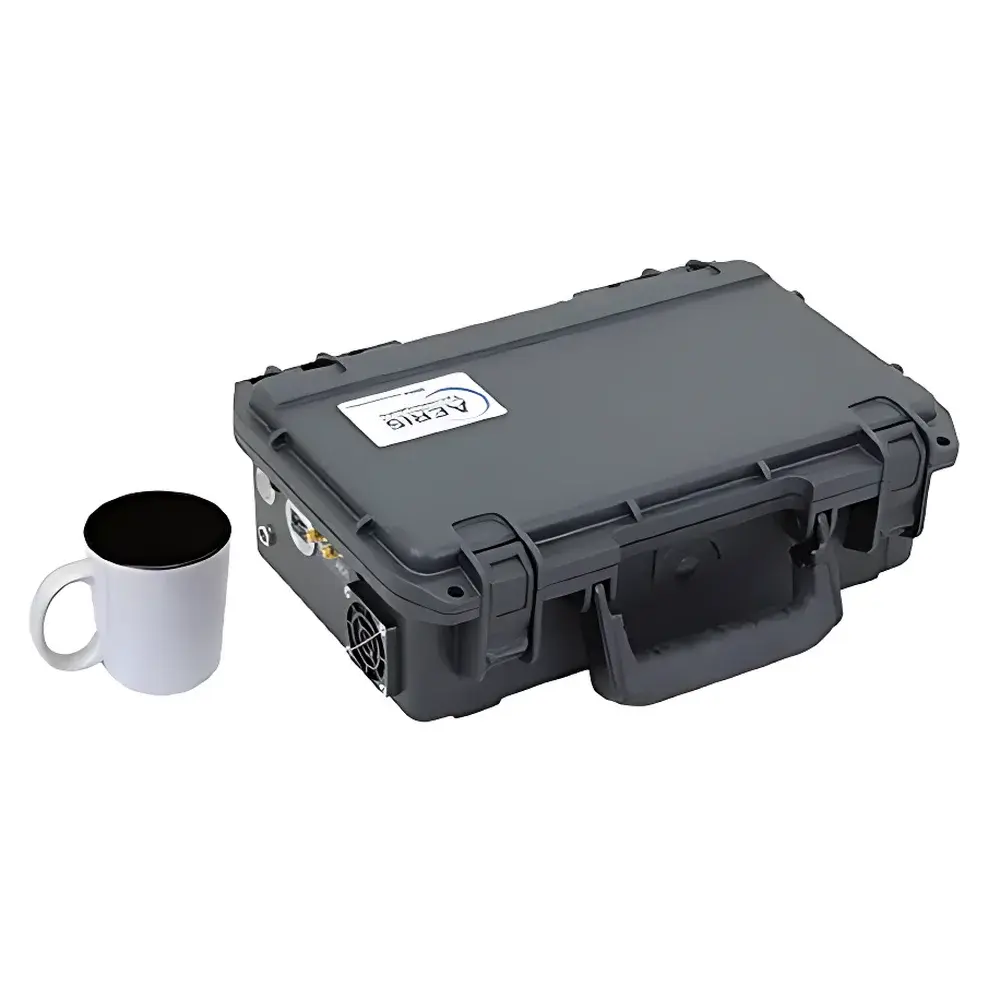
Aeris MIRA Ultra High-Accuracy VOC Analyzer
| Origin | USA |
|---|---|
| Manufacturer Type | Authorized Distributor |
| Origin Category | Imported |
| Model | MIRA ULTRA VOC |
| Price | Upon Request |
Overview
The Aeris MIRA Ultra High-Accuracy VOC Analyzer is a field-deployable, real-time formaldehyde (HCHO) measurement system engineered for precision environmental monitoring and industrial emission quantification. It employs proprietary mid-infrared (MIR) tunable diode laser absorption spectroscopy (TDLAS) with Aeris’ patented optical folding technology—enabling an effective absorption path length exceeding 13 meters within a compact 60 mL multi-pass cell. Unlike near-infrared systems, MIR absorption bands deliver 10³–10⁴× stronger molecular cross-sections for HCHO, directly translating to sub-ppb detection limits and exceptional linearity across five orders of magnitude (<1 ppb to 500 ppm). The sensor core is actively temperature- and pressure-stabilized at 40 °C, mitigating condensation artifacts in high-humidity environments (up to 95% RH, non-condensing) and ensuring long-term drift stability. Designed for regulatory-grade data integrity, the MIRA Ultra operates without consumables, wet chemistry, or external calibration gases—relying instead on autonomous differential sampling and catalytic zero-air generation for trace-level baseline correction.
Key Features
- Real-time HCHO quantification at 1 Hz or 2 Hz update rate, with sensitivity of 1 ppb/s (σ) and achievable ppt-level precision via signal averaging
- Integrated dual programmable sample inlets supporting differential mode operation, automatic zeroing, and on-board calibration cycles
- Thermally stabilized optical core (40 °C) and pressure-regulated flow path for low-drift performance—typical drift <1–2 ppb over 24 hours under controlled conditions
- Ultra-low power consumption: 20 W nominal during steady-state operation; compatible with solar charging, external battery packs, or AC/DC input (12–15 V DC / 110–220 V AC)
- Compact footprint (36.8 × 30.5 × 17.8 cm) and lightweight design (6 kg including internal 6-hour battery and integrated pump)
- Robust optical architecture: sealed monolithic optical bench, no high-reflectivity mirrors, enhanced particulate and moisture resistance
- On-device connectivity: built-in Wi-Fi, USB, RS-232; optional 4–20 mA analog output and GPS module for spatially resolved plume mapping
Sample Compatibility & Compliance
The MIRA Ultra is validated for direct gas-phase analysis of formaldehyde in ambient air, stack emissions, indoor environments, and controlled chamber studies (e.g., ASTM D6007-compliant engineered wood testing). Its MIR-TDLAS methodology eliminates interferences from common VOCs (e.g., methanol, acetaldehyde) due to spectral selectivity in the 2800–3000 cm⁻¹ region. The system meets functional requirements for EPA Method TO-11A equivalence in fixed-site monitoring applications and supports GLP/GMP-aligned data workflows through timestamped, audit-trail-enabled logging. While not certified as a Class I Div 1 device, its ingress protection rating and thermal management enable deployment in non-hazardous industrial perimeters, mobile platforms (vehicles, UAVs), and remote solar-powered stations.
Software & Data Management
Firmware-integrated acquisition software provides real-time concentration visualization, configurable averaging windows, and automated zero/calibration event logging. All measurements are time-stamped with UTC synchronization (via NTP or GPS), stored on internal 32 GB eMMC memory (expandable via microSD), and exportable in CSV or NetCDF format. Remote access is supported via secure Wi-Fi or Ethernet, enabling integration into SCADA, IoT telemetry networks, or centralized environmental data platforms. The system supports 21 CFR Part 11-compliant user authentication, electronic signatures, and immutable audit trails when deployed in regulated QA/QC environments. Firmware updates are delivered over-the-air or via USB, with version-controlled rollback capability.
Applications
- Long-term ambient HCHO monitoring networks for urban air quality assessment and health risk modeling
- Industrial source testing—including wood composite manufacturing, paint formulation facilities, and plastic injection molding plants
- Indoor air quality (IAQ) characterization in residential, commercial, and healthcare settings
- Differential gradient studies using paired units for fugitive emission localization and flux estimation
- Mobile monitoring campaigns aboard ground vehicles or unmanned aerial systems (UAS) for spatially resolved plume mapping
- Chamber-based material emission testing per ASTM D6007, replacing labor-intensive DNPH-HPLC protocols with direct, real-time gas-phase analysis
FAQ
What detection principle does the MIRA Ultra employ?
It uses mid-infrared tunable diode laser absorption spectroscopy (MIR-TDLAS) with a folded multi-pass optical cell optimized for formaldehyde’s fundamental vibrational band.
Does the analyzer require external calibration gases?
No—autonomous zeroing is performed using an integrated catalytic scrubber; span calibration may be conducted optionally with certified standard gas if required by local protocol.
Can it operate unattended for extended periods?
Yes—designed for continuous operation with onboard battery support (6 h), solar compatibility, and robust drift compensation enabling calibration intervals of weeks under stable conditions.
Is humidity compensation applied in real time?
Yes—the system incorporates active temperature stabilization and pressure regulation to minimize water vapor interference; no post-acquisition humidity correction algorithms are needed.
How is data security and traceability ensured?
All measurements include cryptographic timestamps, user-access logs, and write-once storage options compliant with FDA 21 CFR Part 11 and ISO/IEC 17025 documentation requirements.







