
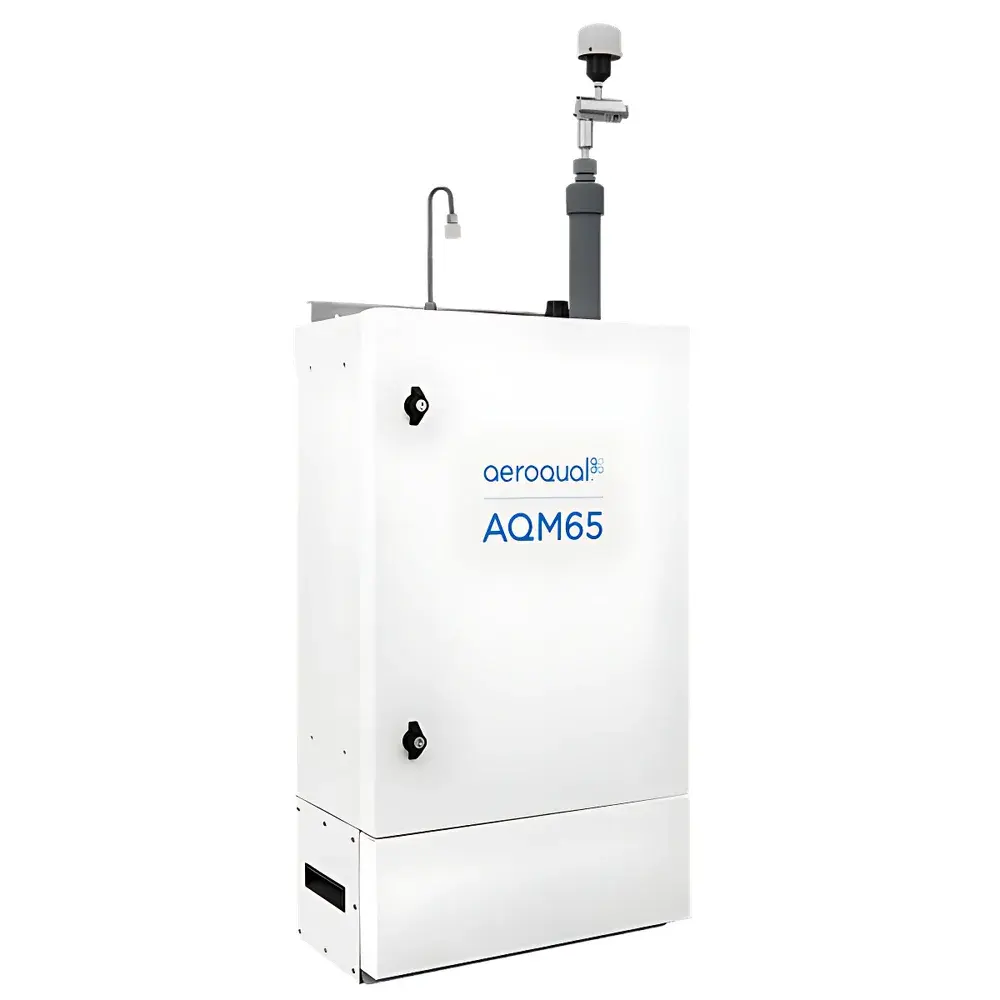
Aeroqual AQM65 Advanced Modular Air Quality Monitoring System
| Brand | Aeroqual |
|---|---|
| Origin | New Zealand |
| Model | AQM65 |
| Particle Detection | PM1, PM2.5, PM10, TSP (via turbidimetric & optical counting methods) |
| Gaseous Pollutants | O₃, NO₂, CO, SO₂, NOₓ, H₂S, CO₂, VOC (ppb–ppm range), CH₄ |
| Measurement Accuracy | ±(1–5 µg/m³ or 1–3% of reading, depending on parameter) |
| Detection Limits | 0.1–10 ppb (gases), 1 µg/m³ (PM) |
| Data Logging | 32 GB internal storage (>5 years at 1-min intervals) |
| Communication | Wi-Fi, Ethernet (LAN), optional 3G/4G cellular |
| Environmental Rating | IP65 |
| Operating Temperature | −35 °C to +50 °C |
| Power Supply | 90–264 VAC, 47–63 Hz (AQM65) |
| Dimensions | 1310 × 510 × 280 mm (AQM65), 483 × 330 × 187 mm (AQS1) |
| Weight | <30 kg (AQM65), <13 kg (AQS1) |
Overview
The Aeroqual AQM65 is a field-deployable, modular air quality monitoring system engineered for high-reliability continuous measurement of ambient gaseous and particulate pollutants. Designed to meet the functional requirements of regulatory-grade networks while maintaining flexibility for research, early-warning, and dense spatial deployment, the AQM65 operates on dual-sensor principles: nephelometric light scattering (670 nm laser with sheath-air protection) for mass concentration (PM₁, PM₂.₅, PM₁₀, TSP), and electrochemical or metal-oxide semiconductor (MOS) sensing for trace gases including O₃, NO₂, CO, SO₂, NOₓ, H₂S, CO₂, VOCs, and CH₄. Its architecture supports both standalone operation and integration into national or municipal air quality management frameworks—functioning as a supplementary node to reference-grade optical stations. The system complies with internationally recognized performance benchmarks aligned with ISO 12103-1 (for aerosol generation), EN 14625 (O₃), EN 14626 (NO₂), and EPA EQOA guidance for low-cost sensor systems used in network augmentation.
Key Features
- Modular sensor architecture enabling on-site replacement of gas and particulate modules without system recalibration or firmware reconfiguration.
- Temperature-controlled internal environment ensuring stable sensor response across −35 °C to +50 °C operating conditions—critical for unattended deployment in arctic, desert, or tropical climates.
- Dual PM detection methodology: integrated turbidimeter (0–6000 µg/m³, ±2 µg/m³ + 5% RD) and optical particle counter (0.3–10 µm size-resolved counting, up to 100,000 counts/L).
- Factory-calibrated gas sensors traceable to NIST-certified standards; optional on-site zero/span verification using the AQS-1 calibration unit or remote automated calibration via Aeroqual Cloud.
- IP65-rated aluminum enclosure with solar-reflective coating and 40–50 mm thermal insulation—engineered for long-term outdoor exposure with minimal thermal drift.
- Embedded Linux-based controller supporting configurable averaging intervals (1 min to 24 hr), local data buffering (32 GB SSD), and redundant communication paths (Wi-Fi, Ethernet, optional 3G/4G).
Sample Compatibility & Compliance
The AQM65 is validated for ambient air sampling under real-world urban, industrial, and peri-urban conditions. Its heated omnidirectional inlet (36 cm length, PTFE-lined interior, stainless-steel exterior with specialty glass coating) minimizes particle loss and hygroscopic bias. Sharp-cut cyclones (optional) enable size-selective PM₁₀, PM₂.₅, or PM₁ sampling per ISO 7708 and EN 12341. Gas inlets incorporate diffusion barriers and residence-time optimization to reduce cross-sensitivity and memory effects. While not certified as a Federal Equivalent Method (FEM) or Federal Reference Method (FRM) device per U.S. EPA requirements, the AQM65 meets the performance criteria outlined in EPA’s “Low-Cost Sensor Performance Targets” (2022) and is widely deployed in compliance-support roles—including GLP-aligned epidemiological cohort studies, environmental impact assessments (EIAs), and ISO 14001-certified facility monitoring programs. All firmware and data handling protocols support audit-ready metadata tagging and time-synchronized logging for regulatory review.
Software & Data Management
Aeroqual Cloud serves as the central SaaS platform for remote configuration, diagnostics, and data visualization. It provides role-based access control, customizable alert thresholds (email/SMS/webhook), and automated QA/QC flagging based on signal noise, zero drift, and inter-sensor correlation anomalies. Raw and averaged datasets are exportable in CSV, NetCDF, or JSON formats, with metadata compliant with ISO 19115-2 for geospatial interoperability. The platform supports 21 CFR Part 11-compliant electronic signatures for calibration logs and audit trails when deployed in GxP environments. On-device firmware enables over-the-air (OTA) updates, secure TLS 1.2+ encrypted transmission, and local data retention during network outages—ensuring continuity of record integrity.
Applications
- Urban air quality networks: High-density deployment for hyperlocal pollution mapping, source attribution, and model validation (e.g., WRF-Chem, CAMx).
- Industrial fence-line monitoring: Real-time tracking of fugitive emissions near petrochemical complexes, power plants, landfills, mining operations, ports, and rail yards.
- Transportation microenvironments: Street-canyon profiling, highway corridor monitoring, airport apron emissions assessment, and EV-charging zone air quality benchmarking.
- Mobile and temporary deployments: Vehicle-mounted units for mobile source emission inventories, construction site compliance reporting, and disaster-response air hazard screening.
- Community science and public health: Longitudinal exposure assessment in schools, hospitals, residential neighborhoods, and vulnerable populations—supporting WHO Air Quality Guidelines alignment.
FAQ
Is the AQM65 compliant with U.S. EPA or EU reference method standards?
The AQM65 is not designated as an FRM or FEM instrument but satisfies EPA’s Low-Cost Sensor Performance Targets and EN 14625/14626 equivalency thresholds for supplemental monitoring applications.
Can the system operate autonomously during extended power outages?
Yes—when paired with an external UPS or solar-battery configuration (e.g., 12 VDC input option on AQS1), the AQM65 maintains full functionality for >72 hours with reduced fan speed and optimized sampling duty cycles.
How frequently must calibration be performed?
Field zero/span checks are recommended every 30 days for regulatory-support deployments; biannual full calibration is advised for research-grade data continuity, using traceable span gases or the AQS-1 calibrator.
Does the system support third-party meteorological integration?
Yes—RS-485 and analog voltage inputs allow seamless connection to Gill WindSonic, Vaisala WXT520, Met ONE MSO, Cirrus MK427, and Novalynx pyranometers for co-located wind, temperature, humidity, rain, noise, and solar irradiance correlation.
What data security protocols are implemented?
All communications use TLS 1.2+, credentials are stored in encrypted key stores, and firmware updates require digital signature verification. Local data at rest is AES-256 encrypted on the SSD.
Related Products







