
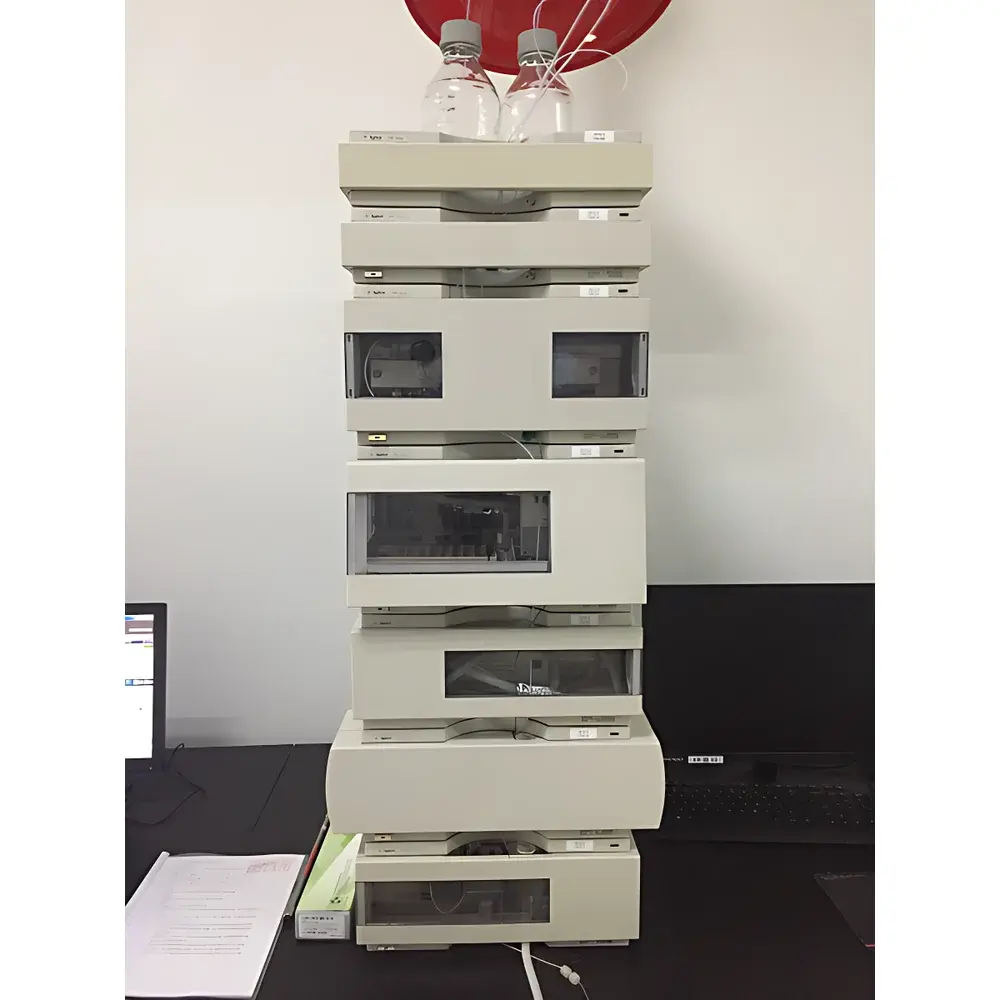
Agilent 1100 Series Used High-Performance Liquid Chromatograph (HPLC) System
| Brand | Agilent Technologies |
|---|---|
| Origin | USA |
| Model | Agilent 1100 |
| Instrument Type | Conventional HPLC |
| Flow Rate Range | 0.001–10.00 mL/min |
| Maximum Pressure | 40 MPa |
| Sample Tray Capacity | 100 positions (2 mL vials) |
| Injection Volume Range | 1–50 µL |
| Column Oven Temperature Range | Ambient |
| UV-Vis Wavelength Range | 190–600 nm |
| Data Acquisition Rate | 100 Hz |
Overview
The Agilent 1100 Series is a modular, high-reliability high-performance liquid chromatography (HPLC) platform originally engineered by Agilent Technologies for routine and method-development applications in pharmaceutical, environmental, food, and academic laboratories. As a second-hand system, this Agilent 1100 configuration retains full operational integrity and is validated for use in regulated environments where traceable performance history and component-level service records are available. The system operates on the principle of reversed-phase, normal-phase, or ion-exchange chromatographic separation, with mobile phase delivery governed by precision dual-piston reciprocating pumps incorporating electronic flow control (EFC) technology. Detection relies on optical absorption (UV-Vis), fluorescence emission, or refractive index changes — all synchronized via a centralized timing architecture to ensure retention time reproducibility within ±0.01 min under isocratic conditions. Its architecture supports compliance-critical workflows through hardware-level audit trail readiness and software-controlled parameter locking.
Key Features
- Modular design enabling flexible configuration: binary pump (G1312A), autosampler (G1313A or G1329A), DAD (G1315A), fluorescence detector (G1321A), or variable-wavelength UV detector (G1314A)
- Dual-lamp UV-Vis detection with wavelength scanning from 190–600 nm and real-time spectral acquisition at up to 100 Hz
- Autosampler with 100-position 2 mL vial capacity, programmable injection volumes from 1–50 µL with <±0.5% RSD precision
- Column oven (G1316A) maintaining ambient temperature stability without active heating or cooling — suitable for methods requiring minimal thermal perturbation
- Vacuum degasser (G1322A or G1379A) integrated upstream of pump to minimize baseline noise and bubble-induced pressure fluctuations
- Robust mechanical construction with stainless-steel fluidic paths, ceramic piston seals, and leak-sensing diagnostics
Sample Compatibility & Compliance
The Agilent 1100 accommodates standard 4.6 mm ID analytical columns (e.g., C18, phenyl-hexyl, HILIC) and supports gradient elution protocols across pH 1.5–12.0 with compatible mobile phases (aqueous/organic mixtures, buffers ≤0.1 M). It meets core functional requirements outlined in ASTM E2632-21 (Standard Guide for Validation of HPLC Systems), ISO 17025:2017 (clause 6.4.3 on equipment verification), and USP Chromatography. When operated with ChemStation G2170BA software and properly documented maintenance logs, the system supports GLP/GMP-aligned data integrity practices including user access controls, electronic signatures, and audit trail generation per FDA 21 CFR Part 11 — provided that local IT validation protocols are applied during deployment.
Software & Data Management
Control and data acquisition are performed using Agilent ChemStation Rev. A.10.02 or later — a Windows-based application offering sequence definition, method development tools, peak integration algorithms (e.g., valley-to-valley, tangent skim), and customizable report templates. Raw data files (.D folders) store chromatograms, spectra, and instrument status logs in vendor-native format; export options include ASCII, CSV, and AIA/CDF for third-party processing. The software enforces role-based permissions and supports optional electronic signature modules compliant with ALCOA+ principles. All system events — including method changes, calibration runs, and maintenance alerts — are timestamped and archived automatically.
Applications
This Agilent 1100 system is routinely deployed for quantitative analysis of small-molecule pharmaceuticals (e.g., assay, dissolution, stability-indicating assays), pesticide residues in agricultural commodities (per EPA Method 8321B), organic acid profiling in beverages (AOAC 2005.03), and impurity identification in synthetic intermediates. Its DAD functionality enables peak purity assessment via spectral homogeneity analysis, while the fluorescence detector provides sub-nanogram sensitivity for polycyclic aromatic hydrocarbons (PAHs) or vitamin derivatives. In academic settings, it serves as a teaching platform for chromatographic theory, method optimization, and detector response characterization.
FAQ
Is this Agilent 1100 system fully refurbished and tested prior to resale?
Yes — each unit undergoes functional verification including pressure testing (to 40 MPa), flow accuracy calibration (gravimetrically verified at 1.0 mL/min), detector linearity assessment (using caffeine standards), and autosampler precision evaluation.
Does the system include original Agilent documentation and service history?
All units ship with scanned copies of factory certificates of conformance, pump/detector serial number logs, and last-known preventive maintenance reports — subject to availability from prior ownership records.
Can this system be upgraded to support modern data systems like OpenLab CDS?
No — the Agilent 1100 hardware lacks native USB/Ethernet interfaces required for OpenLab CDS integration; ChemStation remains the only supported control environment.
What column dimensions and particle sizes are recommended for optimal performance?
Standard 150–250 mm × 4.6 mm ID columns packed with 3–5 µm fully porous silica particles deliver best-in-class resolution and backpressure balance for most applications.
Is remote monitoring or network connectivity supported?
Local area network (LAN) connectivity is possible via Ethernet-enabled PC host running ChemStation; however, no embedded web server or cloud telemetry capabilities exist in the 1100 hardware architecture.
Related Products





