
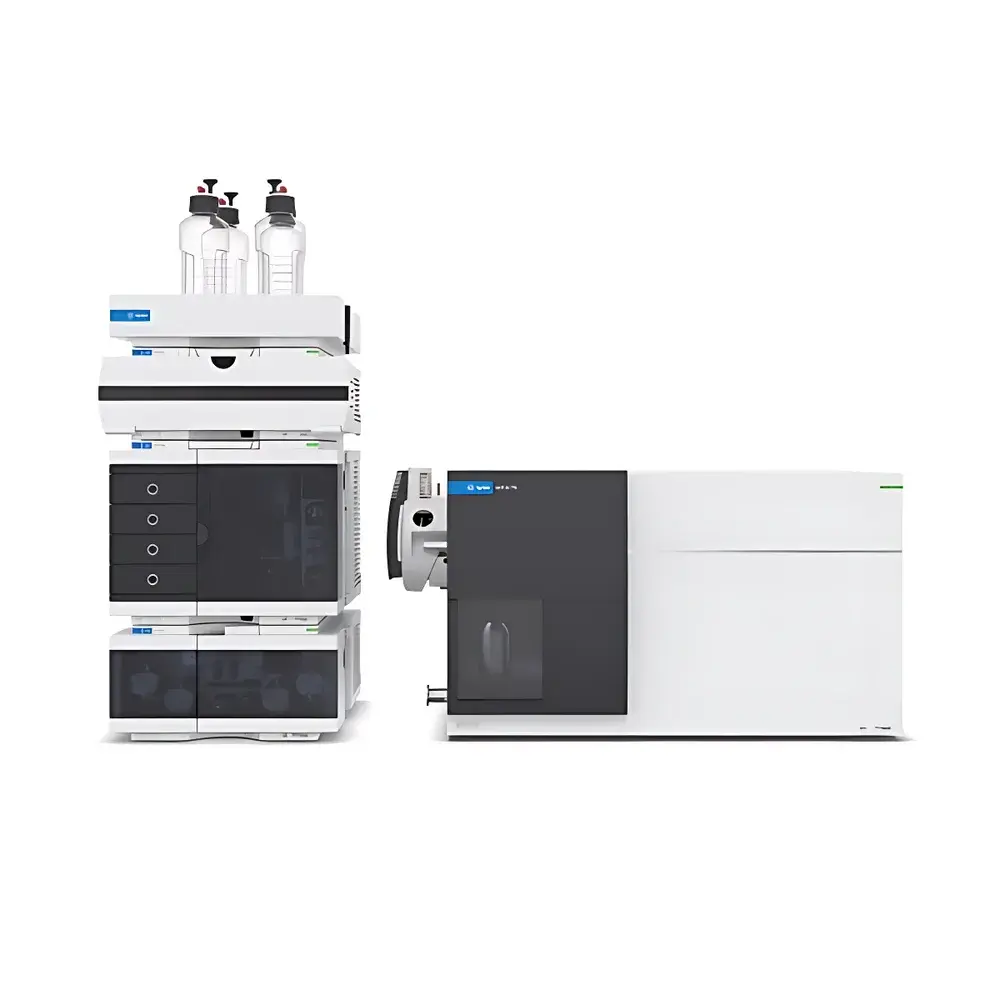
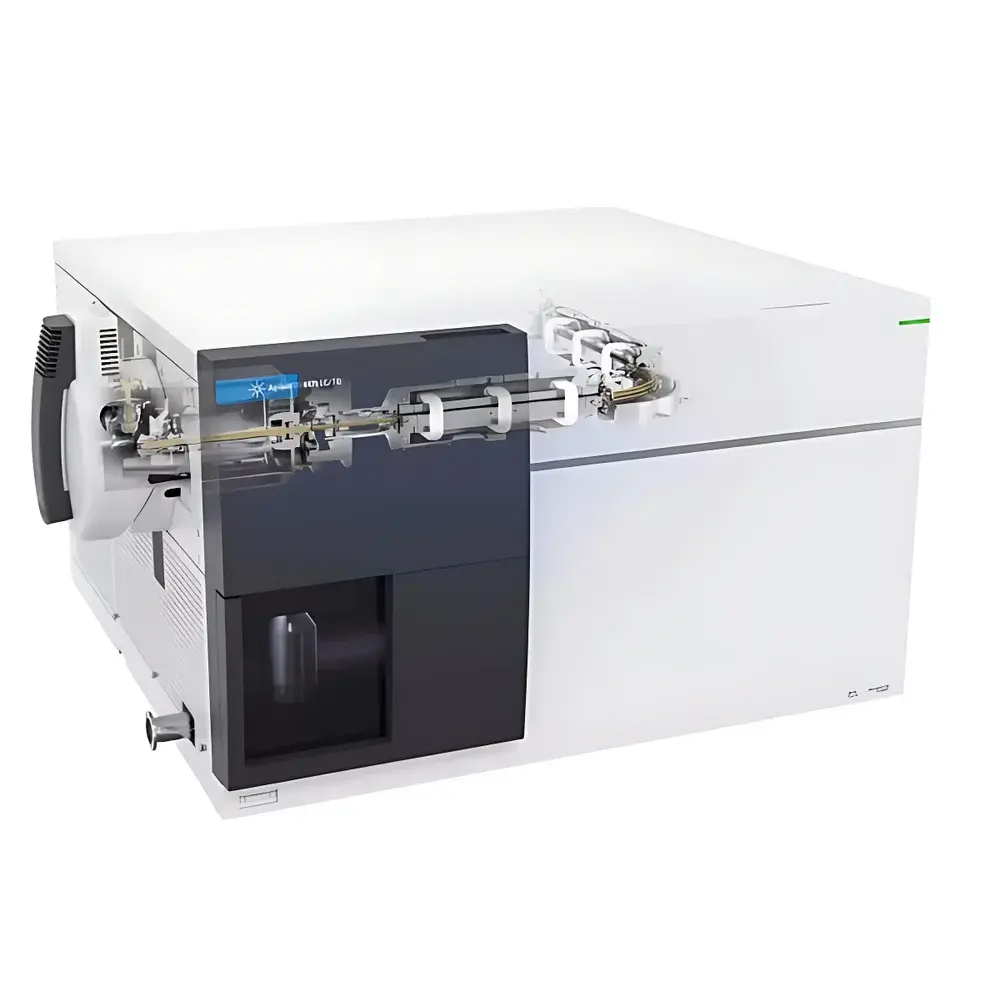
Agilent 6470B Triple Quadrupole LC/MS System
| Brand | Agilent Technologies |
|---|---|
| Origin | Singapore |
| Manufacturer Type | Authorized Distributor |
| Origin Category | Imported |
| Model | 6470B |
| Instrument Type | Tandem Quadrupole (QqQ) |
| Application Scope | General-Purpose |
| Mass Range | m/z 5–3000 |
| Sensitivity | <4 fg on-column reserpine (IDL, AJS + 1290 Infinity II LC) |
| Resolution (FWHM) | Narrow = 0.4 Da, Unit = 0.7 Da, Wide = 1.2 Da, Widest = 2.5 Da |
| Scan Speed | 17,000 Da/s |
| Minimum MRM Dwell Time | 0.5 ms |
| Polarity Switching Time | <25 ms |
| Collision Cell Clean Time | <1 ms |
| Ion Sources | ESI, AJS, APCI, MultiMode (ESI+APCI), NanoESI |
| tMRM Capability | Yes |
| Vacuum Shield (VacShield) | Yes |
| Instrument Health Tracking & Early Maintenance Feedback | Yes |
| Compliance | US FDA 21 CFR Part 11, EU Annex 11, GLP/GMP-ready |
Overview
The Agilent 6470B Triple Quadrupole LC/MS System is a high-performance, robust liquid chromatography tandem mass spectrometry platform engineered for quantitative precision, regulatory compliance, and method versatility in demanding analytical environments. Based on proven quadrupole mass filtering principles—where Q1 selects precursor ions, Q2 serves as a collision-induced dissociation (CID) cell, and Q3 filters diagnostic product ions—the 6470B delivers exceptional specificity and reproducibility in multiple reaction monitoring (MRM) mode. Its architecture integrates fundamental advances in ion optics, vacuum management, and source design to address critical challenges in regulated bioanalysis, environmental monitoring (e.g., PFAS quantification), food safety testing, and pharmaceutical quality control. Unlike single-quadrupole or time-of-flight instruments, the 6470B’s true triple-quadrupole configuration enables selective fragmentation and detection under controlled collision energy, minimizing chemical noise and maximizing signal-to-noise ratios—even in complex matrices.
Key Features
- VacShield Vacuum Shield Technology: Enables routine maintenance of the ion inlet capillary without breaking vacuum—reducing system downtime by up to 70% and preserving long-term mass axis stability across extended operational cycles.
- Agilent Jet Stream (AJS) Ion Source: Delivers superior ionization efficiency through heated nebulization, orthogonal spray geometry, and optimized desolvation gas flow—achieving sub-femtogram IDLs (e.g., <4 fg on-column reserpine) with high intra- and inter-day precision (RSD <5%).
- Modular Ion Source Compatibility: Supports rapid interchange of ESI, APCI, MultiMode (dual ESI/APCI), NanoESI, and AJS configurations without hardware modification—ensuring method flexibility across small molecules, peptides, lipids, and polar metabolites.
- Bent Collision Cell Geometry: Minimizes neutral background and improves transmission efficiency of low-abundance product ions, contributing to a linear dynamic range exceeding 5 orders of magnitude (1–105).
- ±20 kV High-Energy Dynode Detector: Enhances sensitivity for low-intensity transitions while maintaining detector linearity and reducing saturation effects during high-concentration analysis.
- Triggered MRM (tMRM) Acquisition: Simultaneously acquires quantitative MRM data and full-scan product ion spectra—enabling retrospective compound identification, spectral library matching (NIST, Wiley), and confirmatory analysis within a single injection.
Sample Compatibility & Compliance
The 6470B accommodates diverse sample types—from aqueous extracts and plasma digests to organic solvent-based pesticide residues—when coupled with Agilent 1290 Infinity II or other ISO/IEC 17025-compliant UHPLC systems. Its mass range (m/z 5–3000) supports intact protein analysis via multi-charged species and small-molecule quantitation with unit resolution. The system meets stringent regulatory requirements: built-in audit trails, electronic signatures, role-based access control, and automated data integrity checks satisfy US FDA 21 CFR Part 11, EU Annex 11, and WHO GMP guidelines. Instrument Health Tracking logs calibration status, detector gain, vacuum integrity, and source performance—providing objective evidence for GLP audits and internal quality reviews.
Software & Data Management
Controlled via Agilent MassHunter Workstation (version B.09.00 or later), the 6470B supports fully validated workflows including method setup, sequence execution, real-time MRM optimization, and automated peak integration. Quantitative results are traceable through secure project folders with version-controlled methods and raw data immutability. MassHunter’s Data Analysis module includes tMRM spectrum deconvolution, library search scoring (reverse fit, probability-based), and customizable reporting templates compliant with ISO/IEC 17025 clause 7.8. All audit events—including user logins, parameter edits, and report generation—are timestamped and exportable in CSV or PDF/A format for regulatory submission.
Applications
- Quantitative bioanalysis of drugs and metabolites in plasma, urine, and tissue homogenates (ICH M10 compliant)
- Regulatory monitoring of per- and polyfluoroalkyl substances (PFAS) in drinking water and soil leachates (EPA Method 537.1, ASTM D7979)
- Residue analysis of veterinary drugs and pesticides in food commodities (EU SANTE/11813/2021)
- Impurity profiling and stability-indicating assays for pharmaceutical intermediates and APIs
- Targeted lipidomics and metabolomics using scheduled MRM with retention time alignment
FAQ
What is the maximum number of MRM transitions per second the 6470B can acquire?
The system supports up to 500 MRM transitions per second with dwell times as low as 0.5 ms and polarity switching in less than 25 ms.
Is the 6470B compatible with non-Agilent LC systems?
Yes—it accepts standard analog and digital trigger signals from third-party UHPLC platforms via TTL or RS-232 interfaces, though optimal sensitivity and synchronization require Agilent 1290 Infinity II integration.
Does the VacShield feature require special training or tools?
No—capillary replacement is performed using a standard hex key and takes under 90 seconds; no vacuum pump shutdown or venting is necessary.
Can tMRM data be reprocessed for new analytes after acquisition?
Yes—raw tMRM files retain all fragment ion spectra; users may define new MRM transitions or perform retrospective library searches without re-injecting samples.
How often does the system require mass calibration?
Mass calibration remains stable for ≥72 hours under continuous operation; automated recalibration is triggered by Instrument Health Tracking if drift exceeds ±0.1 Da.




