
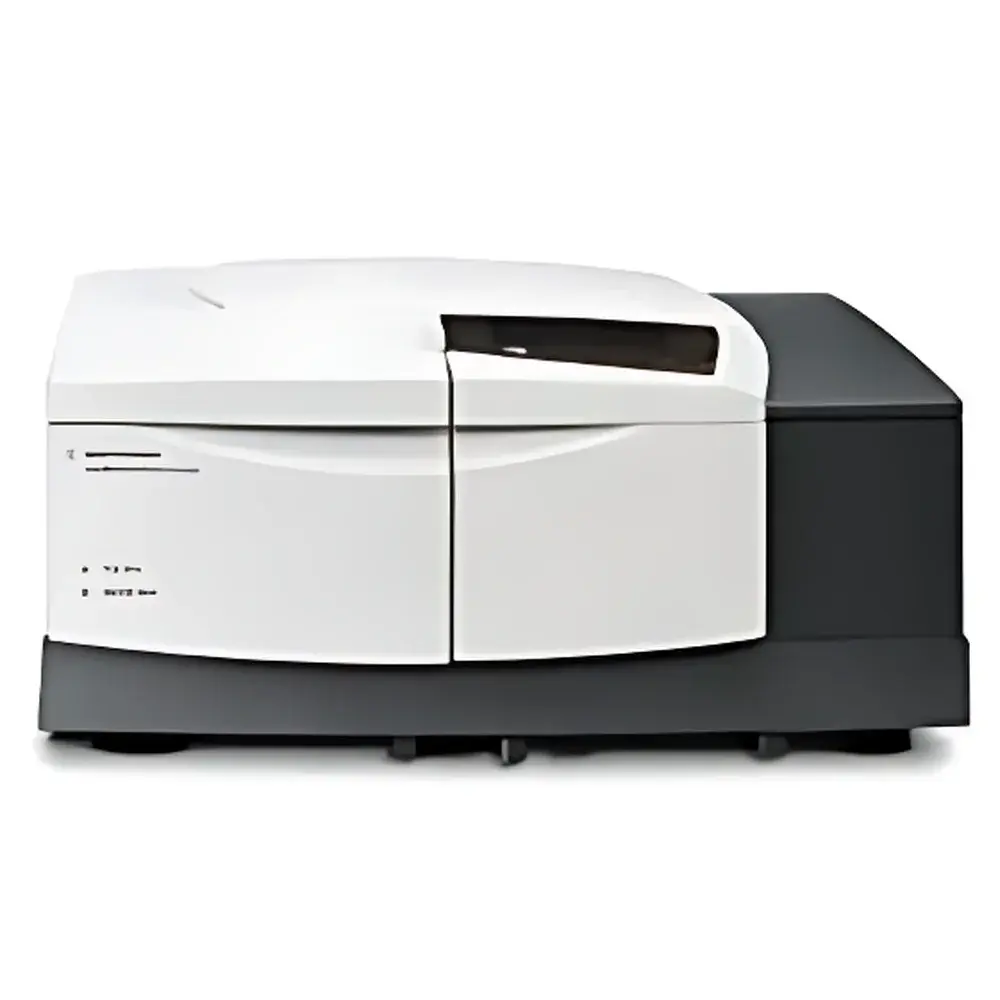
Agilent Cary 660 FTIR Spectrometer
| Brand | Agilent Technologies |
|---|---|
| Model | Cary 660 FTIR |
| Instrument Principle | Fourier Transform Infrared (FTIR) |
| Spectral Range | Standard Mid-IR (4000–400 cm⁻¹) |
| Spectral Resolution | ≤ 0.25 cm⁻¹ (user-selectable down to 0.1 cm⁻¹) |
| Signal-to-Noise Ratio | ≥ 45,000:1 (at 4 cm⁻¹, 1 min scan, peak-to-peak) |
| Detector | High-performance DTGS or optional MCT |
| Beamsplitter | KBr or ZnSe (mid-IR optimized) |
| Interferometer | Precision-machined, dynamically aligned Michelson with HeNe laser reference |
| Scan Speed | Up to 20 kHz mirror velocity |
| Data Format | Compatible with ASTM E1421, JCAMP-DX v6.0, and ISO 14153 |
| Compliance | Designed for GLP/GMP environments |
Overview
The Agilent Cary 660 FTIR Spectrometer is a research-grade, benchtop Fourier Transform Infrared spectrometer engineered for high-fidelity molecular characterization across academic, pharmaceutical, petrochemical, and materials science laboratories. Built upon Agilent’s proven Cary optical platform, it employs a dynamically aligned Michelson interferometer referenced by a stabilized HeNe laser, ensuring long-term spectral accuracy and minimal drift. Its core measurement principle—interferometric acquisition followed by fast Fourier transformation—enables simultaneous detection of all infrared frequencies within the mid-IR range (typically 4000–400 cm⁻¹), delivering superior signal-to-noise ratio (≥ 45,000:1, peak-to-peak, 4 cm⁻¹ resolution, 60-second scan) and reproducible wavenumber calibration traceable to NIST standards. Unlike dispersive IR systems, the Cary 660 leverages Jacquinot (throughput) and Connes (wavenumber precision) advantages inherent to FTIR architecture, making it suitable for both quantitative analysis and structural elucidation of organic, inorganic, and polymeric samples.
Key Features
- Automated electronic recognition of accessories—including ATR, transmission cells, gas cells, and microsampling stages—enabling seamless method reconfiguration and real-time parameter optimization.
- Dynamically aligned interferometer with active alignment monitoring, minimizing maintenance intervals and sustaining sub-0.1 cm⁻¹ wavenumber reproducibility over extended operational periods.
- Modular hardware design supporting field-upgrade paths to Cary 670 and Cary 680 configurations, including integration-ready interfaces for TGA-FTIR, FT-Raman, and IR imaging modules.
- High-stability DTGS detector standard; optional liquid-nitrogen-cooled MCT detector available for rapid-scan kinetics or low-concentration detection.
- Integrated purge management system with automated desiccant status monitoring and dual-purge (dry air/N₂) capability to maintain <10 ppm H₂O/CO₂ in the optical path during hygroscopic or atmospheric-sensitive measurements.
Sample Compatibility & Compliance
The Cary 660 accommodates solid, liquid, gel, and gaseous samples via interchangeable sampling modules: diamond ATR for direct surface analysis of polymers and biological tissues; high-precision demountable cells for solvent-based solutions; heated/gas-flow cells for in situ reaction monitoring; and environmental chambers for temperature-controlled studies (−10 °C to 250 °C). All configurations comply with ISO 17025 requirements for testing laboratories and support analytical validation per ICH Q2(R2) guidelines. When operated with Agilent OpenLab CDS and configured with electronic signatures, audit trails, and role-based access control, the system meets FDA 21 CFR Part 11 and EU Annex 11 expectations for regulated environments.
Software & Data Management
Controlled by Agilent MicroLab software (v5.x), the Cary 660 provides intuitive workflow-driven operation—from instrument setup and spectral acquisition to multivariate analysis (PCA, PLS), spectral library searching (Sadtler, Polymer, BioRad), and report generation. Raw data are stored in vendor-neutral JCAMP-DX v6.0 format, ensuring long-term archival integrity and third-party software interoperability (e.g., MATLAB, Python SciPy). The software architecture supports automated calibration verification (using polystyrene film standard), spectral subtraction, baseline correction, and kinetic time-series processing. For enterprise deployment, integration with LIMS and ELN systems is achieved via ASTM E1421-compliant API protocols.
Applications
- Petrochemical QA/QC: Quantitative determination of oxidation products, additive concentrations, and hydrocarbon composition in lubricants and fuels per ASTM D7417 and D7217.
- Pharmaceutical development: Polymorph screening, excipient compatibility assessment, and residual solvent quantification in APIs following USP and Ph. Eur. 2.2.24.
- Materials science: Crosslink density mapping in elastomers, degradation profiling of composites under thermal/UV stress, and thin-film thickness calculation via interference fringe analysis.
- Academic research: Time-resolved FTIR for catalytic reaction intermediates, protein secondary structure analysis (amide I/II band deconvolution), and nanomaterial surface functionalization verification.
FAQ
What is the minimum resolvable spectral resolution on the Cary 660 FTIR?
The instrument supports user-selectable resolutions from 0.1 cm⁻¹ to 16 cm⁻¹, with factory-verified performance at ≤ 0.25 cm⁻¹ under standard operating conditions.
Can the Cary 660 be used for quantitative analysis in regulated environments?
Yes—when paired with OpenLab CDS and properly validated, it supports full 21 CFR Part 11 compliance, including electronic signatures, audit trails, and secure data archiving.
Is external purging required for routine mid-IR measurements?
While not mandatory, continuous dry air or nitrogen purge is recommended to suppress atmospheric CO₂ and H₂O absorption bands, particularly for high-resolution work below 1500 cm⁻¹.
Does the Cary 660 support step-scan FTIR for time-resolved experiments?
Step-scan functionality is available as an optional upgrade, enabling microsecond-level temporal resolution for photochemical and electrochemical IR studies.
How does the electronic accessory recognition system improve method transfer?
Each accessory contains embedded EEPROM memory storing its optical characteristics and calibration parameters, allowing the software to auto-load appropriate apodization, zero-filling, and phase correction settings without manual intervention.





