
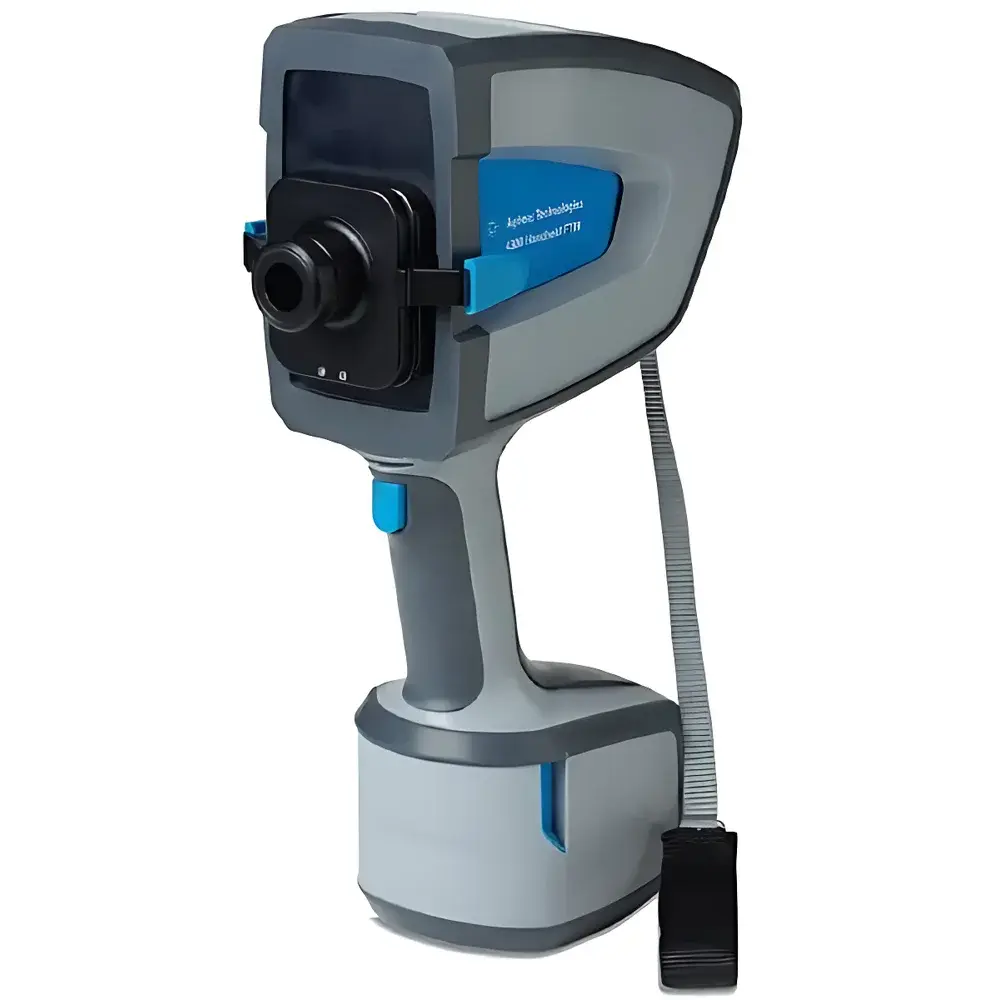
Agilent FTIR4300 Handheld Fourier Transform Infrared Spectrometer
| Origin | USA |
|---|---|
| Instrument Type | Portable |
| Instrument Category | Fourier Transform Infrared (FTIR) |
| Wavenumber Range | 4000–650 cm⁻¹ |
| Spectral Resolution | 4 cm⁻¹ |
| Detector Options | DTGS or Thermoelectrically Cooled MCT |
| Weight | 2.2 kg (4.9 lb) |
| Operating Temperature | 0–50 °C |
| Storage Temperature | −25–75 °C |
| Battery | Rechargeable Li-ion, 10.8 V, 4400 mAh (4 units included) |
| Interface | Integrated PDA touchscreen terminal with wireless PC connectivity |
Overview
The Agilent FTIR4300 Handheld Fourier Transform Infrared Spectrometer is an engineered solution for field-deployable, non-destructive mid-infrared chemical identification and quantitative assessment. Based on Michelson interferometry and rapid-scan FTIR principles, the FTIR4300 delivers laboratory-grade spectral fidelity in a rugged, ergonomic handheld platform. Its optical architecture incorporates a permanently aligned, vibration-resistant interferometer, precision-machined beam splitter, and thermally stabilized laser reference—ensuring long-term wavelength accuracy and minimal drift under variable environmental conditions. Designed explicitly for in situ analysis of high-value, immobile, or geometrically complex objects—including aerospace composites, heritage artifacts, industrial coatings, and geological specimens—the instrument eliminates sample removal, preparation, or transport to centralized labs. Real-time spectral acquisition enables immediate decision-making in quality assurance, forensic verification, and preventive maintenance workflows across regulated and non-regulated environments.
Key Features
- Ergonomic, balanced design weighing only 2.2 kg (4.9 lb), with battery housed at the base to counterbalance the optical head—reducing operator fatigue during extended field use.
- Modular, RFID-enabled sampling interfaces—including diamond ATR, specular reflection, grazing-angle reflection, Ge-ATR, and diffuse reflectance probes—automatically configure software parameters upon attachment, ensuring method traceability and minimizing user error.
- Dual-detector compatibility: Standard DTGS detector for broad dynamic range and ambient-temperature operation; optional thermoelectrically cooled MCT detector for enhanced signal-to-noise ratio (SNR), faster scan rates, and improved sensitivity in low-light or time-critical applications.
- Integrated PDA touchscreen terminal with sunlight-readable display, supporting full spectral acquisition, real-time baseline correction, peak identification, and library matching without external computing hardware.
- Hot-swap battery system: Four rechargeable 10.8 V, 4400 mAh Li-ion batteries allow uninterrupted operation during multi-hour surveys—critical for remote site inspections or production-line audits.
- Robust environmental rating: Operates reliably from 0 to 50 °C and withstands transient shock, dust, and humidity levels typical of industrial, outdoor, and conservation settings.
Sample Compatibility & Compliance
The FTIR4300 supports direct, contact-based or non-contact measurement of solids, liquids, gels, powders, and thin films—without solvent extraction, pelletization, or KBr pressing. Its probe portfolio addresses diverse surface topographies and optical properties: diamond ATR for polymers, elastomers, and viscous materials; Ge-ATR for highly absorbing carbon-filled rubbers; grazing-angle reflection for sub-micron contaminant layers on metallic substrates; and diffuse reflectance for pigments, soils, and weathered cultural heritage surfaces. The system complies with ASTM E1252 (standard practice for general techniques of infrared quantitative analysis), ISO 18380 (FTIR terminology and performance criteria), and supports audit-ready data handling per FDA 21 CFR Part 11 when paired with validated Agilent MicroLab software—enabling electronic signatures, secure user roles, and immutable audit trails for GLP/GMP environments.
Software & Data Management
Acquisition and analysis are managed via Agilent’s MicroLab FTIR software suite—deployed either on the integrated PDA or remotely via Windows-based workstation. The software provides real-time spectral preview, automatic atmospheric compensation (H₂O/CO₂ subtraction), multi-point mapping, and customizable reporting templates. Built-in spectral libraries include polymer, pharmaceutical, mineral, pigment, and contaminant databases—with support for user-defined library creation, hierarchical search algorithms, and similarity scoring (e.g., correlation coefficient, Euclidean distance). All raw interferograms and processed spectra are stored in standardized JCAMP-DX format, ensuring interoperability with third-party chemometric tools (e.g., MATLAB, Unscrambler). Data export options include CSV, PDF, and PNG, with metadata embedding (operator ID, GPS coordinates, probe type, date/time stamp) for full analytical traceability.
Applications
- Aerospace & Automotive: Quantification of thermal/UV degradation in composite laminates; verification of adhesive cure state; detection of hydrocarbon contamination on turbine blades.
- Coatings & Polymers: Thickness estimation of clearcoats via interference fringe analysis; identification of counterfeit resins; monitoring of oxidation onset in polyolefins.
- Cultural Heritage: Non-invasive identification of binding media, pigments, and varnishes on paintings and manuscripts; differentiation of aged vs. modern restoration materials.
- Energy & Mining: Mineralogical mapping of drill core samples; detection of hydrocarbon residues on solar panel encapsulants; assessment of wind turbine blade matrix damage.
- Food & Agriculture: Rapid assessment of fruit ripeness (starch/sugar ratio); soil organic matter quantification; detection of adulterants in powdered commodities.
- Pharmaceutical & Chemical: Raw material identity testing (RMIT) at receiving docks; verification of cleaning efficacy on shared equipment surfaces.
FAQ
Is the FTIR4300 compliant with regulatory requirements for GMP or GLP laboratories?
Yes—when used with validated MicroLab software and configured with electronic signatures, role-based access control, and audit-trail logging, the system meets documentation and data integrity requirements of FDA 21 CFR Part 11 and EU Annex 11.
Can the FTIR4300 perform quantitative analysis?
Quantitative capability depends on calibration strategy and probe selection; the instrument supports external standard, internal standard, and partial least squares (PLS) regression models using reference spectra acquired under controlled conditions.
What is the typical measurement time per spectrum?
With the MCT detector and 4 cm⁻¹ resolution, single-spectrum acquisition requires ≤1 second; DTGS mode averages 4–8 seconds per spectrum depending on SNR requirements.
Does the system require routine alignment or recalibration?
No—optical alignment is factory-sealed and thermally compensated; wavelength calibration is maintained via HeNe laser reference, requiring only annual verification using NIST-traceable polystyrene film.
Are spectral libraries included with the instrument?
Yes—standard shipment includes Agilent’s Polymer, Pharmaceutical, and Mineral libraries (≥15,000 reference spectra); additional domain-specific libraries (e.g., Paints & Coatings, Forensics) are available as licensed add-ons.




