
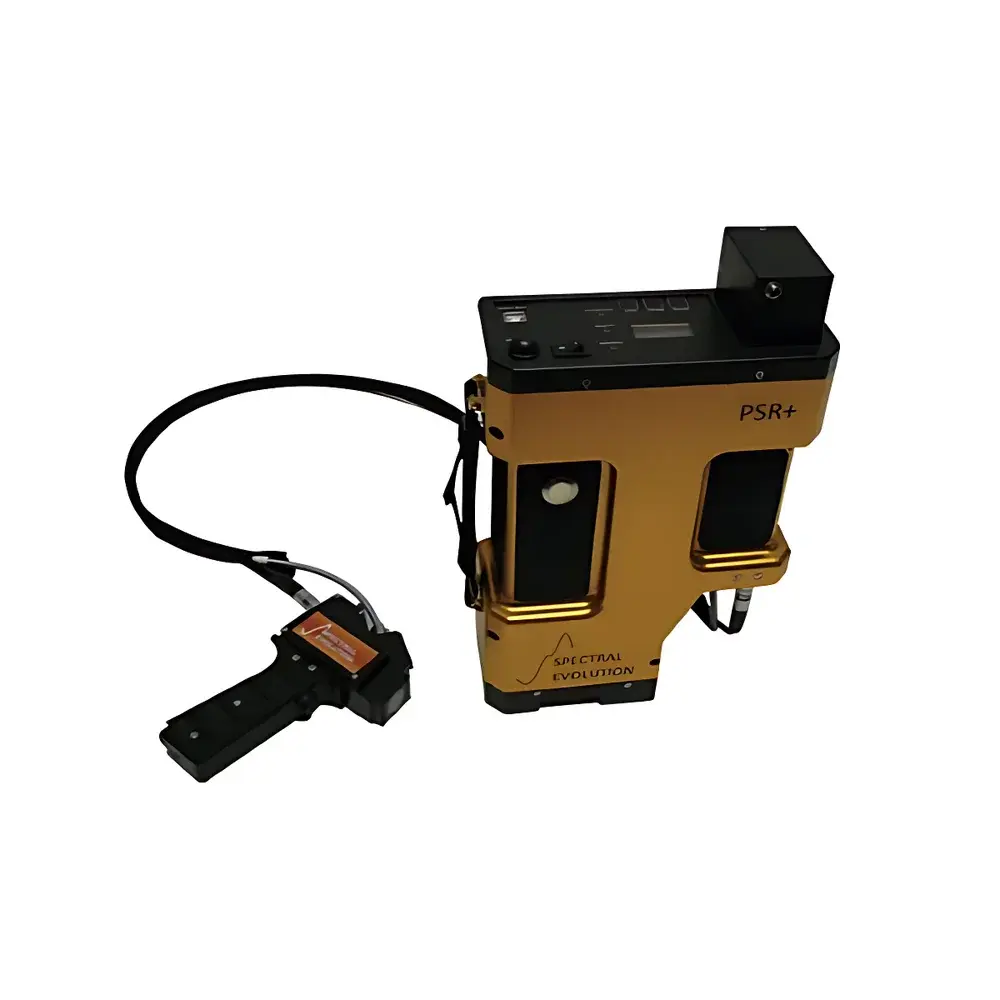
Spectral Evolution PSR+ Portable Field Spectroradiometer
| Brand | SEI |
|---|---|
| Origin | USA |
| Manufacturer Type | Authorized Distributor |
| Import Status | Imported |
| Model | PSR+ |
| Price Range | USD 68,000 – 109,000 |
Overview
The Spectral Evolution PSR+ Portable Field Spectroradiometer is a high-performance, field-deployable optical measurement instrument engineered for precision spectral characterization across terrestrial, aquatic, and atmospheric environments. Operating on the principle of dual-detector grating spectrometry, the PSR+ integrates a cooled Si CCD array (350–1000 nm) and two thermoelectrically cooled InGaAs arrays (1000–1800 nm and 1800–2500 nm) to deliver continuous, high-fidelity spectral response from ultraviolet through shortwave infrared (UV-VNIR-SWIR: 350–2500 nm). Its all-reflective, holographic grating design eliminates moving optical components—ensuring mechanical stability, long-term calibration retention, and immunity to vibration-induced misalignment. The system is optimized for radiometric, reflectance, and transmittance measurements under variable ambient illumination, supporting rigorous scientific protocols in remote sensing validation, environmental monitoring, and material spectroscopy.
Key Features
- Full-spectrum coverage from 350 nm to 2500 nm with no spectral gaps or detector switching artifacts
- High-resolution spectral sampling: 1.4 nm (VNIR), 2.0 nm (SWIR); spectral resolution of 3 nm (350–1000 nm), 6 nm (1800–2500 nm), and 8 nm (1500 nm)
- Zero-motion optical architecture: fixed grating, linear array detectors, and solid-state shutterless acquisition for enhanced reliability in field conditions
- Integrated Class II laser targeting system for precise spatial registration of measurement footprints under daylight or low-light conditions
- Field-configurable optical input: interchangeable fore-optics (4°, 8°, 14° field-of-view lenses), fiber optic probes, cosine correctors, and integrating spheres
- Real-time auto-exposure and auto-integration time selection via onboard firmware—enabling one-button spectral capture without operator intervention
- Baseline drift lock algorithm with on-board dark current compensation and reference standard auto-calibration routines
- Bluetooth 4.2 + 10/100BASE-T Ethernet interface for synchronized data streaming, remote control, and firmware updates
- Ruggedized aluminum chassis with passive thermal management; operational temperature stability maintained over −10 °C to +45 °C ambient range
- Ergonomic nylon-reinforced carrying harness and tripod-mounting compatibility (dual ¼”-20 threaded ports)
Sample Compatibility & Compliance
The PSR+ supports non-contact, non-destructive spectral analysis of heterogeneous natural and engineered surfaces—including vegetation canopies, soil substrates, mineral outcrops, water bodies, photovoltaic materials, and pharmaceutical tablets. Its radiometric calibration traceability is established against NIST-traceable standards, with spectral irradiance accuracy certified per ASTM E275, ISO 9050, and USP . The instrument meets IEC 61000-4 electromagnetic compatibility requirements and complies with FDA 21 CFR Part 11 when used with validated Spectral Evolution acquisition software featuring audit trail, electronic signature, and data integrity controls. All factory calibrations include full uncertainty budgets and are documented in accordance with GLP/GMP-aligned laboratory practices.
Software & Data Management
Data acquisition is managed via Spectral Evolution’s Windows-native SpectraWiz® software—deployable on ruggedized PDAs or laptops—and includes real-time spectral visualization, batch processing, and metadata tagging (GPS, time stamp, FOV, integration time, ambient temperature). The onboard memory stores up to 10,000 spectra independently; when paired with an optional PDA, storage capacity scales to ≥100,000 spectra with automatic georeferencing. Advanced analysis modules support vegetation indices (NDVI, PRI, REIP), mineral identification (spectral absorption feature fitting per USGS spectral library), solar simulator spectral match evaluation (IEC 60904-9), correlated color temperature (CCT), and CIE chromaticity mapping. Export formats include ASCII, CSV, ENVI BIL, and HDF5—ensuring interoperability with ENVI, MATLAB, Python (SciPy/NumPy), and ArcGIS workflows.
Applications
- Ground-truthing and validation of airborne/satellite hyperspectral sensors (e.g., AVIRIS-NG, PRISMA, Sentinel-2)
- Quantitative crop phenotyping: chlorophyll content estimation, water stress detection, nitrogen status mapping
- Geological surveying: clay mineral discrimination, hydrocarbon seep detection, rare earth element proxy identification
- Aquatic optics: CDOM and phytoplankton pigment quantification, Secchi depth modeling, turbidity correlation
- Photovoltaic quality control: spectral responsivity verification, anti-reflective coating performance assessment
- Food and pharmaceutical QA: tablet coating uniformity, moisture content prediction, adulterant screening via spectral fingerprinting
- Urban remote sensing: impervious surface classification, roof material identification, heat island effect analysis
FAQ
What spectral calibration standards are used for factory calibration?
All PSR+ units are calibrated using NIST-traceable tungsten-halogen and deuterium lamps, with reflectance calibration performed against Spectralon® standards certified to ±0.5% absolute reflectance uncertainty.
Can the PSR+ operate in direct sunlight without saturation?
Yes—the instrument features dynamic range optimization algorithms and dual-gain VNIR/SWIR amplification stages, enabling stable measurement under up to 2× solar irradiance (AM1.5G) without detector saturation.
Is spectral data export compatible with ENVI or Python-based analysis pipelines?
Yes—native ENVI BIL and HDF5 export options are supported, and ASCII/CSV outputs include wavelength headers and metadata fields required for reproducible spectral analysis in SciPy, Pandas, or scikit-learn environments.
How often is recalibration recommended?
Annual recalibration is recommended for regulatory compliance; however, the baseline drift lock function and onboard dark/reference checks enable extended field use (up to 18 months) between formal recalibrations when operated within specified environmental limits.
Does the system support GPS synchronization?
Yes—integrated Bluetooth GPS receivers (optional) or external NMEA-compliant devices can be time-synchronized to spectral acquisitions, enabling geotagged spectral libraries for GIS integration.




