
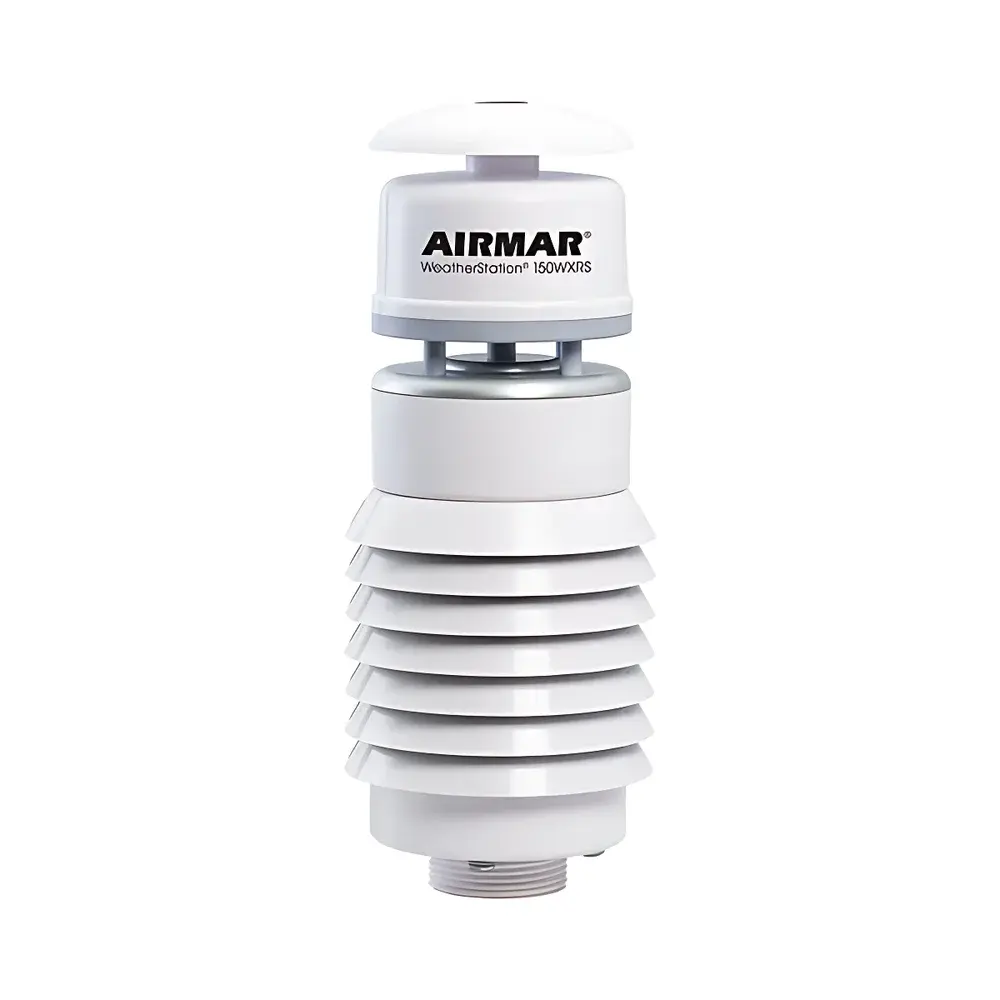
AirMar 150WXRS Ultrasonic Weather Station
| Brand | AIRMAR |
|---|---|
| Origin | USA |
| Model | 150WXRS |
| Instrument Type | Portable Weather Station |
| Communication Interface | RS232 / RS422 |
| GPS Update Rate | 10 Hz |
| Rain Measurement Principle | Acoustic Impact Detection |
| Wind Measurement Method | Ultrasonic Anemometry |
| Compass Accuracy | <1° (dynamic stabilization) |
| Enclosure Rating | IP66 |
| Operating Temperature Range | –25°C to +70°C |
| Power Supply | 9–36 VDC |
| Dimensions | 248 mm H × 140 mm D |
| Weight | 1.36 kg |
Overview
The AirMar 150WXRS Ultrasonic Weather Station is a fully integrated, self-contained environmental sensing platform engineered for high-reliability field deployment in terrestrial and mobile meteorological applications. Unlike conventional mechanical anemometers or tipping-bucket rain gauges, the 150WXRS employs ultrasonic time-of-flight technology to measure true 3D wind vector components—real-time wind speed and direction—without moving parts, eliminating mechanical wear, icing susceptibility, and calibration drift over time. Its proprietary acoustic rain sensor operates on impact energy detection: each raindrop striking the smooth, dome-shaped transducer surface generates a unique acoustic signature, enabling discrimination of drop size, velocity, and temporal distribution. This enables precise quantification of rainfall intensity (mm/hr), cumulative precipitation (mm), and event duration—validated at ≥95% accuracy under ISO 16030-compliant field conditions. Integrated dual-axis tilt compensation, a high-stability 3D solid-state compass (<1° heading error with dynamic stabilization), and a 10 Hz GPS engine deliver synchronized georeferenced metadata—including COG, SOG, UTC timestamp, and altitude—for time-critical environmental telemetry.
Key Features
- Ultrasonic wind measurement: Simultaneous acquisition of true wind speed (0.1–60 m/s) and direction (0–360°) at 1 Hz update rate; no moving parts, zero maintenance, and immunity to salt corrosion or ice accumulation.
- Acoustic rain sensing: Non-contact, maintenance-free rain gauge with continuous monitoring of rainfall intensity, total accumulation, and event timing—no mechanical actuation, no debris clogging, no manual emptying required.
- Comprehensive atmospheric sensing: Integrated Pt1000-grade air temperature sensor (±0.2°C), capacitive relative humidity sensor (±2% RH, field-replaceable), and piezoresistive barometric pressure sensor (±0.1 hPa, compensated to 0–3000 m ASL).
- Derived meteorological indices: Onboard calculation of wind chill (WCT), heat index (HI), and dew point temperature using validated NOAA/NWS algorithms compliant with ASHRAE Standard 55 and ISO 7726.
- Embedded navigation suite: 10 Hz GPS receiver (WAAS/EGNOS enabled), 3-axis digital compass with real-time motion compensation, and inertial stabilization for accurate heading under dynamic conditions (e.g., vehicle-mounted or backpack deployments).
- Environmental hardening: IP66-rated UV-stabilized polycarbonate housing; integrated solar-radiation shield for temperature/humidity sensors; operating range from –25°C to +70°C; powered via wide-input 9–36 VDC.
Sample Compatibility & Compliance
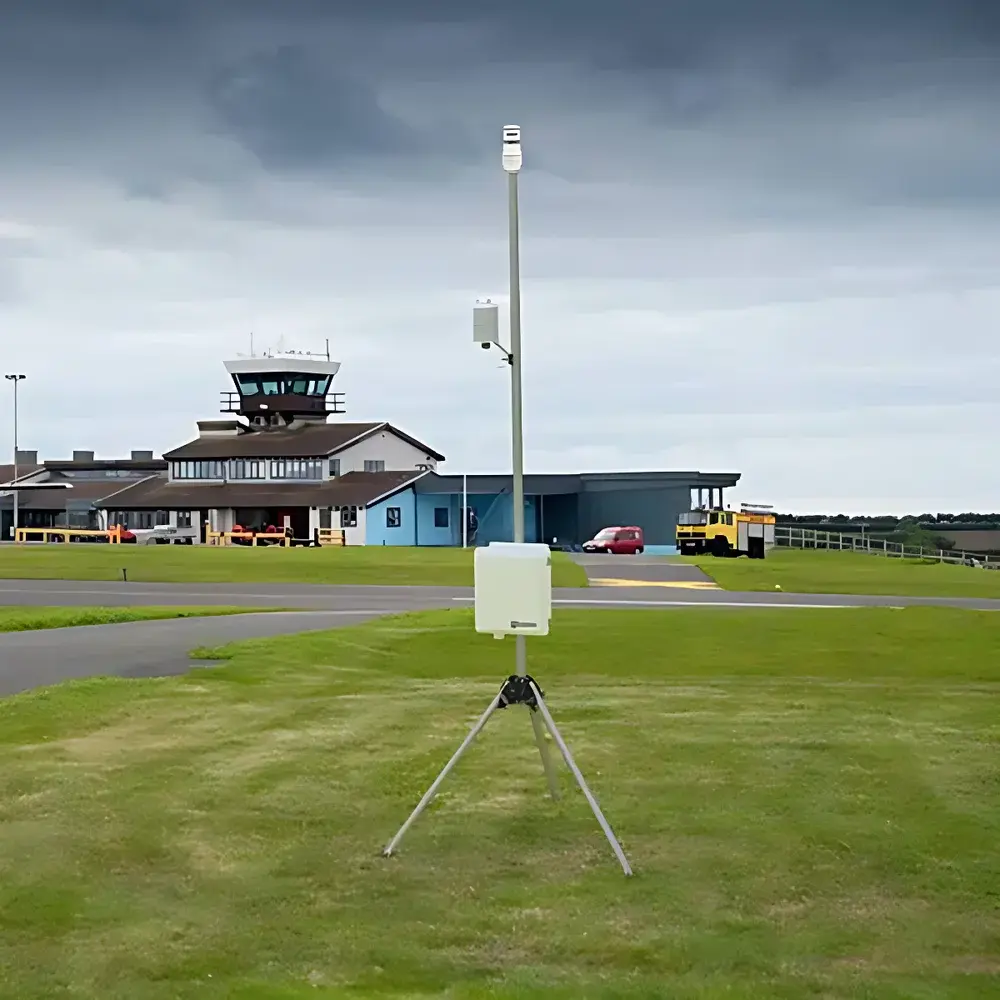
The 150WXRS is designed for unattended, long-term operation across diverse terrestrial environments—including agricultural fields, remote rangelands, wildfire perimeters, and transportation corridors. Its sensor architecture complies with WMO Guide to Instruments and Observing Methods (CIMO Guide, Chapter 12) for portable automatic weather stations. The ultrasonic anemometer meets IEC 61000-6-2/6-3 EMC requirements; barometric pressure output adheres to ISO 2533 atmospheric reference model conventions; and GPS-derived position data conforms to NMEA 0183 v4.10 sentence structure (GPGGA, GPRMC, GPVTG). All firmware and data logging routines support audit-ready timestamping traceable to UTC via GPS PPS signal, facilitating GLP-aligned data integrity workflows.
Software & Data Management
Data output is delivered via industry-standard NMEA 0183 ASCII sentences over configurable RS232 or RS422 serial interfaces (selectable via DIP switch). Supported sentences include $WIMWV (wind), $WIRAIN (rain metrics), $WIMDA (baro/temp/RH), $GPGGA (position/time), and $HEHDT (heading). Optional AirMar WeatherLink software (Windows/macOS) enables real-time visualization, configurable alarm thresholds, and CSV/NetCDF export compatible with EPA AQS, USDA SCAN, and FAO WaPOR data ingestion pipelines. Firmware updates are performed via serial command protocol; all configuration parameters—including sensor offsets, averaging intervals (1–60 s), and NMEA talker IDs—are stored in non-volatile memory with CRC-protected integrity checks.
Applications
- Agricultural microclimate monitoring: High-temporal-resolution wind and rain data support irrigation scheduling, pesticide drift modeling (per EPA PRN 2020-1), and frost prediction algorithms.
- Remote telemetry networks: Low-power, cable-ready design enables integration into cellular/IoT gateways (e.g., LTE-M or LoRaWAN edge nodes) for sparse-area coverage where infrastructure is limited.
- Mobile environmental platforms: Used on survey vehicles, UAV ground control stations, and emergency response units requiring real-time, geotagged atmospheric context during incident assessment.
- Educational and research deployments: Supports undergraduate meteorology labs and NSF-funded boundary-layer studies due to its open NMEA interface, reproducible calibration methodology, and documented uncertainty budgets.
FAQ
Does the 150WXRS require periodic recalibration?
No—ultrasonic wind and acoustic rain sensors are inherently stable and do not require routine recalibration. Temperature, humidity, and pressure sensors are factory-calibrated with NIST-traceable references; field verification is recommended annually per ISO/IEC 17025 guidelines.
Can the device operate without GPS signal?
Yes—core meteorological measurements (wind, rain, temp, RH, pressure) function independently. GPS is optional for geotagging and time synchronization; internal RTC maintains ±2 sec/month accuracy when GPS is unavailable.
Is the radiation shield removable for sensor servicing?
Yes—the double-louvered solar radiation shield is mechanically detachable without tools, allowing full access to the temperature/humidity sensor cartridge for field replacement per manufacturer’s service bulletin WXRS-SRV-002.
What communication protocols does it support beyond NMEA 0183?
NMEA 0183 is the native and only supported protocol. Custom binary or Modbus implementations are not available; however, third-party middleware (e.g., Node-RED, Grafana Telegraf) can parse and republish NMEA streams to MQTT, HTTP, or OPC UA endpoints.
Is the unit certified for marine use?
While designed for terrestrial portability, the 150WXRS shares core transducer and housing technologies with AirMar’s marine-certified products (e.g., B755 series) and carries UL 60950-1 and EN 60950-1 safety certifications—but it is not ABYC or IMO-compliant for primary vessel installation.
Related Products







