
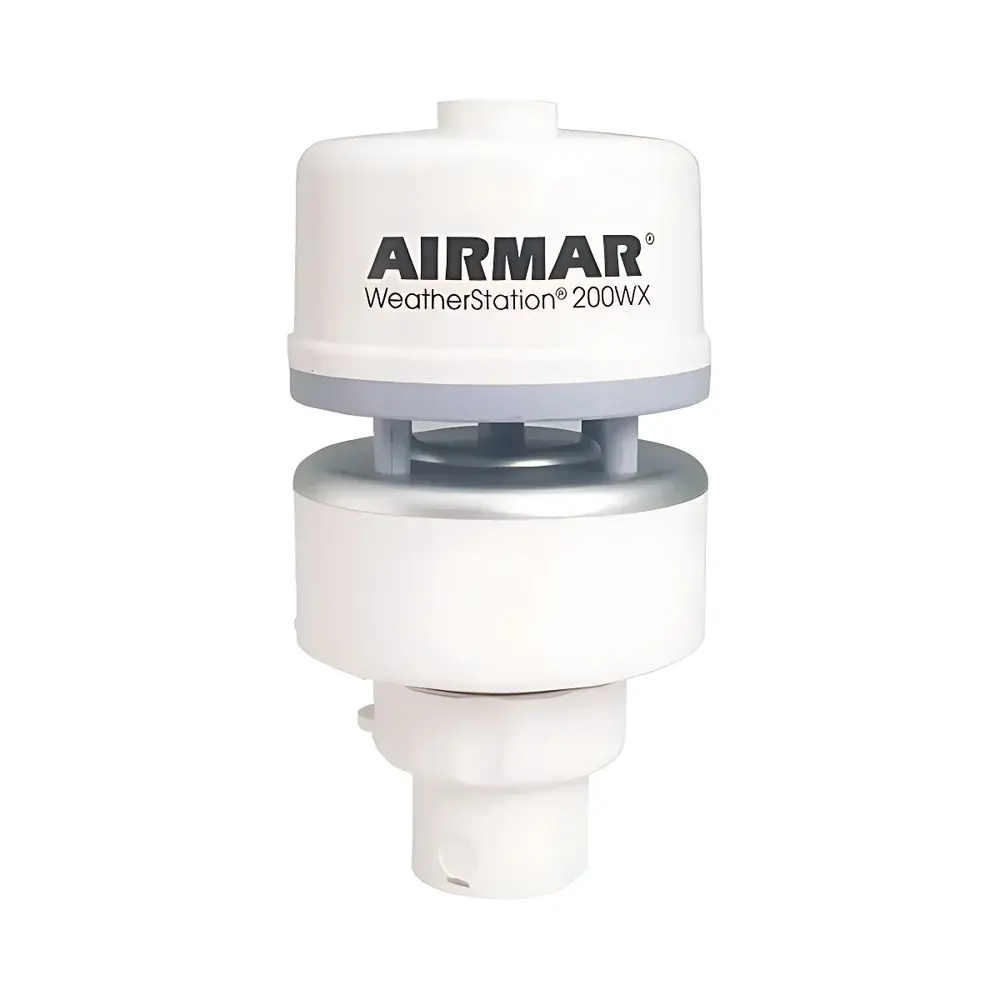
AIRMAR 200WX-IPX7 Ultrasonic Weather Station
| Brand | AIRMAR |
|---|---|
| Origin | USA |
| Model | 200WX-IPX7 |
| Instrument Type | Portable Weather Station |
| IP Rating | IPX7 |
| Output Protocols | NMEA 0183 (RS422/RS232) & NMEA 2000® (CAN bus) |
| GPS Update Rate | 10 Hz |
| Compass Accuracy | <1° (dynamic stabilization) |
| Wind Measurement Principle | Ultrasonic anemometry (no moving parts) |
Overview
The AIRMAR 200WX-IPX7 Ultrasonic Weather Station is a marine-grade, compact environmental sensor system engineered for continuous, high-integrity meteorological and navigational data acquisition in demanding offshore and autonomous operations. Unlike mechanical anemometers subject to wear, icing, or inertia-induced lag, the 200WX-IPX7 employs time-of-flight ultrasonic wind sensing—measuring orthogonal acoustic pulse transit times across three transducer pairs to compute true apparent wind speed and direction with zero mechanical hysteresis. Integrated with a calibrated thermistor for ambient air temperature, a piezoresistive barometric pressure sensor, a tri-axis fluxgate compass with dynamic tilt compensation, a MEMS gyroscope for yaw rate derivation, and a certified 10 Hz GPS receiver (providing position, COG, SOG, and UTC timestamp), the unit delivers synchronized, time-aligned environmental and motion metadata. Its IPX7-rated housing ensures operational integrity after immersion in 1 m of freshwater for up to 30 minutes—making it suitable for deployment on USVs, moored buoys, ASVs, and workboats where space, reliability, and environmental resilience are non-negotiable.
Key Features
- Ultrasonic wind sensing: Measures true apparent wind speed (0–60 m/s) and direction (0–360°) without moving parts—eliminating maintenance, friction error, and start-up thresholds.
- Multi-parameter synchronization: All sensors (wind, temperature, pressure, compass, gyroscope, GPS) share a common 100 ms internal timebase, enabling precise temporal correlation for post-processing and model validation.
- Dynamic attitude compensation: Onboard 9-DOF inertial measurement unit (IMU) fuses compass, accelerometer, and gyroscope data to maintain heading accuracy <1° RMS under pitch/roll up to ±30° and acceleration up to 2 g.
- Dual NMEA interface support: Simultaneous output via NMEA 0183 (selectable RS422 or RS232) and NMEA 2000® (CAN bus) ensures plug-and-play integration with marine chartplotters, autonomy stacks, and data loggers.
- Marine-optimized thermal design: Internal temperature compensation algorithms correct for self-heating effects across –20°C to +55°C operating range, ensuring stable barometric pressure accuracy (±0.5 hPa) and wind calibration integrity.
- Low-power architecture: Draws <1.2 W typical at 12 VDC, supporting extended battery or solar-powered deployments on remote buoys and uncrewed platforms.
Sample Compatibility & Compliance
The 200WX-IPX7 is designed for direct mounting on marine structures with minimal protrusion—ideal for mast tops, buoy decks, and USV bow rails. Its low-profile form factor (127 mm diameter × 92 mm height) avoids flow distortion while maintaining sensor exposure. The unit complies with IEC 60945 (marine navigation equipment), EN 60945:2020, and meets EMC requirements per EN 60945 Annex B. While not certified for safety-critical flight control, its data outputs are compatible with ISO 22892-1 (unmanned surface vehicle data logging) and support GLP-aligned environmental monitoring workflows when paired with validated data acquisition systems. Pressure and temperature sensors are traceably calibrated to NIST standards; GPS module conforms to ICD-GPS-200 Rev M specifications.
Software & Data Management
Raw sensor outputs are delivered as standardized NMEA 0183 sentences (MWV, MWD, GGA, RMC, HDM, HDG, VHW) and NMEA 2000 PGNs (130306, 130310, 130311, 130312, 127250, 127257). No proprietary software is required for basic integration; however, AIRMAR provides configuration utilities (via USB-to-serial adapter) for baud rate, sentence filtering, and firmware updates. Time-stamped binary logs (e.g., using open-source tools like gpsd or custom CAN bus sniffers) enable alignment with external payloads such as ADCPs, multibeam echosounders, or optical sensors. Audit-trail-ready deployments may implement middleware (e.g., ROS 2 nodes or MQTT brokers) to enforce data provenance, payload tagging, and secure TLS-encrypted transmission—meeting baseline requirements for ISO/IEC 17025-compliant environmental data chains.
Applications
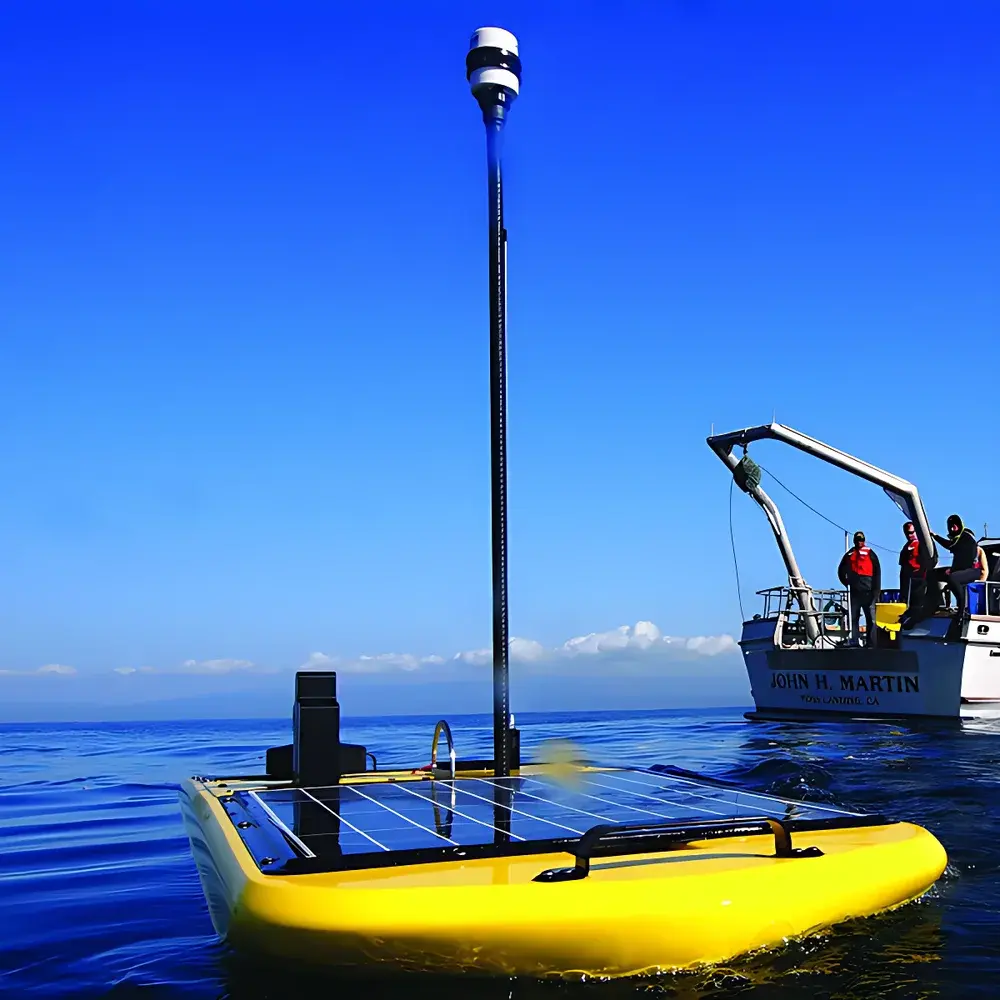
- Unmanned Surface Vehicle (USV) autonomy: Provides real-time wind-relative heading correction, dynamic weather routing inputs, and motion-state feedback for path planning and collision avoidance algorithms.
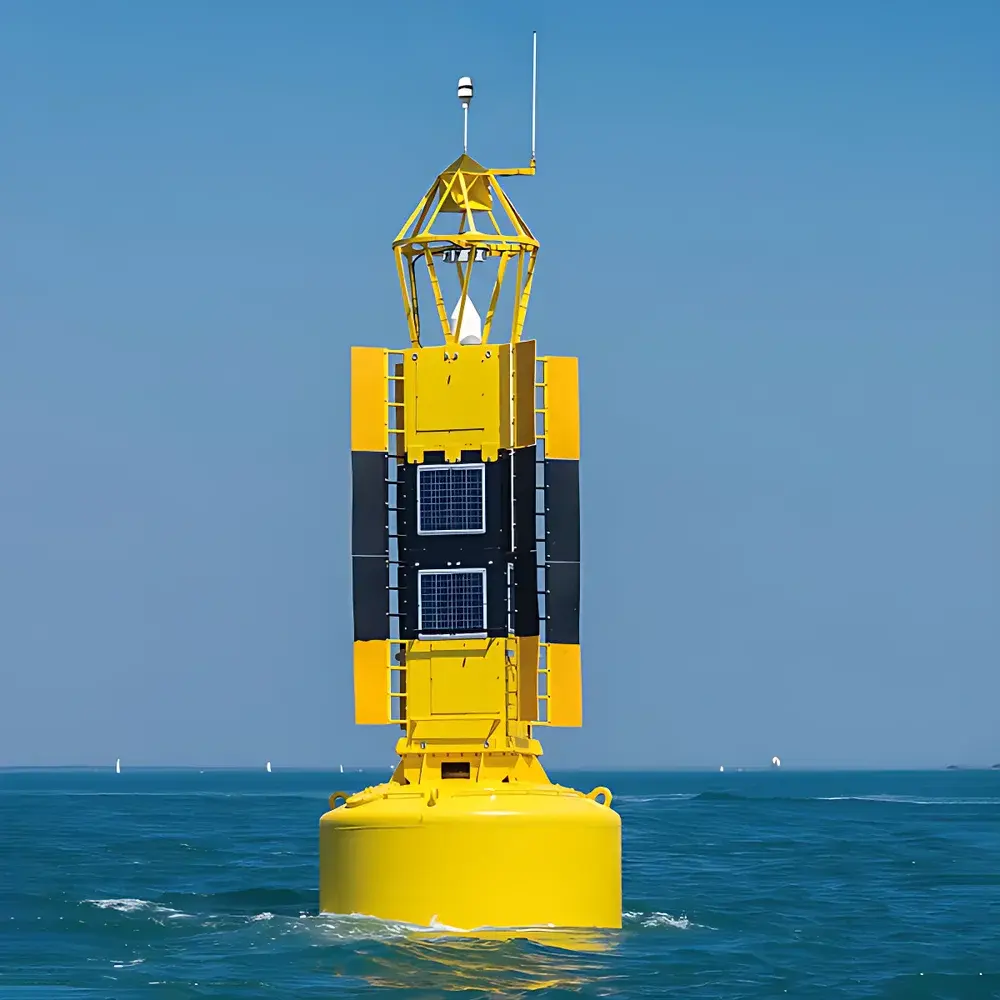
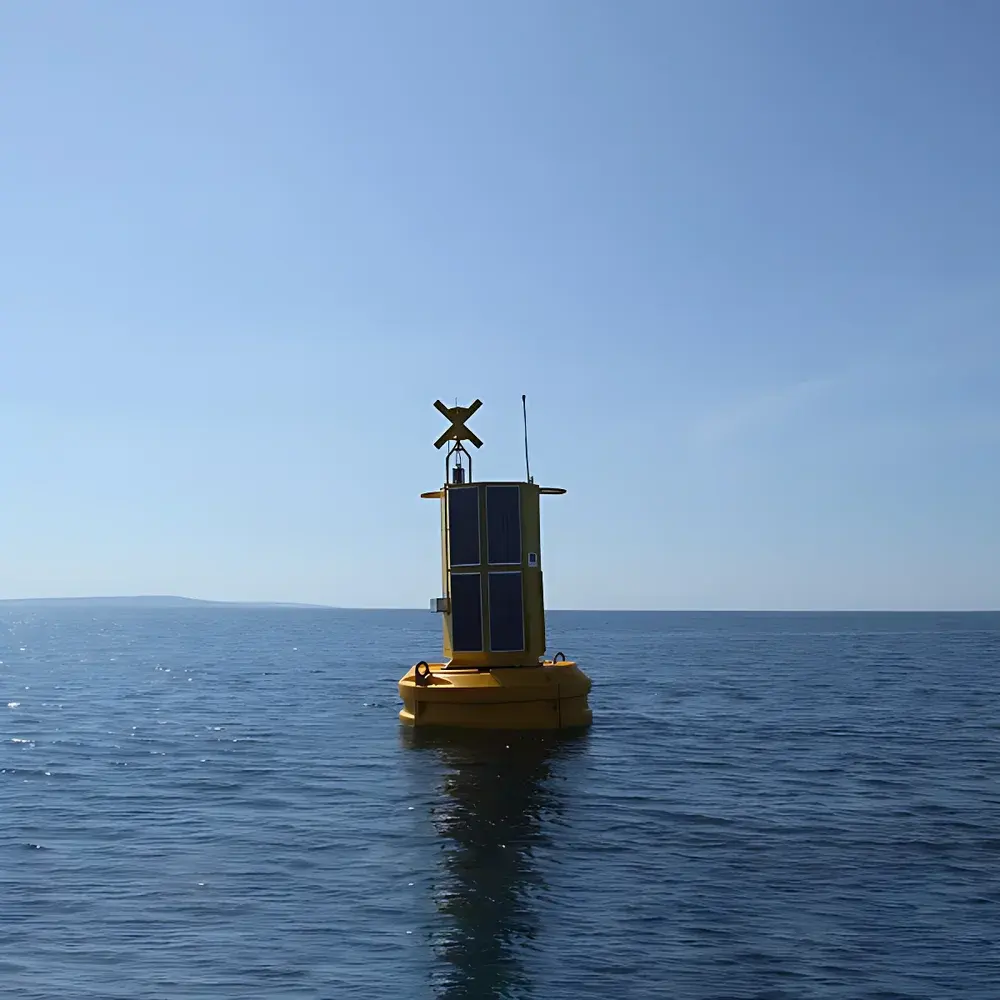
- Oceanographic buoy networks: Serves as primary atmospheric forcing sensor on NOAA, IOOS, and regional buoy programs—delivering long-term, gap-free wind-pressure-temperature series compliant with WMO observational standards.
- Port and harbor situational awareness: Mounted on dockside poles or crane jibs to feed local nowcasting models, berth assignment logic, and crane operation safety interlocks.
- Offshore energy support: Deployed on service vessels and platform supply boats to monitor localized microclimates affecting crane ops, helicopter landing, and ROV launch/recovery windows.
- Academic field campaigns: Used in coastal boundary layer studies, air–sea interaction experiments, and validation of mesoscale numerical weather prediction (NWP) models due to its portability and metrological traceability.
FAQ
Is the 200WX-IPX7 suitable for permanent submersion?
No—it is rated IPX7 (immersion up to 1 m for 30 min), not IP68. It is designed for splash, wave wash, and temporary submersion events—not continuous underwater operation.
Does it support custom data output formats beyond NMEA?
No native support for ASCII JSON, CSV, or binary protocols; all outputs conform strictly to NMEA 0183 and NMEA 2000® standards. Protocol translation must be handled externally.
What mounting hardware is included?
The unit ships without mounting brackets or cables. Compatible stainless steel pole mounts (e.g., AIRMAR MNT-200) and shielded marine-grade cable assemblies (e.g., AIRMAR CBL-200WX-RS422) are available separately.
Can the internal compass be recalibrated in-field?
Yes—compass hard-iron and soft-iron offsets can be adjusted using AIRMAR’s PC-based configuration tool, requiring a full 360° rotation about all three axes in a magnetically clean environment.
Is firmware update capability retained after initial installation?
Yes—firmware updates remain accessible via the RS232/RS422 serial interface using the provided configuration utility, even after integration into NMEA 2000 networks.







