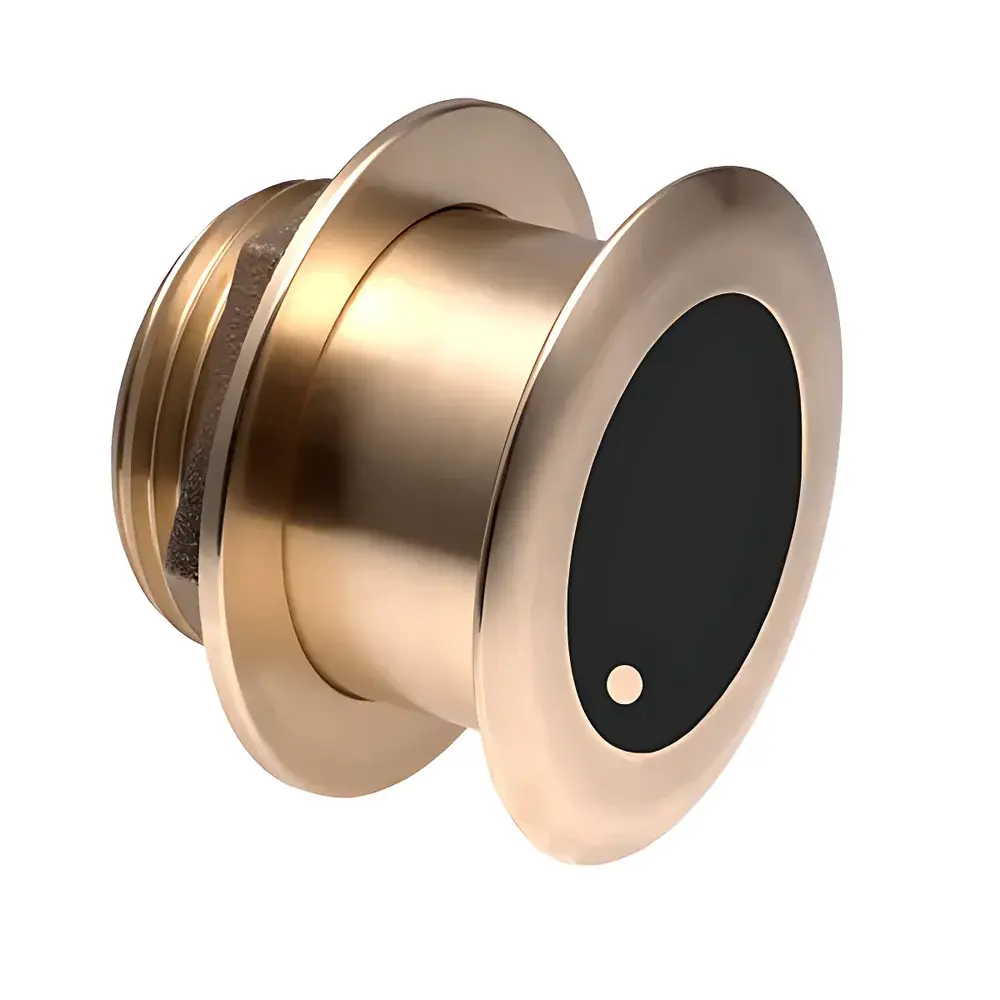
AirMar B175M Chirp Depth Sounder
| Brand | AirMar |
|---|---|
| Origin | USA |
| Model | B175M |
| Operating Frequency Range | 85–135 kHz |
| Transmit Power | 1000 W |
| Beamwidth | 16°–11° (depending on tilt) |
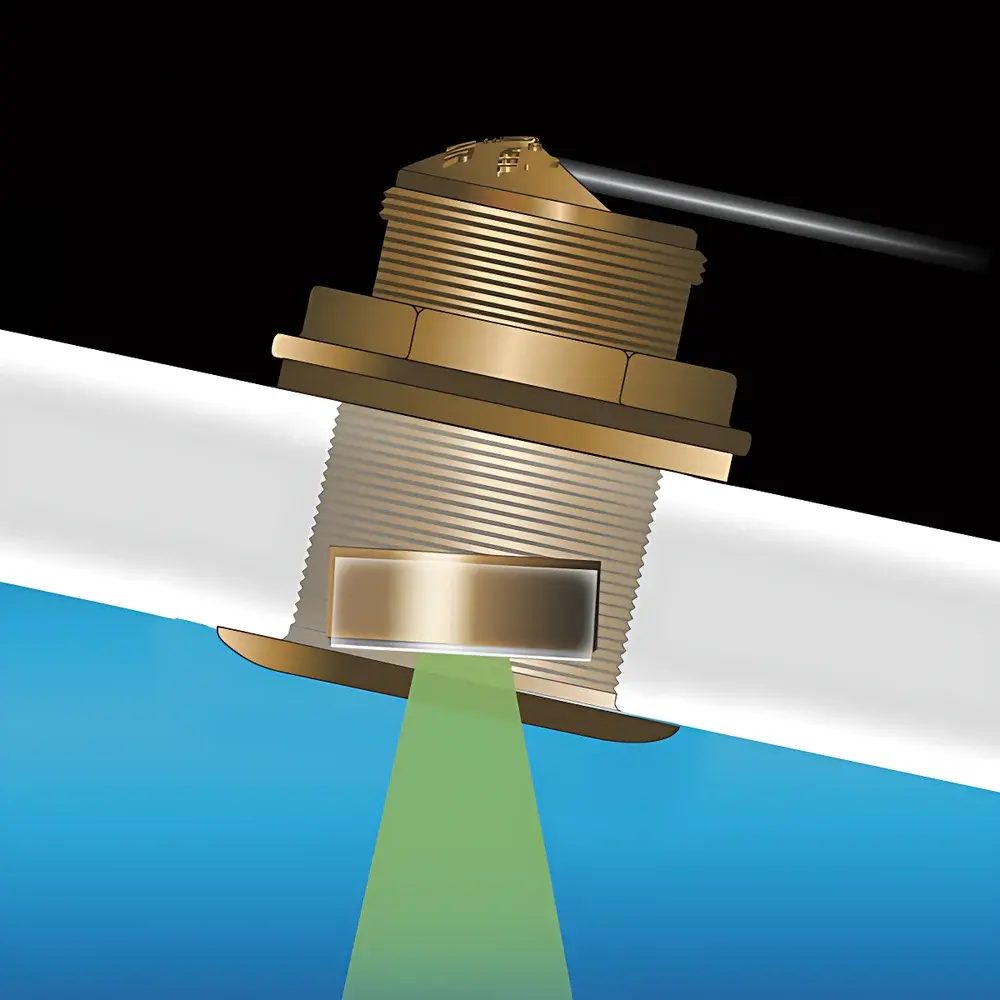
| Transducer Mounting | Low-profile through-hull |
| Housing Material | Bronze |
| Acoustic Window | Polyurethane |
| Maximum Hull Angle | 24° |
| Cutout Diameter | 98 mm |
| Stub Length | 118 mm |
| Cable Length | 10 m |
| Integrated Temperature Sensor | Yes |
| Weight | 1.4 kg |
| Compatible Hull Materials | Fiberglass, Wood |
| Recommended Vessel Length | Up to 11 m |
| Chirp Bandwidth | 50 kHz |
| Tilt Options | 0°, 12°, 20° |
| Compliance | CE, FCC, RoHS |
Overview
The AirMar B175M is a high-performance, through-hull mounted single-beam CHIRP (Compressed High-Intensity Radar Pulse) depth sounder transducer engineered for precision bathymetric measurement and real-time water temperature profiling in marine environments. Unlike conventional pulsed sonar systems, the B175M employs wideband frequency-modulated CHIRP technology operating across a continuous 85–135 kHz bandwidth—delivering significantly enhanced target resolution, improved signal-to-noise ratio, and superior bottom discrimination. This enables reliable detection of seabed features at depths up to 3,000 meters (10,000 ft), while resolving fine-scale acoustic returns from baitfish schools, game fish, submerged structures, and sediment layering with five to ten times greater detail than legacy narrowband echosounders. Its low-profile through-hull design minimizes hydrodynamic drag and maintains hull integrity without requiring external fairings or bracket mounts.
Key Features
- CHIRP broadband transmission (85–135 kHz) with 50 kHz total bandwidth for optimal range-resolution trade-off
- 1000 W peak transmit power supporting deep-water operation and robust penetration through turbid or thermocline-affected water columns
- Three fixed beam tilt options (0°, 12°, 20°) to accommodate varying hull deadrise angles—ensuring optimal acoustic coupling and vertical beam alignment
- Integrated high-accuracy thermistor-based water temperature sensor with fast thermal response time (< 2 s), calibrated to ±0.5°C over 0–30°C
- Patented Xducer ID® technology enabling automatic transducer recognition and configuration by compatible multifunction displays (MFDs), reducing setup errors and ensuring firmware-optimized parameter loading
- Corrosion-resistant bronze housing with polyurethane acoustic window—certified for long-term immersion in saltwater and brackish environments
- Low-profile through-hull installation (98 mm cutout, 118 mm stub length) suitable for fiberglass and wooden hulls up to 11 m LOA
Sample Compatibility & Compliance
The B175M is designed for deployment on recreational and light-commercial vessels with planing or semi-displacement hull forms constructed from fiberglass-reinforced polymer (FRP) or solid wood. It is not rated for metal hulls or cored composite laminates without structural reinforcement around the mounting aperture. The transducer complies with international electromagnetic compatibility standards (FCC Part 15 Class B, CE Directive 2014/30/EU), environmental safety regulations (RoHS 2011/65/EU), and marine equipment directives (MED 2014/90/EU Annex II conformity assessment). Its output signal format adheres to NMEA 2000 (IEC 61162-3) and analog depth/temperature outputs conform to NMEA 0183 v3.01 specifications, ensuring interoperability with certified chartplotters, data loggers, and vessel monitoring systems. While not FDA-regulated, its design supports GLP-aligned data acquisition workflows when integrated into scientific survey platforms.
Software & Data Management
The B175M operates as a sensor node within NMEA 2000 networks, transmitting raw echo envelope data, corrected depth, water temperature, and transducer status metadata. When paired with AirMar-compatible MFDs (e.g., Garmin GPSMAP, Raymarine Axiom, Furuno TZTouch), users access configurable CHIRP sweep parameters—including pulse compression algorithms, gain profiles, noise filtering thresholds, and bottom lock sensitivity—via intuitive touchscreen interfaces. All configuration changes are logged with timestamps and user identifiers, supporting audit-ready traceability under ISO/IEC 17025-compliant calibration protocols. Optional third-party software (e.g., QPS Qimera, Hypack MAX) enables post-processed bathymetric gridding, backscatter analysis, and integration with GNSS-corrected positioning sources for georeferenced survey deliverables.
Applications
- Commercial and recreational fishing operations requiring precise fish-target differentiation and bottom contour mapping
- Hydrographic survey support for nearshore bathymetry, dredging verification, and habitat classification studies
- Scientific oceanographic profiling where concurrent depth and in-situ temperature measurements inform water column stratification models
- Marine infrastructure inspection—including pier pilings, pipeline routes, and underwater cable corridors—leveraging high-resolution CHIRP imaging capability
- Vessel performance optimization through real-time draft monitoring and shallow-water navigation safety enhancement
FAQ
Is the B175M compatible with non-AirMar displays?
Yes—it outputs standard NMEA 2000 PGNs (128259, 128267) and NMEA 0183 sentences (DPT, MTW), enabling integration with any display supporting those protocols.
Can it be installed on aluminum or steel hulls?
No—the transducer requires direct acoustic coupling through non-metallic hull materials; installation on metal hulls necessitates an externally mounted fairing system (not included).
What is the maximum recommended vessel speed for accurate depth readings?
For optimal accuracy and signal stability, operation below 35 knots is recommended; higher speeds may induce cavitation-induced signal dropout depending on hull geometry and sea state.
Does the B175M support dual-frequency operation?
No—it is a fixed-band CHIRP transducer operating exclusively within the 85–135 kHz medium-frequency band; multi-band capability requires separate transducers (e.g., B175L or B175H).
How often does the temperature sensor require recalibration?
Under normal marine exposure conditions, annual verification against a traceable reference standard is sufficient; no field recalibration is user-serviceable.