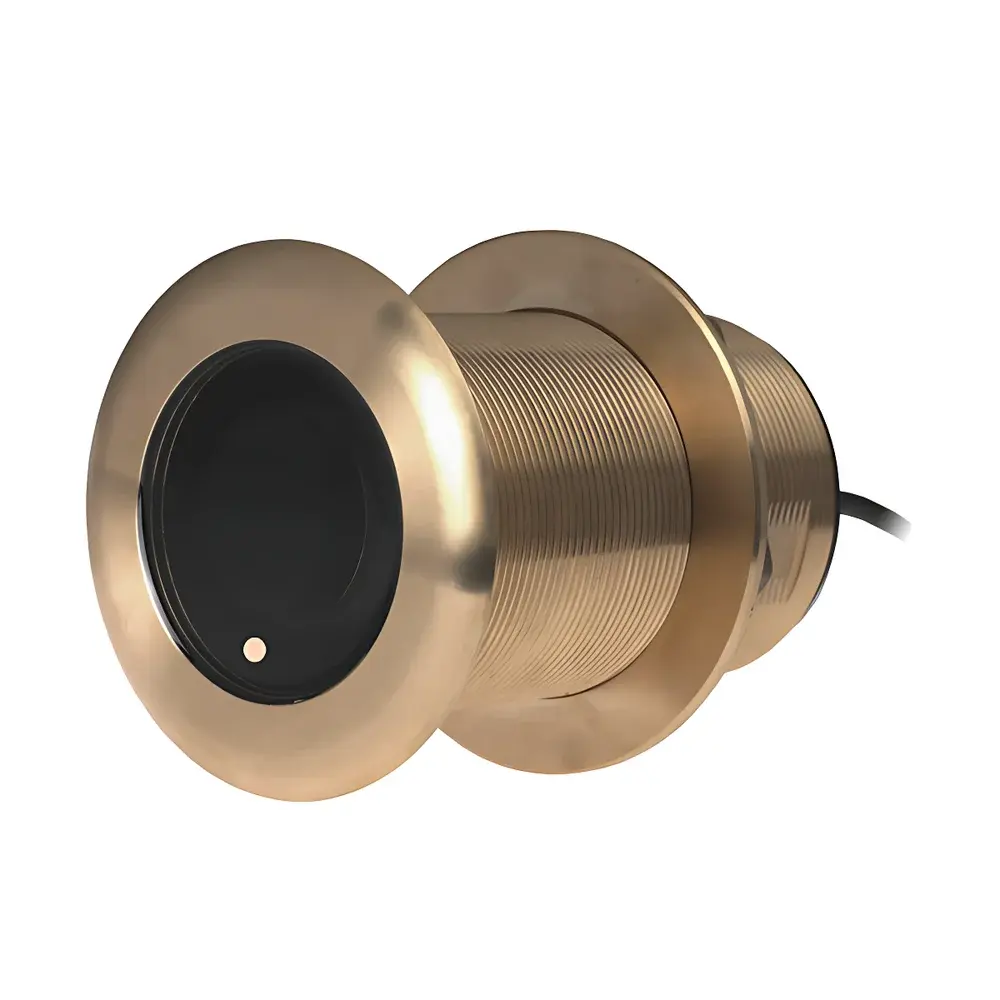
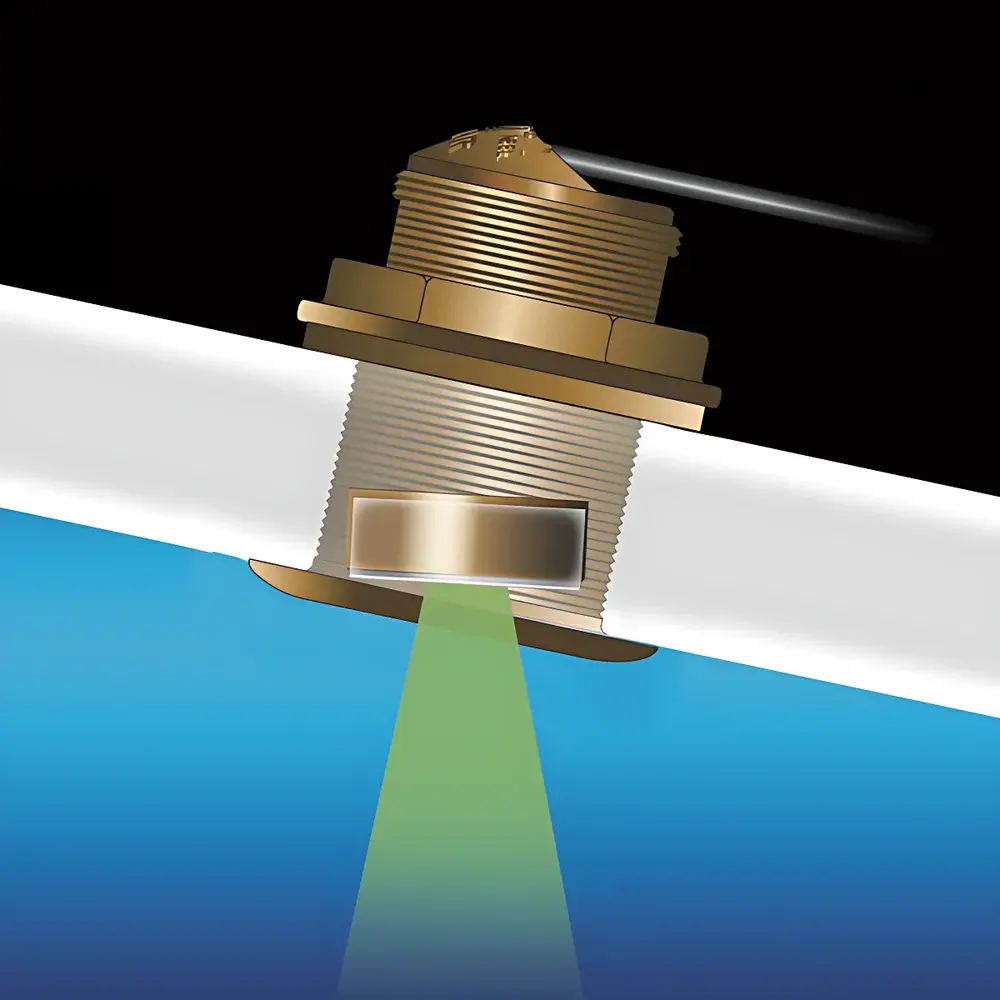
AirMar B75L Chirp Depth Sounder
| Brand | AIRMAR |
|---|---|
| Origin | USA |
| Model | B75L |
| Operating Frequency Range | 40–75 kHz |
| Output Power | 300 W |
| Beam Width | 32°–21° (depending on tilt) |
| Transducer Mounting | Through-hull |
| Housing Material | Bronze |
| Porthole Diameter | 70 mm |
| Stub Length | 95 mm |
| Cable Length | 10 m |
| Integrated Temperature Sensor | Yes |
| Weight | 1.4 kg |
| Maximum Hull Deadrise Angle | 24° |
| Acoustic Window Material | Polyurethane |
| Compatible Hull Materials | Fiberglass, Wood |
| Total Bandwidth | 35 kHz |
| Xducer ID® Technology | Yes |
Overview
The AirMar B75L Chirp Depth Sounder is a high-performance, through-hull mounted single-beam echosounder engineered for precision bathymetric profiling and real-time water column analysis in marine environments. Utilizing broadband chirp sonar technology—where frequency-modulated pulses sweep across a 35 kHz bandwidth (40–75 kHz)—the B75L achieves significantly improved signal-to-noise ratio, range resolution, and target separation compared to conventional fixed-frequency echo sounders. This enables reliable bottom detection at depths up to 3,000 meters (10,000 ft), with enhanced discrimination of biological targets (e.g., baitfish schools vs. game fish) and submerged structural features such as rock outcrops, wrecks, or artificial reefs. Its low-frequency operation prioritizes penetration and long-range performance, making it especially suited for offshore survey, commercial fishing, and scientific hydrographic applications where deep-water fidelity and thermal context are critical.
Key Features
- Chirp sonar architecture delivering 5× to 10× greater resolution and detail versus legacy pulse-echo systems
- Integrated high-stability thermistor for simultaneous water temperature measurement with depth data
- Three optional deadrise-compatible tilt configurations: 0° (flat hull), 12°, and 20°—ensuring optimal beam alignment across diverse vessel geometries
- Polyurethane acoustic window optimized for impedance matching with fiberglass and wood hulls, minimizing signal loss and cavitation artifacts
- Patented Xducer ID® technology enabling automatic transducer recognition and configuration validation within compatible multifunction displays (MFDs)
- Low-profile bronze housing with corrosion-resistant finish, rated for continuous submersion in seawater
- Standard 10-meter shielded coaxial cable with NMEA 2000® and analog depth/temperature outputs for seamless integration into marine electronics networks
Sample Compatibility & Compliance
The B75L is validated for installation on vessels up to 11 meters LOA with fiberglass or wooden hulls exhibiting deadrise angles ≤24°. Its 70 mm porthole requirement accommodates standard through-hull drilling templates used in recreational and light-commercial craft. The transducer complies with IEC 62237 (marine sonar equipment safety) and meets EMC requirements per EN 55022 Class B. While not certified for regulatory hydrographic survey (e.g., IHO S-44), its output stability and repeatability support GLP-aligned field data collection when paired with calibrated display systems and time-synchronized GPS inputs. All firmware updates and configuration files adhere to NMEA 0183 v4.10 and NMEA 2000® TP1/TP2 standards.
Software & Data Management
The B75L operates as a sensor node within NMEA 2000® networks, publishing depth, water temperature, and raw echo log metadata (including gain, pulse width, and frequency sweep parameters) via standardized PGNs (e.g., PGN 128259 for depth, PGN 130311 for environmental data). When interfaced with compatible chartplotters (e.g., Garmin GPSMAP, Raymarine Axiom, Furuno TZTouch), users access real-time split-screen views combining CHIRP sonar imagery, depth contours, and thermal overlays. Raw echo data can be logged in .nmea or proprietary binary formats for post-processing using third-party tools such as SonarLog, QGIS + MB-System plugins, or MATLAB-based spectral analysis workflows. Audit trails for configuration changes—including tilt angle selection and power level—are retained in non-volatile memory and accessible via diagnostic menus compliant with NMEA 2000® Device Configuration PGNs.
Applications
- Commercial and sport fishing operations requiring precise identification of pelagic biomass layers and benthic habitat boundaries
- Pre-survey reconnaissance for ROV/AUV deployment zones in deep continental shelf environments
- Long-term water column monitoring for temperature-depth profile correlation in limnological and oceanographic studies
- Underwater infrastructure inspection (pipelines, cables, mooring anchors) where high-resolution bottom return characterization is essential
- Integration into autonomous surface vehicle (ASV) platforms for uncrewed bathymetric mapping missions
FAQ
What is the maximum operational depth of the B75L?
The B75L reliably detects seabed returns down to 3,000 meters under typical oceanic conditions (15°C, 35 ppt salinity); actual performance depends on absorption coefficient, noise floor, and bottom composition.
Can the B75L be installed on aluminum or steel hulls?
No—its polyurethane acoustic window and bronze housing are specifically tuned for fiberglass and wood substrates; installation on metal hulls requires alternative transducer models with appropriate impedance-matching materials.
Does the B75L support dual-frequency or multi-beam functionality?
No—it is a dedicated single-beam chirp transducer operating exclusively in the 40–75 kHz band; multi-frequency capability requires separate B75M or B75H units or a multi-channel CHIRP MFD.
Is firmware update capability available via NMEA 2000®?
Yes—firmware revisions may be delivered over NMEA 2000® using certified update tools from AirMar or authorized integrators; all updates preserve calibration coefficients and Xducer ID® registration.
How does Xducer ID® improve system reliability?
Xducer ID® stores unique transducer parameters (beam pattern, delay, sensitivity) in onboard EEPROM, allowing the host display to auto-configure signal processing algorithms—reducing setup errors and ensuring consistent interpretation of echo returns across different installations.