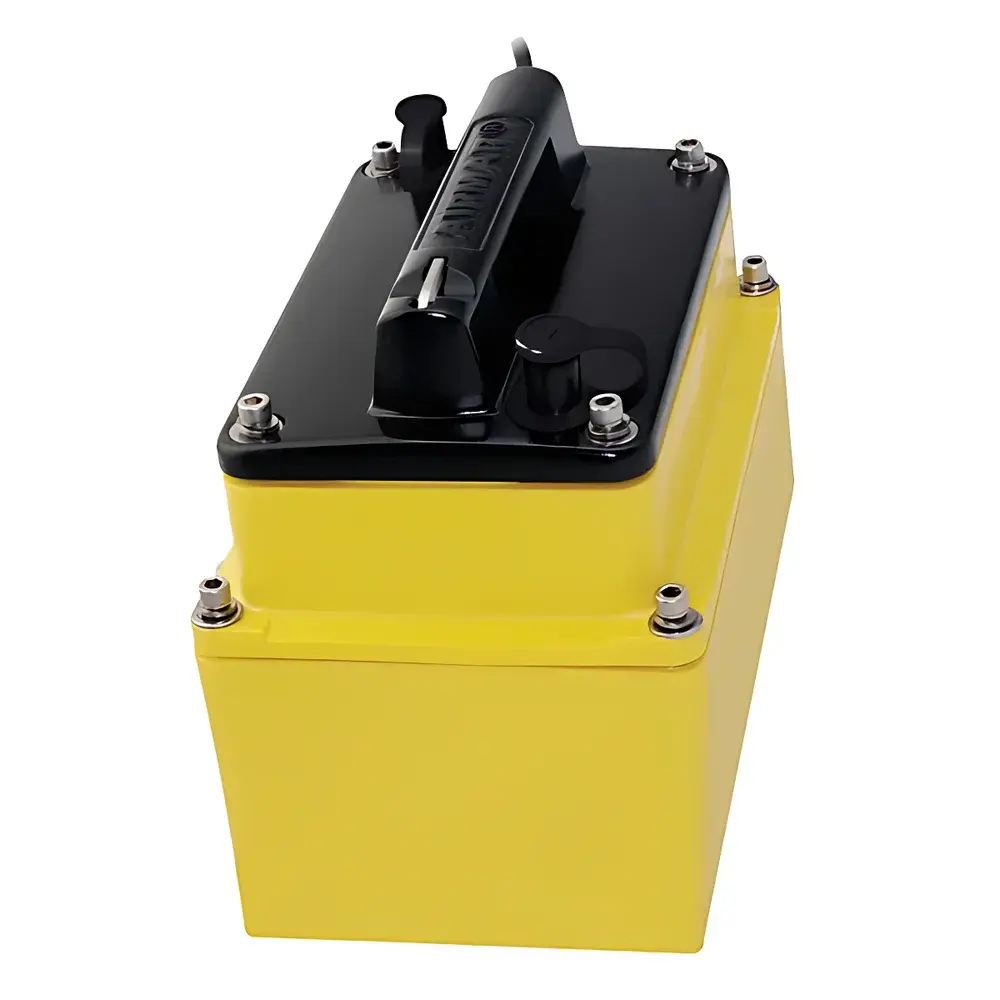
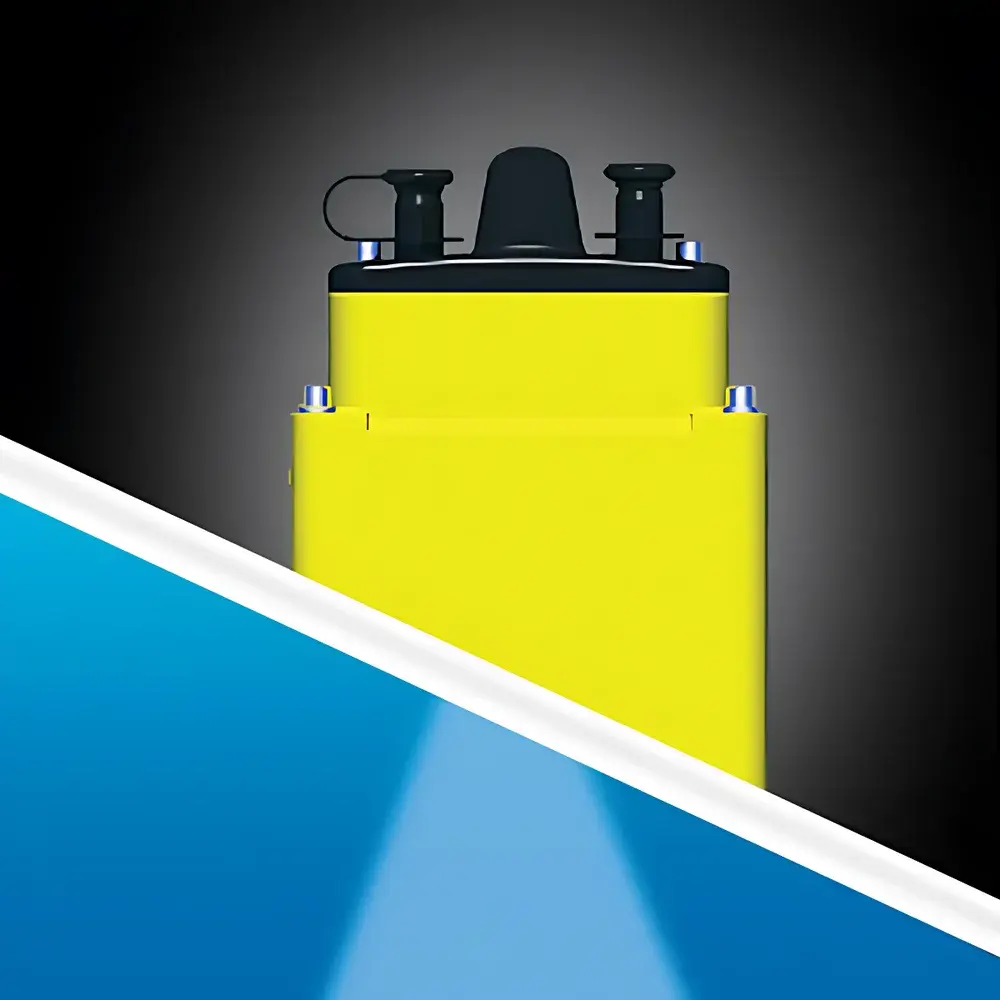
AirMar M265LM Dual-Band Chirp Depth Sounder
| Brand | AIRMAR |
|---|---|
| Origin | USA |
| Model | M265LM |
| Frequency Bands | Low Band 42–65 kHz (Beamwidth 25°–16°), Medium Band 85–135 kHz (Beamwidth 16°–11°) |
| Output Power | 1000 W |
| Installation Type | In-hull Mount |
| Housing Material | Polyurethane Encapsulated Plastic |
| Transducer Window | Polyurethane |
| Cable Length | 10 m |
| Integrated Temperature Sensor | Yes |
| Weight | 6.2 kg |
| Total Bandwidth | 73 kHz |
| Compatible Frequencies | 50 kHz, 88 kHz, 107 kHz |
| Hull Compatibility | Solid Fiberglass Hulls Only |
| Proprietary Technology | Xducer ID® |
Overview
The AirMar M265LM Dual-Band Chirp Depth Sounder is an in-hull mounted, broadband echosounder engineered for high-fidelity bathymetric profiling and target discrimination in marine research, commercial fishing, and hydrographic survey applications. Unlike conventional pulsed sonar systems, the M265LM employs frequency-modulated continuous-wave (FMCW) “Chirp” technology—transmitting swept-frequency signals across two discrete, overlapping bands (low: 42–65 kHz; medium: 85–135 kHz). This architecture delivers significantly improved range resolution, signal-to-noise ratio (SNR), and target separation capability compared to fixed-frequency echo sounders. The system achieves bottom detection at depths up to 3,000 meters (10,000 ft) with enhanced sensitivity to subtle acoustic impedance contrasts—enabling reliable differentiation between plankton layers, baitfish schools, pelagic game species, and complex benthic structures such as rock outcrops, wrecks, or submerged vegetation. Its dual-band design ensures operational flexibility across varying water column conditions: low-band energy penetrates turbid or deep environments with minimal attenuation, while the medium band provides superior lateral resolution and fine-scale feature definition in mid-depth coastal and continental shelf waters.
Key Features
- Dual-band Chirp architecture with independent low-band (42–65 kHz) and medium-band (85–135 kHz) transduction—optimized for simultaneous depth mapping and biological target classification.
- Patented Xducer ID® technology enables automatic transducer recognition, calibration parameter recall, and firmware-validated configuration—reducing setup time and eliminating manual gain/offset errors.
- Integrated high-stability thermistor-based water temperature sensor with fast thermal response (<2 s time constant) and ±0.2°C accuracy over 0–35°C range—critical for sound speed correction in precision depth calculation.
- In-hull mounting design eliminates hull penetration, preserving structural integrity and reducing drag; compatible exclusively with solid fiberglass hulls (minimum thickness: 12 mm, no core materials).
- 1000 W peak acoustic output power coupled with a total instantaneous bandwidth of 73 kHz supports robust performance in high-clutter environments and under variable salinity/temperature gradients.
- Beamwidth tapering (25°–16° for low band; 16°–11° for medium band) provides adaptive vertical coverage—wider angles enhance seabed detection in steep-slope terrain, while narrower angles improve horizontal resolution at shallower depths.
Sample Compatibility & Compliance
The M265LM is designed for deployment on vessels with solid fiberglass hulls (non-cored, non-foam-filled construction) and requires direct acoustic coupling between the transducer face and hull interior surface. It is not suitable for aluminum, steel, wood, or cored composite hulls due to excessive signal attenuation or resonance interference. The unit complies with FCC Part 15 Class B and CE EMC Directive 2014/30/EU for electromagnetic compatibility. While not certified for safety-critical navigation per IMO Resolution A.694(17), it meets IEC 62288 Ed. 2.0 (Maritime Navigation and Radiocommunication Equipment) for environmental robustness (IP66 front panel rating, operating temperature −20°C to +55°C). Data outputs conform to NMEA 2000 (PGN 128267, 128275) and NMEA 0183 v4.10 standards, ensuring interoperability with ECDIS, chartplotters, and data loggers used in GLP-aligned field studies.
Software & Data Management
The M265LM interfaces natively with industry-standard marine display platforms (e.g., Garmin GPSMAP, Raymarine Axiom, Furuno TZtouch) via NMEA 2000. Raw echo data—including time-varying amplitude, phase, and spectral content per ping—is accessible through optional AirMar SonarLog™ software (Windows-based) for post-processing, spectral analysis, and target strength quantification. All logged datasets include embedded metadata (timestamp, GPS position, vessel heading, water temperature, and transducer ID), supporting traceable data lineage required under ISO/IEC 17025:2017 for accredited testing laboratories. Audit trails for configuration changes are retained locally for ≥30 days, aligning with basic data integrity expectations under FDA 21 CFR Part 11 when used in regulated aquatic resource assessment workflows.
Applications
- Commercial fisheries stock assessment—resolving multi-species aggregations and estimating biomass distribution using target strength modeling.
- Pre-construction hydrographic surveys for offshore wind farm site characterization, including seabed morphology, sediment type inference, and obstacle detection.
- Academic limnology and oceanography—monitoring diel vertical migration patterns, thermocline dynamics, and suspended particulate matter concentration gradients.
- Marine protected area (MPA) monitoring—tracking seasonal habitat use by demersal and pelagic species without requiring towed or moored instrumentation.
- Port and channel maintenance—detecting sediment accumulation, scour features, and submerged debris with sub-meter vertical resolution at depths >1,000 m.
FAQ
Is the M265LM suitable for installation on aluminum or steel hulls?
No. The transducer requires direct acoustic coupling through a solid fiberglass substrate. Metal hulls reflect and scatter Chirp energy, resulting in severe signal loss and unreliable bottom tracking.
Does the unit support real-time spectral analysis or only processed depth/target data?
Raw IQ (in-phase/quadrature) echo samples are available via proprietary API for third-party signal processing; standard NMEA outputs provide calibrated depth, temperature, and target detection flags only.
What is the minimum recommended hull thickness for in-hull mounting?
12 mm of uninterrupted solid fiberglass (no core, no gelcoat delamination); hull curvature radius must exceed 250 mm to ensure uniform transducer contact.
Can the M265LM be integrated into an existing NMEA 2000 network with legacy instruments?
Yes—provided the network complies with NMEA 2000 certification requirements (certified backbone, proper termination, and <50 Ω loop resistance); galvanic isolation is recommended when interfacing with non-marine-grade sensors.
How does Xducer ID® improve measurement repeatability across multiple deployments?
Xducer ID® stores factory-measured beam pattern coefficients, electrical impedance curves, and temperature compensation tables—automatically loading correction profiles during initialization to eliminate inter-unit variability and reduce operator-dependent calibration drift.