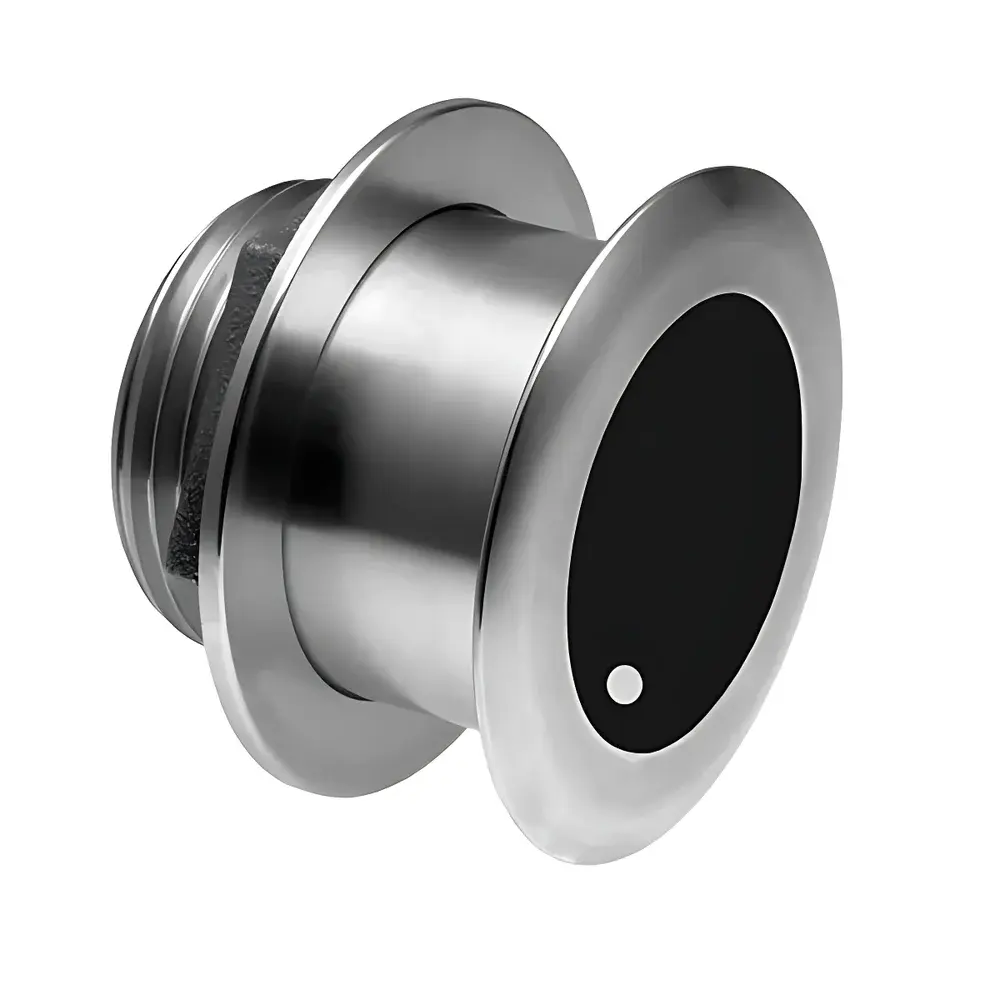
AIRMAR SS175M Chirp Single-Beam Echo Sounder
| Brand | AIRMAR |
|---|---|
| Origin | USA |
| Model | SS175M |
| Operating Frequency Range | 85–135 kHz |
| Beamwidth | 16°–11° (depending on tilt) |
| Output Power | 1000 W |
| Transducer Housing Material | Stainless Steel |
| Mounting Type | Low-Profile Through-Hull |
| Hole Diameter | 98 mm |
| Stub Length | 118 mm |
| Cable Length | 10 m |
| Integrated Temperature Sensor | Yes |
| Weight | 2.7 kg |
| Maximum Hull Tilt Compensation | 28° |
| Acoustic Window Material | Polyurethane |
| Total Chirp Bandwidth | 50 kHz |
| Compatible Hull Materials | Stainless Steel or Aluminum |
| Recommended Vessel Length | Up to 11 m |
| Proprietary Technology | Xducer ID® |
Overview
The AIRMAR SS175M is a high-performance, through-hull mounted single-beam chirp echo sounder engineered for precision depth and water temperature measurement in marine environments. Utilizing advanced frequency-modulated (FM) chirp sonar technology, the SS175M transmits continuous broadband signals across an 85–135 kHz band—delivering significantly enhanced target resolution and signal-to-noise ratio compared to conventional pulsed echosounders. Its 1000 W peak acoustic output enables reliable bottom detection at depths up to 3000 meters (10,000 ft), while the dynamically variable beamwidth (16° at lower frequencies tapering to 11° at higher frequencies) ensures optimal spatial discrimination of underwater features—including fish schools, bathymetric contours, and submerged structures. Designed for integration with NMEA 2000 and NMEA 0183 networks, the SS175M serves as a foundational sensor for scientific hydrographic surveys, commercial fisheries monitoring, and high-fidelity navigation systems requiring traceable, repeatable acoustic data.
Key Features
- Chirp sonar architecture with 50 kHz total bandwidth (85–135 kHz), enabling superior range resolution and target separation
- Integrated high-stability thermistor-based water temperature sensor with fast thermal response time (< 3 s to 90% step change)
- Stainless steel transducer housing with polyurethane acoustic window—corrosion-resistant and acoustically optimized for minimal signal attenuation
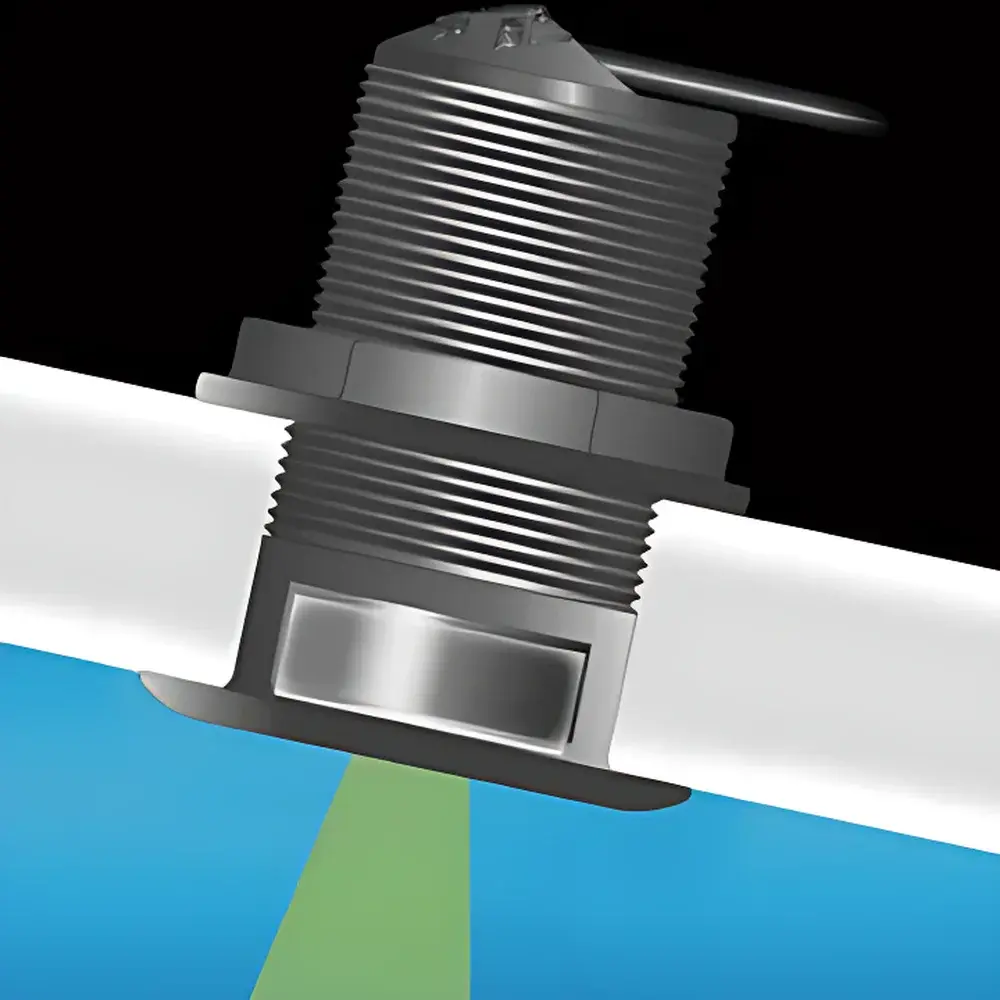
- Three fixed tilt options (0°, 12°, 20°) accommodate hull deadrise angles up to 28°, ensuring vertical beam alignment without external gimbal hardware
- Xducer ID® digital identification protocol—enables automatic transducer recognition, calibration parameter recall, and firmware-aware configuration via compatible chartplotters or multifunction displays
- Low-profile through-hull installation design (98 mm hole diameter, 118 mm stub length) minimizes drag and preserves hull integrity on vessels up to 11 meters LOA
- Optimized for both recreational and professional applications, including compliance with ISO 17025-accredited hydrographic survey workflows when paired with validated acquisition software
Sample Compatibility & Compliance
The SS175M is compatible with fiberglass, aluminum, and stainless steel hulls—provided mounting surfaces meet minimum thickness and structural rigidity requirements per AIRMAR Installation Manual Rev. 4.2. It supports operation in seawater, brackish water, and freshwater environments with salinity ranges from 0–40 ppt. While not certified to IEC 60945 or EN 62288 for Class-approved maritime safety systems, the transducer meets EMC Directive 2014/30/EU and RoHS 2011/65/EU environmental compliance standards. Its analog and digital outputs are interoperable with systems adhering to NMEA 2000 (IEC 61162-3) and NMEA 0183 (IEC 61162-1) protocols. For laboratory-grade validation, raw echo data may be captured using third-party software compliant with IEEE 1451.4 TEDS metadata standards.
Software & Data Management
The SS175M does not include embedded firmware-based data logging; instead, it streams real-time depth, temperature, and confidence metrics (e.g., signal amplitude, noise floor, bottom lock status) via standard NMEA sentences (DPT, MTW, DBT). When integrated with compatible MFDs or PC-based acquisition platforms (e.g., Qinsy, Hypack, or SonarWiz), users can record synchronized multibeam-chirp datasets with timestamped metadata, enabling post-processing for spectral analysis, bottom classification, or GLP-compliant reporting. Xducer ID® metadata includes factory-applied calibration coefficients traceable to NIST-traceable reference standards, supporting audit-ready documentation for QA/QC procedures in regulated aquatic research.
Applications
- Commercial and artisanal fisheries: Discrimination of baitfish layers, gamefish aggregations, and thermocline-associated biomass using amplitude and frequency-dependent backscatter profiling
- Hydrographic survey support: High-resolution bathymetric mapping in coastal zones, fjords, and inland reservoirs where traditional narrowband echosounders exhibit limited vertical resolution
- Environmental monitoring: Long-term water column temperature profiling combined with depth-referenced acoustic backscatter for tracking seasonal stratification dynamics
- Underwater infrastructure inspection: Detection and characterization of pipelines, cables, and wreck sites through enhanced lateral resolution and reduced side-lobe interference
- Academic oceanography: Field deployment on small research vessels (< 12 m) for cross-platform intercomparison studies involving multi-frequency chirp systems
FAQ
What is the maximum operational depth for the SS175M under typical oceanic conditions?
The SS175M achieves reliable bottom detection to 3000 meters in seawater with sound speed profiles ≥ 1500 m/s and ambient noise levels below NL = 65 dB re 1 µPa²/Hz (1–10 kHz). Performance varies with sediment type, water column turbidity, and surface roughness.
Does the SS175M support dual-frequency or split-beam functionality?
No—it is a single-beam, medium-bandwidth chirp transducer. Dual-frequency capability requires separate transducers (e.g., B175L + B175H) or a multi-element array system.
Is the temperature sensor calibrated to NIST-traceable standards?
Yes—the integrated thermistor is factory-calibrated against NIST SRM 1750 reference standards, with calibration certificate provided upon request for ISO/IEC 17025 laboratories.
Can the SS175M be used on planing hulls operating above 35 knots?
Yes, provided the transducer is installed in a properly faired through-hull fitting and the vessel’s hull deadrise angle falls within the selected tilt variant’s compensation range (0°, 12°, or 20°). Cavitation-induced signal loss is mitigated by the polyurethane window’s broadband impedance matching.
How is Xducer ID® data accessed and verified during system commissioning?
Xducer ID® parameters are read automatically over NMEA 2000 by compatible displays (e.g., Garmin GPSMAP, Raymarine Axiom, Furuno TZtouch) and logged in device configuration files; verification requires connection to AIRMAR’s Transducer Configuration Utility v3.1 or later.