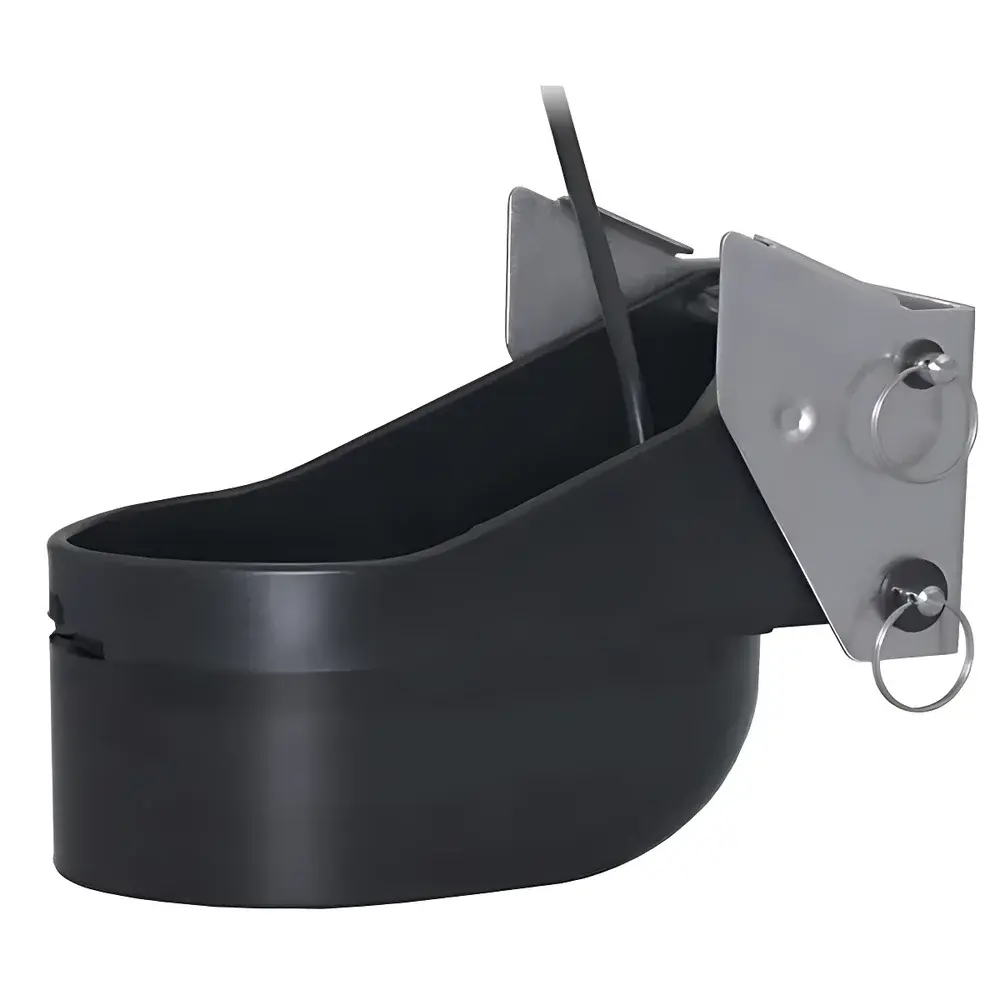
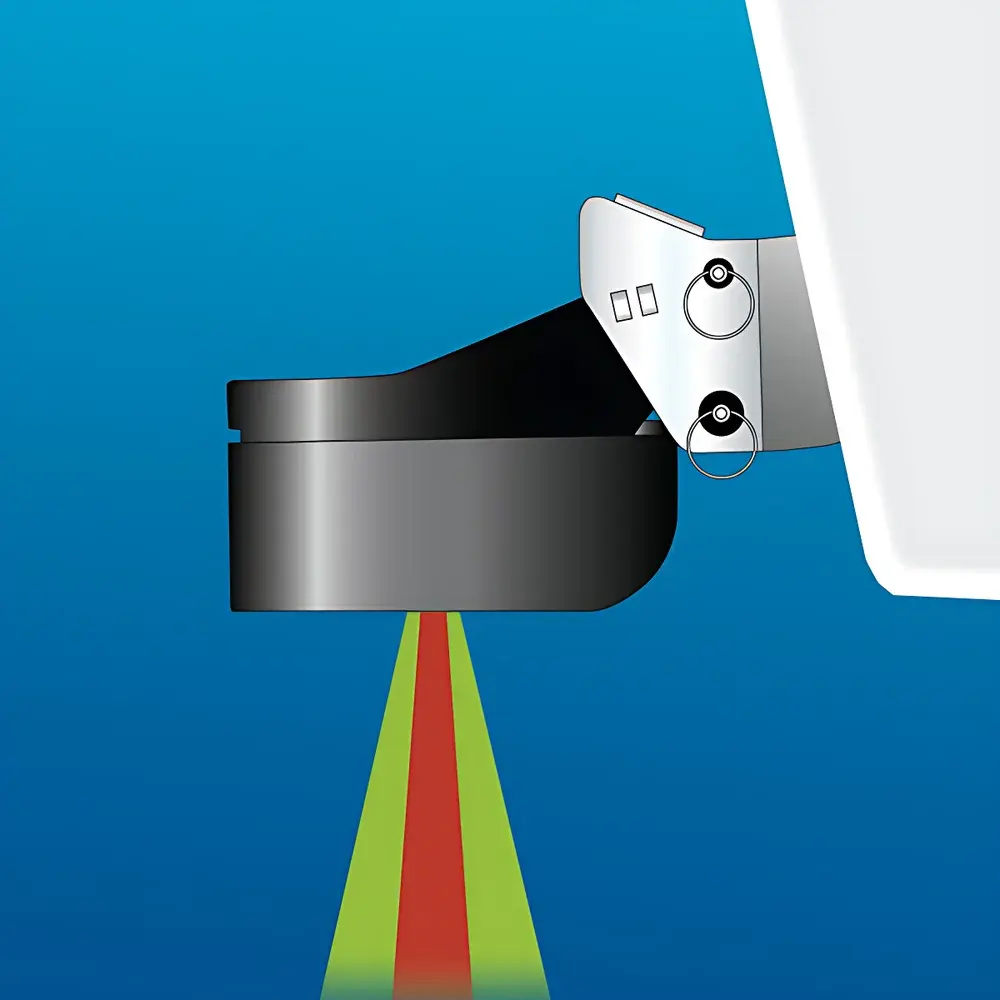
Airmar TM260 Transom-Mount Depth Sounder
| Brand | Airmar |
|---|---|
| Origin | USA |
| Model | TM260 |
| Power Output | 1000 W |
| Operating Frequencies | 50 kHz / 200 kHz |
| Beam Widths | 19° @ 50 kHz, 6° @ 200 kHz |
| Housing Material | Polyurethane |
| Mounting Type | Transom-mount |
| Temperature Sensor Accuracy | ±0.2°C |
| Cable Length | 10 m |
| Weight | 4 kg |
| Maximum Hull Tilt Angle | 28° |
| Transom Angle Range | 3°–21° |
Overview
The Airmar TM260 is a high-performance, transom-mounted broadband echosounder engineered for precision depth measurement and underwater target resolution in marine navigation, commercial fishing, and recreational boating applications. Utilizing dual-frequency pulse-echo acoustic principles—operating simultaneously at 50 kHz (for long-range bottom detection and sediment profiling) and 200 kHz (for high-resolution near-bottom imaging and fish-target discrimination)—the TM260 delivers consistent signal-to-noise ratio and minimal beam distortion across dynamic vessel conditions. Its hydrodynamically optimized polyurethane transducer face minimizes cavitation and flow-induced noise, while the integrated stainless-steel mounting assembly ensures mechanical stability under sustained operation at speeds up to 30 knots. Unlike through-hull or trolling motor variants, the TM260’s transom-mount architecture eliminates hull modification requirements and supports rapid field deployment without compromising acoustic coupling integrity.
Key Features
- Dual-frequency operation (50/200 kHz) with independent beam geometry: 19° conical beam at 50 kHz for wide-area bathymetric coverage; 6° narrow beam at 200 kHz for detailed structural and biological target delineation.
- 1000 W peak acoustic output power compliant with IEC 62237-2 and EN 60945 marine transducer safety standards.
- Integrated digital temperature sensor with ±0.2°C accuracy referenced to NIST-traceable calibration protocols, enabling real-time sound velocity correction for improved depth accuracy.
- XducerID® technology provides plug-and-play compatibility with major chartplotter and fishfinder platforms—including Garmin, Lowrance, and Simrad—by auto-negotiating frequency, power, and data format via NMEA 2000 or analog interface.
- Adjustable transom bracket supporting tilt angles from 3° to 21°, accommodating varying hull deadrise profiles without requiring custom shimming or permanent hardware modification.
- Polyurethane acoustic window with Shore A 90 hardness rating ensures long-term resistance to UV degradation, biofouling adhesion, and mechanical abrasion in saltwater environments.
- Stainless-steel (AISI 316) mounting hardware rated for continuous immersion per ASTM A967 passivation specifications.
Sample Compatibility & Compliance
The TM260 is certified for use on vessels up to 12 meters LOA and meets electromagnetic compatibility (EMC) requirements under EN 301 489-1 V2.2.0 and radio equipment directive (RED) 2014/53/EU. It complies with ISO 8846:2018 for marine electrical systems and carries CE marking for maritime instrumentation. The transducer is compatible with echo sounders rated for 600–1000 W input power and supports both analog (0–10 V, RS-422) and digital (NMEA 2000) output configurations. Its mechanical design conforms to ABYC E-11 and ISO 10133 guidelines for transom-mounted transducers, including maximum allowable hull flex and load distribution thresholds.
Software & Data Management
The TM260 interfaces natively with vendor-specific sonar processing firmware (e.g., Garmin Panoptix LiveScope, Lowrance ActiveTarget, Simrad Halo). Raw echo data is time-stamped and synchronized with GPS position via NMEA 2000 PGN 128259 (Depth, Temperature, and Water Temperature). When used with compatible multi-function displays (MFDs), it supports GLP-compliant audit trails for temperature-corrected depth logging, including operator ID, timestamp, and sensor health diagnostics. Firmware updates are delivered via microSD card or over-the-air (OTA) through supported MFD platforms, ensuring alignment with evolving IHO S-100 hydrographic data model requirements.
Applications
- Commercial and sport fishing operations requiring real-time bottom contour mapping and pelagic target tracking.
- Coastal survey support for shallow-water bathymetry where through-hull installation is impractical.
- Marine research vessel auxiliary depth sensing in tandem with multibeam systems for cross-validation.
- Autonomous surface vehicle (ASV) integration for uncrewed hydrographic data collection in restricted-access zones.
- Regulatory compliance monitoring for dredging depth verification and habitat assessment under EPA Method 1600 and NOAA NOS standards.
FAQ
Is the TM260 suitable for saltwater and freshwater environments?
Yes—the polyurethane housing and passivated stainless-steel hardware are corrosion-resistant and validated for continuous immersion in both saline and freshwater conditions per ASTM B117 salt-spray testing.
Does the TM260 require external power regulation or matching transformers?
No—it features built-in impedance-matching circuitry and operates directly from standard 12/24 VDC marine power buses with integrated transient voltage suppression per ISO 7637-2.
Can the TM260 be used with older analog-only fishfinders?
Yes—its dual-output architecture supports legacy analog echo signals (0–10 V) alongside modern NMEA 2000 digital transmission.
What is the warranty coverage and service lifecycle expectation?
Airmar provides a 2-year limited warranty covering material and workmanship defects; typical service life exceeds 10 years under normal operational duty cycles per MIL-STD-810H environmental stress screening.
How does XducerID® simplify system integration?
XducerID® embeds transducer-specific metadata (frequency, beamwidth, sensitivity, calibration coefficients) into the NMEA 2000 stream, allowing MFDs to auto-configure display parameters and apply appropriate gain compensation without manual setup.