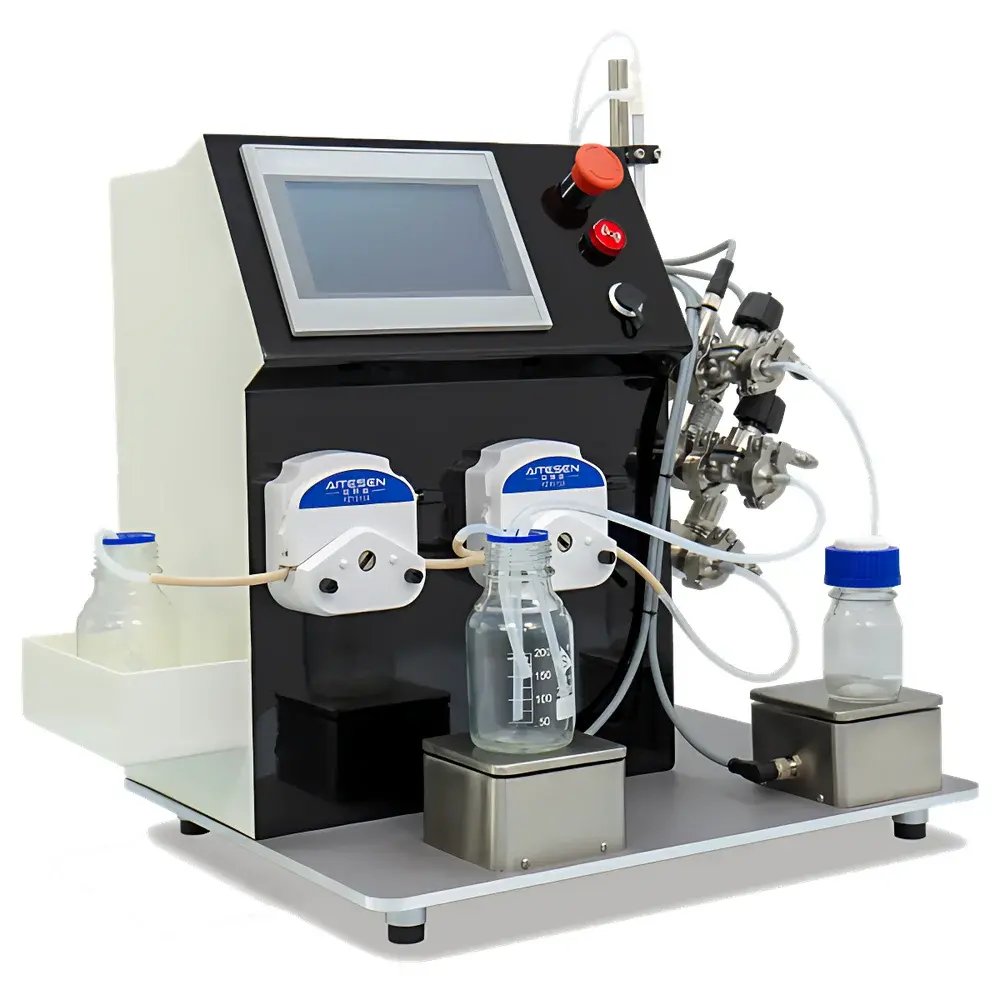
AITESEN LDS-L2 Laboratory-Scale Tangential Flow Filtration (TFF) System
| Brand | AITESEN |
|---|---|
| Origin | Jiangsu, China |
| Manufacturer Type | Authorized Distributor |
| Product Category | Domestic |
| Model | LDS-L2 |
| Quotation | Upon Request |
| Minimum Sample Volume | ≤30 mL |
| Pressure Range | −1 to 5 bar (with integrated pressure sensors) |
| Maximum Recirculation Flow Rate | ≥2200 mL/min |
| Weight Measurement Accuracy | ±0.5% (0–4100 g) |
| Controlled Parameters | Pf (Feed Pressure), Pr (Retentate Pressure), Pp (Permeate Pressure), TMP (Transmembrane Pressure), ΔP (Pressure Drop) |
| Operation Mode | Fully Automated PLC-Controlled TFF |
| Compatible Membranes | PES and Cellulose-based Cassettes & Hollow Fiber Modules (MWCO: 5–1000 kDa |
| Effective Filtration Area | 0.01–0.1 m²) |
| Software Compliance | FDA 21 CFR Part 11–compliant audit trail, role-based access control (Operator / Process Engineer / Administrator) |
Overview
The AITESEN LDS-L2 is a laboratory-scale, fully automated tangential flow filtration (TFF) system engineered for process development and small-batch validation in biopharmaceutical and nanomedicine applications. It operates on the fundamental principle of cross-flow membrane separation: feed solution recirculates parallel to the membrane surface under controlled pressure, minimizing concentration polarization and fouling while enabling continuous permeate generation. Unlike dead-end filtration, this hydrodynamic design sustains high flux stability over extended operation—critical for reproducible buffer exchange, concentration, diafiltration, and purification of sensitive biomolecules and nanoformulations. The system integrates real-time gravimetric monitoring, multi-point pressure sensing, and closed-loop flow control to deliver precise, scalable process data aligned with Quality by Design (QbD) frameworks.
Key Features
- Fully automated PLC-driven operation with unattended execution of multi-step TFF protocols—including concentration, diafiltration, and sequential buffer exchange.
- High-precision load cell (±0.5% accuracy, 0–4100 g range) enables dynamic sample volume tracking without inline flow meters or density assumptions.
- Comprehensive pressure monitoring: Pf, Pr, Pp, TMP, and ΔP are continuously measured and logged—supporting empirical optimization of shear-sensitive formulations such as mRNA-LNPs and liposomal therapeutics.
- Wide operational flexibility: accommodates both cassette-style and hollow fiber modules (0.01–0.1 m² active area; MWCO 5–1000 kDa), compatible with PES and regenerated cellulose membranes.
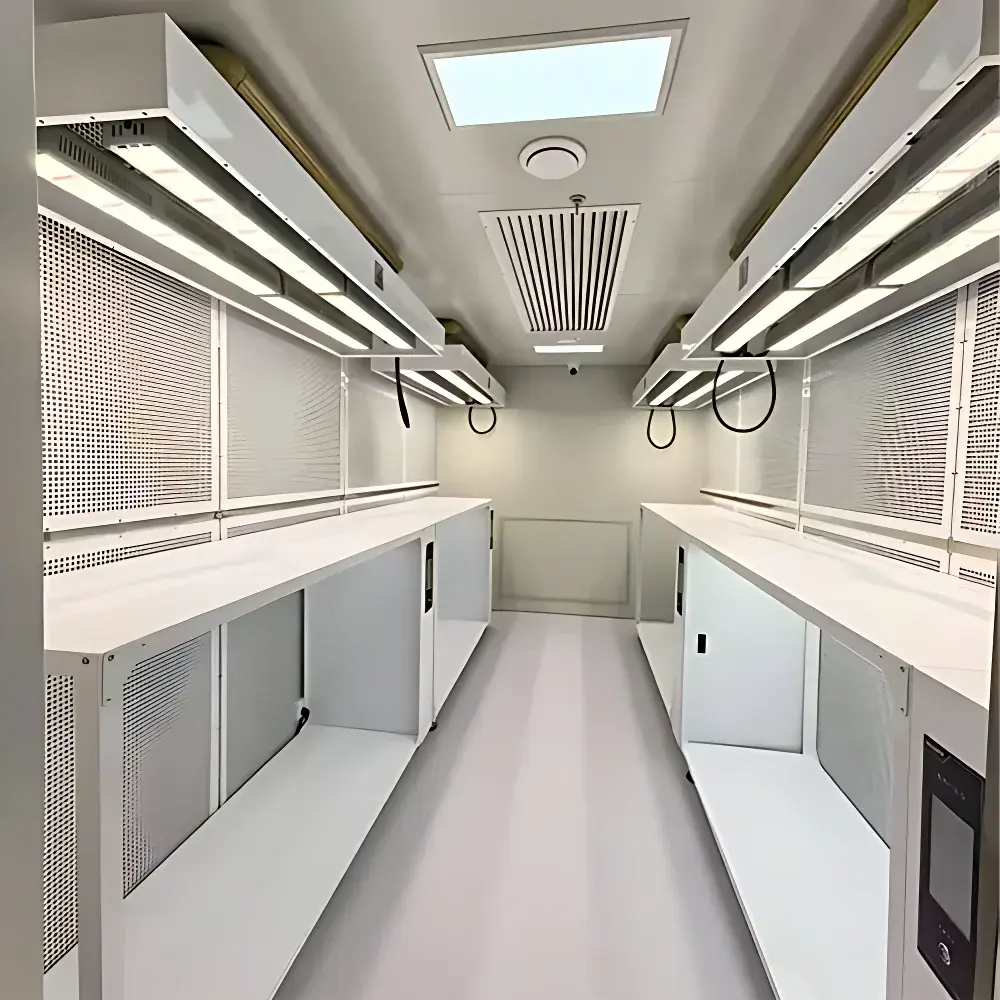
- Robust mechanical architecture with sanitary-grade wetted parts (316L stainless steel, USP Class VI elastomers), designed for cleanroom-compatible installation and routine cleaning-in-place (CIP) procedures.
- Integrated safety logic: automatic shutdown triggered by preset pressure thresholds, permeate backpressure anomalies, or weight deviation beyond user-defined limits.
Sample Compatibility & Compliance
The LDS-L2 supports a broad spectrum of biologics and nanocarriers, including plasmid DNA, monoclonal antibodies, recombinant proteins, siRNA, lipid nanoparticles (LNPs), chemotherapy liposomes (e.g., doxorubicin HCl, irinotecan HCl, daunorubicin), and polymer-based nanoparticles. Its fluid path integrity and material compatibility meet ISO 13485-aligned design principles for medical device-associated process equipment. All software functions—including electronic signatures, audit trail generation, and parameter change history—are compliant with FDA 21 CFR Part 11 requirements for regulated environments. The system supports GLP/GMP-aligned documentation practices through batch record export (PDF/CSV), trend visualization, and time-stamped event logging.
Software & Data Management
The proprietary AITESEN TFF Control Software provides an intuitive, role-based interface built on deterministic PLC firmware. Three-tiered access control (Operator / Process Engineer / Administrator) enforces procedural governance: operators initiate runs and view live trends; process engineers configure multi-stage protocols and alarm thresholds; administrators manage user accounts, audit logs, and system calibration records. Real-time dashboards display dynamic volume, flow direction, component status (pump, valves, sensors), and deviation alerts. All critical process parameters—including elapsed time per step, cumulative permeate volume, TMP profiles, and mass balance—are timestamped and exportable in CSV, Excel, and PDF formats. Batch reports include metadata (user ID, timestamp, version-controlled protocol ID), ensuring full traceability for regulatory submissions.
Applications
- Process development for mRNA-LNP formulation: rapid buffer exchange into cryoprotective or lyophilization-compatible media; removal of free lipids and unencapsulated nucleic acids.
- Liposome purification and concentration: post-extrusion diafiltration to eliminate ethanol residues, detergent, or unreacted phospholipids—critical for sterility assurance and in vivo safety.
- Plasmid DNA polishing: endotoxin reduction via size-selective retention and isotonic diafiltration prior to downstream chromatography.
- Cell culture harvest clarification: integration with centrifugation or depth filtration to recover viable cells or clarify lysates while preserving antigen integrity.
- Scale-down modeling: generation of robust, predictive process maps (e.g., TMP vs. flux, shear rate vs. particle stability) that inform pilot- and manufacturing-scale TFF system selection.
FAQ
What membrane formats are supported by the LDS-L2?
The system accepts standard TFF cassettes (e.g., Pellicon, Vivaflow) and hollow fiber modules with effective filtration areas from 0.01 to 0.1 m² and MWCOs ranging from 5 kDa to 1000 kDa.
Does the LDS-L2 support GMP-compliant data handling?
Yes—software includes FDA 21 CFR Part 11–compliant electronic signatures, immutable audit trails, and role-based permissions for all data entry, modification, and deletion events.
Can the system perform multi-step diafiltration with automatic buffer switching?
While the base configuration supports single-buffer diafiltration, optional solenoid valve manifolds enable automated sequential buffer introduction under programmable logic control.
Is temperature control integrated into the LDS-L2?
The system does not include active heating or cooling; however, it is compatible with external jacketed reservoirs or recirculation chillers via standardized fittings and analog I/O interfaces.
What is the minimum viable sample volume for method development studies?
The LDS-L2 achieves reliable process control down to ≤30 mL total feed volume—ideal for precious preclinical candidates and early-stage formulation screening.