
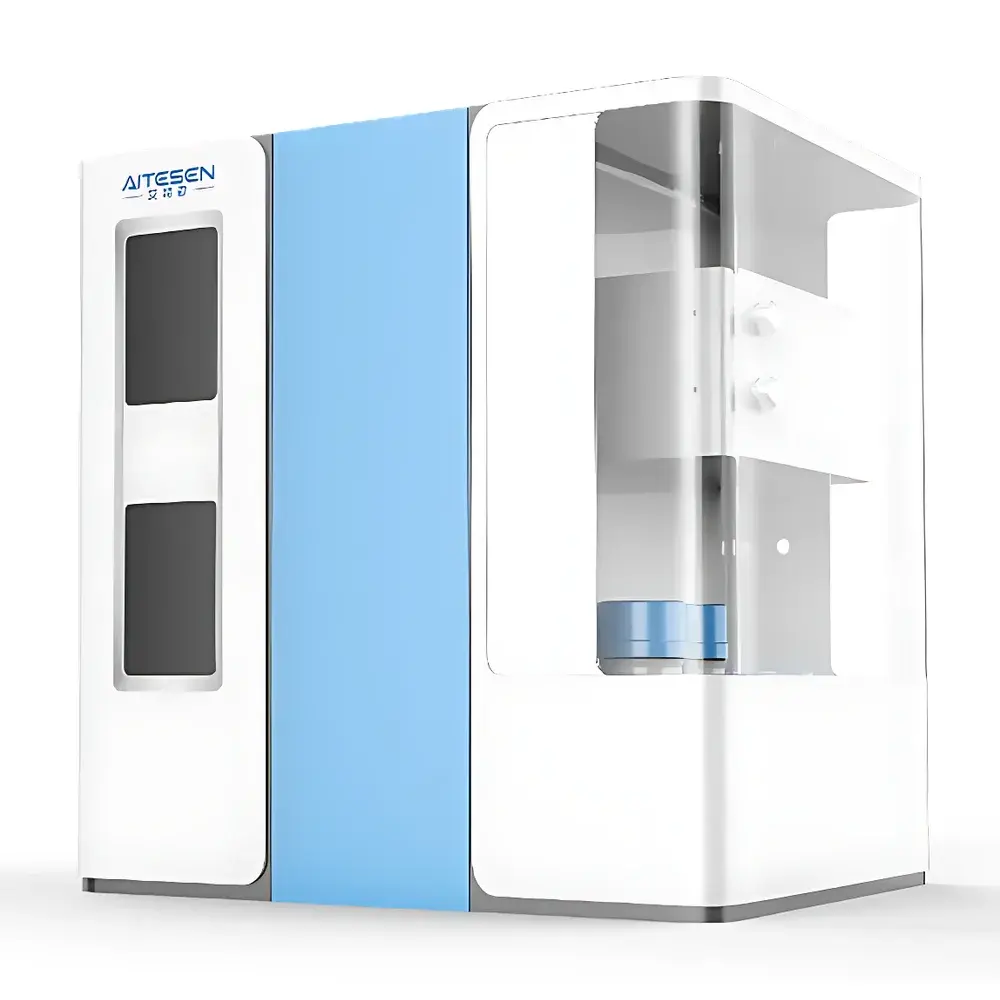
Aitesen MPE-L2/L3 Microfluidic Preparation System for Liposome Emulsification
| Brand | Aitesen |
|---|---|
| Origin | Jiangsu, China |
| Manufacturer Type | Authorized Distributor |
| Product Origin | Domestic (China) |
| Model | MPE-L2 / MPE-L3 |
| Pricing | Upon Request |
Overview
The Aitesen MPE-L2 and MPE-L3 Microfluidic Preparation Systems are engineered for precise, scalable, and reproducible preparation of liposomes, polymeric nanoparticles, and other colloidal drug delivery systems. Based on laminar and controlled turbulent flow principles within microstructured channels, these systems implement continuous-flow hydrodynamic focusing and interfacial shear-driven emulsification—core mechanisms recognized in ISO 13485-aligned nanomedicine process development. Unlike batch-based homogenization or sonication methods, the MPE platform enables real-time control over mixing ratios, residence time, flow rate differentials, and interfacial energy input—critical parameters governing nucleation kinetics, vesicle self-assembly, and final particle size distribution. The MPE-L2 serves primarily in early-stage research and formulation screening, while the MPE-L3 extends into pilot-scale process validation with throughput up to 20 L/h—supporting seamless technology transfer from lab to GMP-compliant manufacturing environments per ICH Q5A and Q5C guidelines.
Key Features
- Modular dual-pump architecture: syringe pump for precise low-volume reagent delivery (MPE-L2) and high-pressure positive displacement pump for scalable emulsification (MPE-L3)
- In-process multi-injection capability: enables sequential addition of stabilizers, active pharmaceutical ingredients (APIs), or co-solvents without system shutdown
- Chip-integrated residence time control: adjustable channel geometry and flow path length allow fine-tuning of incubation duration post-emulsification
- Pressure-regulated shear modulation: programmable backpressure control ensures consistent droplet breakup across varying viscosities and phase ratios
- Material compatibility: fluidic pathways constructed from chemically inert stainless steel, fused silica, or biocompatible polymers (e.g., cyclic olefin copolymer), validated per USP and cytotoxicity testing
Sample Compatibility & Compliance
The MPE systems accommodate aqueous-organic biphasic systems typical in lipid nanoparticle (LNP) synthesis—including ethanol-dissolved lipids mixed with acidic buffer solutions—and support formulations containing PEGylated lipids, ionizable cationic lipids, cholesterol, and DSPC. Chip configurations are customizable for single-emulsion (O/W), double-emulsion (W/O/W), or solvent-switching protocols. All hardware and operational protocols comply with GLP documentation standards; optional audit trail logging and electronic signature modules align with FDA 21 CFR Part 11 requirements when integrated with validated LIMS or MES platforms. Device calibration certificates traceable to NIM (National Institute of Metrology, China) are provided upon installation.
Software & Data Management
The embedded control interface supports synchronized parameter logging at 10 Hz resolution—including flow rates (mL/min), system pressure (bar), temperature (°C), and elapsed time. Export formats include CSV and HDF5 for downstream statistical analysis in MATLAB, Python (Pandas/SciPy), or JMP. Optional integration with PAT-ready analytics (e.g., inline UV-Vis or dynamic light scattering via third-party modules) allows closed-loop feedback control during continuous operation. All configuration files and method templates are version-controlled and exportable for cross-laboratory protocol harmonization—essential for multi-site clinical trial material production under ICH M4Q(R2).
Applications
- Liposome and lipid nanoparticle (LNP) formulation for mRNA vaccine development and siRNA delivery
- Controlled synthesis of polymeric micelles, nanoemulsions, and exosome-mimetic vesicles
- Process characterization studies supporting Quality-by-Design (QbD) frameworks per ICH Q8(R2)
- Scale-down modeling for commercial extrusion or microfluidic manufacturing lines
- Stability assessment through accelerated aging trials using identical process signatures across scales
FAQ
What is the minimum sample volume required for method development on the MPE-L2?
Typical method screening can be performed with ≤2 mL total reagent volume per run, depending on chip geometry and target particle concentration.
Can the MPE-L3 meet regulatory requirements for clinical-grade material production?
While the MPE-L3 itself is not a GMP-certified device, its design basis, material certifications, and data integrity features support qualification as a critical process unit in GMP facilities when installed under appropriate validation protocols (IQ/OQ/PQ).
Is chip cleaning and sterilization validated for repeated use?
Yes—standard cleaning cycles using 70% ethanol, 0.1 M NaOH, or autoclaving (for polymer chips rated to 121°C) are documented and compatible with ISO 14644-1 Class 5 cleanroom handling procedures.
Related Products





