
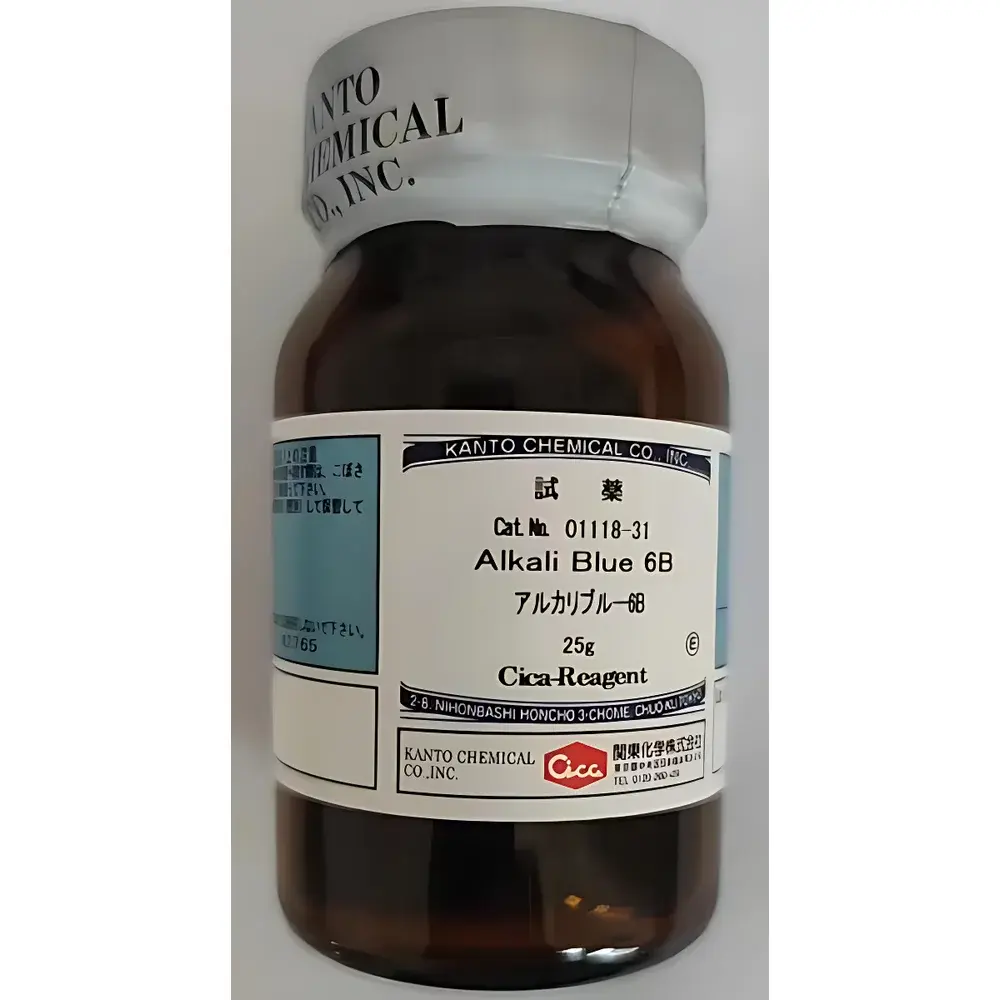
Alkali Blue 6B Indicator (KANTO Chemical, Cat. No. 01118-31)
| Brand | KANTO Chemical |
|---|---|
| Origin | Japan |
| Model | 01118-31 |
| CAS No. | 30586-13-1 |
| pH Transition Range | 9.4 (blue) to 14.0 (red) |
| Purity Grade | Class I (Deer Grade) |
| Loss on Drying (105 °C) | ≤10.0 % |
| Residue on Ignition (as sulfate, after drying) | ≤45.0 % |
| Packaging | 25 g per amber glass bottle |
| Storage | Store sealed in a cool, dry place |
Overview
Alkali Blue 6B Indicator is a high-purity, certified acid-base indicator specifically formulated for standardized titrimetric determination of acidity in light petroleum products. It operates on the principle of reversible protonation–deprotonation within its azo dye molecular structure, resulting in a distinct and reproducible color transition from blue to red across a well-defined alkaline pH range (9.4–14.0). This narrow, high-pH transition window makes it uniquely suitable for non-aqueous potentiometric and visual titrations where interference from weakly acidic or amphoteric matrix components must be minimized. As specified in GB/T 258–2016 — the Chinese national standard equivalent in scope and methodology to ASTM D974 and ISO 6618 — Alkali Blue 6B serves as the primary endpoint indicator in ethanol-extraction titrations using potassium hydroxide in ethanol solution. Its performance directly governs endpoint sharpness, titration reproducibility, and quantitative accuracy in routine quality control laboratories handling gasoline, naphtha, kerosene, diesel, and jet fuel.
Key Features
- Manufactured and quality-controlled by KANTO Chemical Co., Inc. (Japan), a globally recognized supplier of reference-grade analytical reagents and certified standards.
- Complies with GB/T 258–2016 specification requirements for indicator purity, transition sharpness, and spectral stability under standardized test conditions.
- Supplied in Class I (Deer Grade) purity — the highest designation for analytical indicators in Japanese industrial standards (JIS K 8001), ensuring minimal background absorbance and consistent batch-to-batch response.
- Packaged in amber glass bottles (25 g per unit) to prevent photodegradation of the chromophore; bottles feature hermetic sealing and inert headspace to maintain chemical integrity during long-term storage.
- Verified low volatility and thermal stability: loss on drying at 105 °C ≤10.0 %, residue on ignition (as sulfate) ≤45.0 %, confirming minimal inorganic salt contamination and suitability for trace-level acidity assays.
Sample Compatibility & Compliance
Alkali Blue 6B demonstrates optimal solubility and color fidelity in anhydrous ethanol (≥99.5 %), the solvent mandated by GB/T 258–2016 and ASTM D974. It remains stable in the presence of common light hydrocarbon matrices and does not form precipitates or secondary complexes with alkali metal cations under titration conditions. The indicator is compatible with both manual burette-based and automated potentiometric titration systems equipped with non-aqueous pH electrodes. From a regulatory standpoint, its use supports compliance with GLP (Good Laboratory Practice) documentation requirements when integrated into validated test methods. While not a regulated substance under REACH or TSCA in its supplied form, full safety data (SDS) and certificate of analysis (CoA) — including HPLC chromatograms, UV-Vis spectra, and pH transition curve data — are provided with each batch for audit readiness and method validation.
Software & Data Management
As a consumable reagent rather than an instrument, Alkali Blue 6B does not interface with software platforms. However, its integration into digital laboratory workflows is supported through LIMS (Laboratory Information Management Systems) via configurable reagent tracking modules. Each bottle carries a unique lot number traceable to KANTO’s manufacturing records, enabling full chain-of-custody logging, expiry monitoring, and automatic re-order triggers. When used in conjunction with compliant titration software (e.g., METTLER TOLEDO TitraLab®, Hanna Instruments HI902C), endpoint detection algorithms can be calibrated using reference titrations performed with this indicator, ensuring alignment with GB/T 258–2016 procedural constraints. Audit trails generated during such analyses meet FDA 21 CFR Part 11 requirements for electronic records when deployed on validated systems.
Applications
- Routine acidity testing of refinery intermediates and finished fuels per GB/T 258–2016, ASTM D974, and ISO 6618.
- Quality assurance in petrochemical blending facilities where acid number deviations indicate oxidation degradation or catalyst carryover.
- Research applications involving basicity profiling of synthetic lubricants and bio-derived hydrocarbon blends.
- Calibration verification of pH electrodes operating in non-aqueous media (e.g., ethanol–hydrocarbon mixtures).
- Reference material preparation for interlaboratory comparison studies targeting ISO/IEC 17043 proficiency testing schemes.
FAQ
What is the recommended concentration for preparing the Alkali Blue 6B indicator solution?
A 0.1 g/100 mL solution in 95 % (v/v) ethanol is specified in GB/T 258–2016. Solutions should be prepared fresh weekly and protected from ambient light.
Can Alkali Blue 6B be substituted with phenolphthalein or other indicators in GB/T 258 testing?
No. Phenolphthalein (pH 8.2–10.0) lacks sufficient alkaline range overlap and exhibits poor contrast in ethanol–hydrocarbon extracts. Substitution invalidates method compliance and voids accreditation under CNAS or ILAC frameworks.
How long is the shelf life of unopened Alkali Blue 6B indicator?
When stored sealed in original amber glass packaging at ≤25 °C and <60 % RH, the guaranteed shelf life is 36 months from date of manufacture, as confirmed by accelerated stability testing per ICH Q1A(R2).
Is a Certificate of Analysis (CoA) provided with each bottle?
Yes. Each lot includes a KANTO-branded CoA listing assay value, transition pH range verification, residual solvent content, and conformance to JIS K 8001 Deer Grade specifications.
Does this product require special import documentation for customs clearance in the EU or USA?
No. As a non-hazardous, non-controlled organic dye meeting UN GHS Category 5 (low acute toxicity), it ships under standard commercial invoice and packing list without export license or SDS-driven classification delays.





