
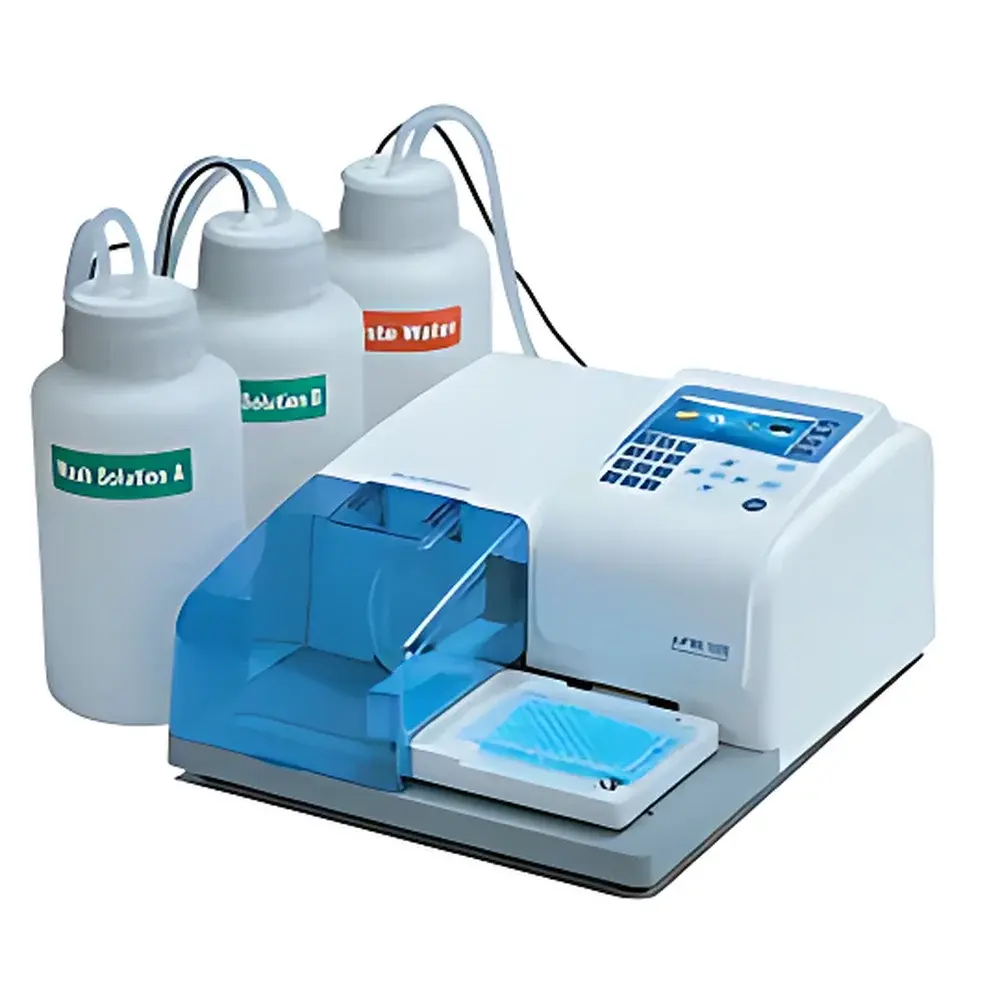
Allsheng APW-200 Automated Microplate Washer
| Brand | Allsheng |
|---|---|
| Origin | Zhejiang, China |
| Model | APW-200 |
| Plate Format | 96-well |
| Residual Volume | ≤1 µL per well |
| Wash Head Options | 8-channel or 12-channel |
| Wash Volume Range | 50–2000 µL (50 µL increments) |
| Wash Cycles | 1–99 |
| Wash Modes | Single-point, dual-point, multi-point |
| Soak & Shake Duration | Up to 99 min 00 sec |
| Number of Wash Solutions | 3 independent channels |
| Fluid Containers | Three 2.5 L wash bottles + one 2.5 L waste bottle |
| Dispense Accuracy | ≤2% @ 300 µL |
| Dispense Precision (CV) | ≤1.5% @ 300 µL |
| Display | 4.3-inch color LCD |
| Onboard Memory | 100 user-programmable protocols |
| Connectivity | USB port for protocol transfer and firmware updates |
| Power Supply | AC 110/240 V, 50/60 Hz |
| Weight | 12 kg |
Overview
The Allsheng APW-200 Automated Microplate Washer is an engineered solution for high-throughput, reproducible washing of 96-well microplates in ELISA, cell-based assays, immunoassays, and other plate-based life science workflows. It operates on a precision fluidic architecture that integrates programmable aspiration/dispense cycles, adjustable soak intervals, and orbital agitation—enabling consistent removal of unbound reagents while minimizing cross-contamination and residual volume. Designed for laboratories requiring reliability across diverse plate geometries—including flat-bottom, U-bottom, V-bottom, and C-bottom configurations—the APW-200 delivers ≤1 µL residual volume per well under standardized operating conditions, directly supporting low-background signal integrity essential for quantitative detection systems such as absorbance, fluorescence, and luminescence microplate readers.
Key Features
- Precision Fluid Management: Dual-calibrated 8-channel or 12-channel wash heads support accurate dispensing (≤2% error at 300 µL) and highly reproducible aspiration (CV ≤1.5% at 300 µL), with volume selection in 50 µL increments from 50 to 2000 µL.
- Multi-Mode Washing Protocols: Configurable single-point, dual-point, and multi-point dispensing strategies optimize reagent coverage and clearance efficiency across varied well bottom profiles and assay chemistries.
- Integrated Soak & Agitation: Programmable soak duration up to 99 minutes and independent orbital shaking enhance binding dissociation and particulate suspension prior to aspiration—critical for high-sensitivity immunoassays and cell detachment protocols.
- Intelligent Fluid Monitoring: Built-in liquid level sensors continuously track wash solution and waste levels; automatic alerts trigger when wash bottles are depleted or the waste reservoir approaches capacity, preventing overflow and pump backflow damage.
- Modular Hardware Design: Quick-swap wash heads, standardized 2.5 L bottle interfaces, and internal filtration within fluid pathways reduce maintenance downtime and extend system longevity.
- Onboard Protocol Management: Stores up to 100 user-defined methods with parameter recall, pause/resume functionality, and USB-based protocol synchronization between instruments or with external PCs.
Sample Compatibility & Compliance
The APW-200 accommodates standard ANSI/SLAS-compliant 96-well microplates regardless of bottom geometry—ensuring compatibility with major vendors’ plates used in clinical diagnostics, biopharmaceutical QC, and academic research. Its sealed fluidic architecture minimizes aerosol generation during aspiration, supporting biosafety Level 2 (BSL-2) laboratory practices. While not certified to ISO 13485 or FDA 21 CFR Part 11 out-of-the-box, the device supports audit-ready operation through timestamped protocol execution logs (stored locally via USB), consistent parameter recall, and hardware-level interlocks that prevent unintended program overrides—facilitating alignment with GLP and GMP documentation requirements when integrated into validated workflows.
Software & Data Management
No proprietary software installation is required. All configuration, method editing, and execution occur via the embedded 4.3-inch color touchscreen interface with intuitive icon-driven navigation. Protocols—including wash volume, cycle count, soak time, agitation speed, and dispense pattern—are saved in non-volatile memory and can be exported/imported using standard FAT32-formatted USB flash drives. Firmware updates are performed offline via the same interface, ensuring operational continuity in regulated environments where network connectivity is restricted. The system maintains a local history log of executed runs (date/time stamp, selected protocol ID, operator ID if entered), enabling traceability without dependency on external LIMS integration.
Applications
- ELISA and multiplex immunoassay plate washing prior to substrate addition
- Cell culture plate washing in high-content screening (HCS) and cytotoxicity assays
- Preparation of plates for AlphaScreen®, HTRF®, and other proximity-based detection platforms
- Removal of unbound antibodies, streptavidin-HRP conjugates, or secondary reagents in diagnostic development
- Routine QC washing in biomanufacturing environments where consistency across shifts and operators is critical
FAQ
What plate formats does the APW-200 support?
The APW-200 is designed exclusively for ANSI/SLAS-standard 96-well microplates with flat, U-, V-, or C-bottom configurations.
Can I use the APW-200 with 384-well plates?
No—this instrument is mechanically and fluidically optimized for 96-well format only; 384-well washing requires dedicated hardware with higher channel density and reduced dead volume.
Is the APW-200 compliant with FDA 21 CFR Part 11?
The device does not include electronic signature capability or role-based access control natively; however, its deterministic protocol execution, USB-based audit trail export, and immutable parameter storage support validation under Part 11 when deployed within a broader compliant infrastructure.
How often should the internal filter be replaced?
Under normal usage (≤20 plates/day), the integrated wash bottle inlet filter requires replacement every 6 months or after 500 wash cycles—whichever occurs first—to maintain dispensing accuracy and prevent clogging.
Does the APW-200 support detergent-based wash buffers?
Yes—provided the detergent concentration remains below 0.5% (v/v) and viscosity stays within aqueous-compatible range (<5 cP); higher concentrations may impair sensor response and increase residual carryover.





