
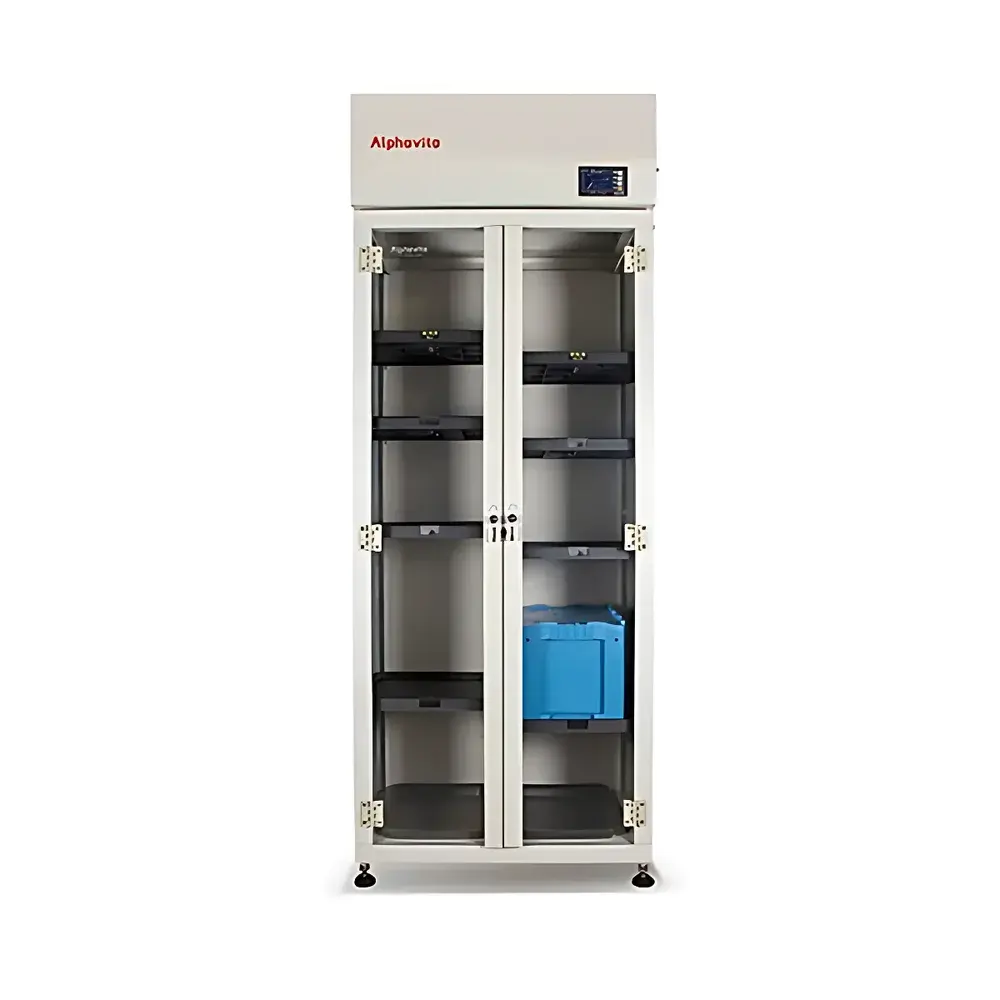
Alphavita MCC-800 Air-Cleaning Chemical Storage Cabinet
| Brand | Alphavita |
|---|---|
| Model | MCC-800 |
| Origin | Liaoning, China |
| Construction | Galvanized steel with epoxy-polyester coating |
| Interior Shelving | Polypropylene (PP) |
| External Dimensions (W×D×H) | 800 × 525 × 1960–2362 mm |
| Internal Dimensions (W×D×H) | ≥796 × 470 × 1752 mm |
| Airflow Rate | 240 m³/h |
| Air Changes per Hour | ≥410 ACH |
| Shelf Load Capacity | ≥180 kg per shelf |
| Filtration Media | Dual standard activated carbon molecular filters (PP housing) |
| Adsorption Capacity | IPA ≥500 g, Cyclohexane ≥750 g, HCl ≥1620 g |
| TVOC Sensor Resolution | 0.1 ppm |
| Display | 3.5-inch LED smart interface |
| Compliance | JG/T 385–2012 |
| Third-Party Liability Insurance | ≥¥5 million RMB |
Overview
The Alphavita MCC-800 Air-Cleaning Chemical Storage Cabinet is an engineered solution for the safe, compliant, and continuous containment of volatile, corrosive, and hazardous chemicals in research laboratories, quality control facilities, and pharmaceutical production environments. Unlike conventional ventilated cabinets that exhaust air externally, the MCC-800 operates as a recirculating, filter-based containment system—drawing ambient air from the laboratory, passing it through modular adsorption media, and returning purified air to the room. Its core principle relies on high-efficiency molecular filtration combined with variable-air-volume (VAV) fan control and real-time environmental monitoring to maintain consistent negative pressure, prevent vapor accumulation, and eliminate cross-contamination risks. Designed in strict adherence to JG/T 385–2012—the Chinese industry standard governing performance, safety, and verification requirements for chemical storage cabinets—the MCC-800 meets defined minimum thresholds for adsorption capacity, air exchange rate, structural integrity, and operational intelligence. It is not intended for flammable liquid storage under NFPA 30 or FM Global standards; rather, it serves as a primary containment unit for low-to-moderate volatility reagents requiring continuous vapor suppression without ducted exhaust infrastructure.
Key Features
- Modular dual-stage filtration system housed in polypropylene (PP) frames, compatible with application-specific media configurations—including acid gas, organic vapor, and particulate-dual cartridges—for broad-spectrum adsorption across >500 documented chemical compounds.
- VAV-integrated centrifugal blower with automatic speed modulation: increases RPM upon door opening to sustain cabinet-level negative pressure (−15 to −25 Pa typical), then returns to energy-optimized baseline during closed operation.
- Integrated 3.5-inch LED smart display showing real-time parameters: internal temperature, fan RPM, filter service-life countdown, door-open status, and dual-point TVOC concentration (outlet and ambient), resolved to 0.1 ppm.
- Structural robustness: 1.2 mm cold-rolled galvanized steel chassis with baked-on epoxy-polyester coating (≥75 µm thickness), corrosion-resistant to pH 2–12 exposure; adjustable leveling feet for floor irregularity compensation.
- PP polymer shelves (≥180 kg load capacity per shelf) with raised 15 mm perimeter lips to contain incidental spills; non-porous, chemically inert, and autoclavable up to 121°C.
- Comprehensive safety interlocks: audible/visual door-open alarm, auto-triggered fan boost, and persistent log recording of all critical events (e.g., filter saturation alerts, temperature excursions, door dwell time >30 s).
Sample Compatibility & Compliance
The MCC-800 is validated for storage of common laboratory reagents including but not limited to alcohols (e.g., isopropanol), hydrocarbons (e.g., cyclohexane), mineral acids (e.g., hydrochloric acid), and halogenated solvents. Its filtration performance is certified per JG/T 385–2012 test protocols using standardized challenge agents—ensuring minimum adsorption capacities of 500 g (IPA), 750 g (cyclohexane), and 1620 g (HCl) per filter module. The cabinet is not rated for Class I flammable liquids per UL 1275 or EN 14470-1; users must consult SDS for compatibility prior to loading. All units are backed by a third-party public liability insurance policy exceeding ¥5 million RMB, issued by a Class-A national insurer. End-of-life spent filters are managed under formal industrial waste disposal agreements with licensed hazardous waste handlers holding valid permits issued by China’s Ministry of Ecology and Environment (MEE)—documentation available upon request.
Software & Data Management
The optional EMonitor cloud-connectivity system enables remote supervision via web browser or mobile application (iOS/Android). Through secure Wi-Fi or 4G LTE connectivity, users access live sensor telemetry, configure alarm thresholds (e.g., TVOC >1.0 ppm, door-open duration >60 s), download audit-ready CSV logs (timestamped, user-ID tagged), and receive push notifications—even when the app is backgrounded. All data transmissions comply with TLS 1.2+ encryption. System firmware supports over-the-air (OTA) updates and maintains local event buffering during network outages. For regulated environments, EMonitor optionally supports 21 CFR Part 11-compliant electronic signatures, role-based access control, and immutable audit trails—facilitating GLP/GMP-aligned documentation workflows without requiring on-premise server infrastructure.
Applications
- Pharmaceutical QC labs storing reference standards, assay reagents, and stability study samples where vapor-mediated degradation must be minimized.
- Academic chemistry departments managing diverse solvent inventories without dedicated fume hood infrastructure.
- Biotechnology facilities housing enzyme inhibitors, crosslinking agents, and small-molecule libraries requiring stable, low-VOC ambient conditions.
- Hospital pharmacy satellite storage for cytotoxic drugs, radiopharmaceutical precursors, and controlled substances under continuous environmental monitoring.
- Environmental testing labs handling VOC calibration standards, pesticide stock solutions, and EPA Method 8260 analytes.
FAQ
Does the MCC-800 require external ductwork or make-up air systems?
No. It is a self-contained, recirculating system designed for installation in standard laboratory spaces without HVAC modifications.
How often must the filters be replaced?
Filter service life depends on chemical load, volatility, and usage frequency; the smart display provides dynamic countdown based on cumulative airflow and TVOC breakthrough trends—typically 6–12 months under moderate use.
Can the cabinet be integrated into a central laboratory monitoring platform?
Yes. EMonitor supports Modbus TCP and RESTful API interfaces for integration with BMS, LIMS, or custom dashboards.
Is the MCC-800 suitable for storing hydrofluoric acid (HF)?
No. HF requires specialized calcium-based or magnesium oxide impregnated media not included in standard configurations; contact technical support for custom filtration validation.
What documentation is provided for regulatory audits?
Each unit ships with JG/T 385–2012 conformance report, third-party insurance certificate, filter adsorption test data, MEE-compliant waste handling agreement, and full electrical safety certification (GB 4793.1).



