
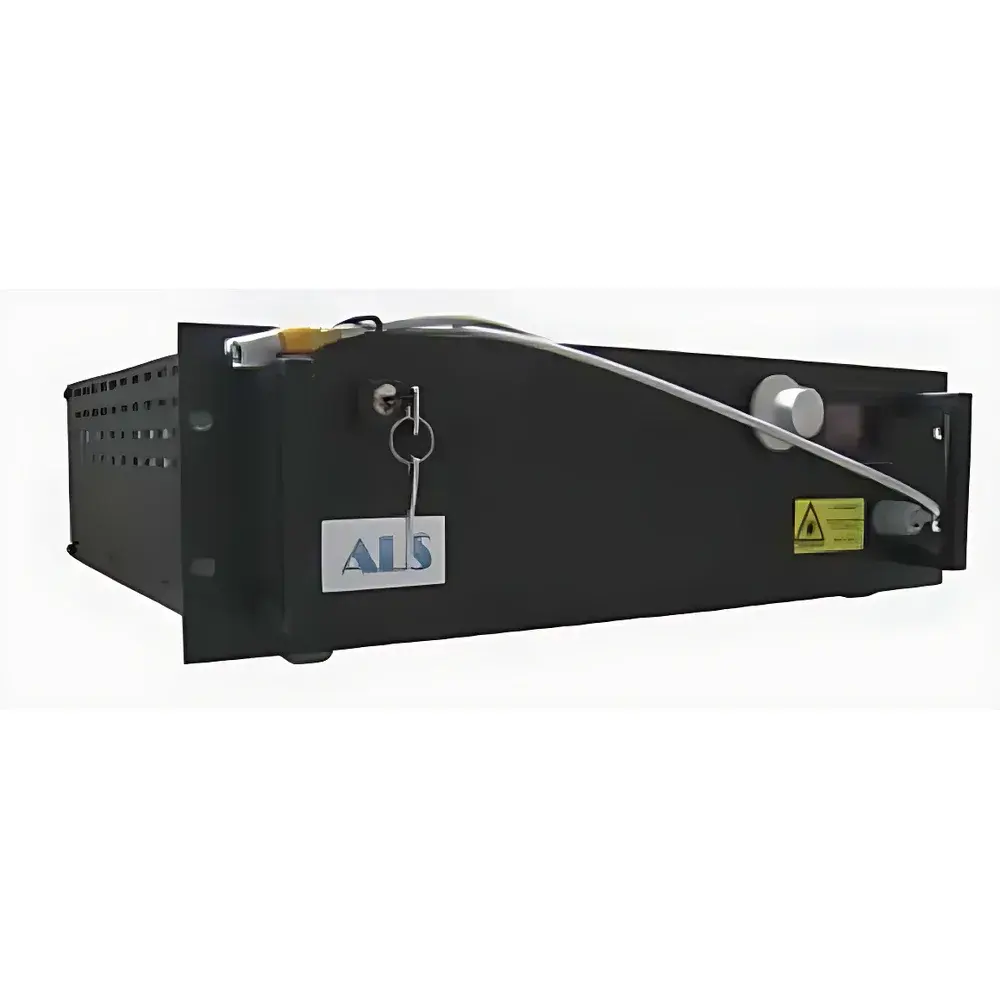
ALS-IR Series High-Power Narrow-Linewidth Fiber Laser System (976 nm / 1030 nm / 1064 nm)
| [Origin | USA |
|---|---|
| Manufacturer Type | Authorized Distributor |
| Origin Category | Imported |
| Model | ALS-IR Series |
| Output Power | Up to 50 W (wavelength-dependent) |
| Linewidth | Down to 50 kHz (single longitudinal mode) |
| Wavelength Drift | < 0.05 pm over several hours |
| Beam Mode | TEM₀₀ |
| Cooling | Conduction-cooled, no external chiller required |
| Maintenance | Maintenance-free, >100,000 h diode lifetime |
| Compliance | RoHS, CE, IEC 60825-1 Class 4 Laser Product] |
Overview
The ALS-IR Series is a fully integrated, high-brightness narrow-linewidth fiber laser platform engineered for demanding scientific and industrial applications requiring precise wavelength control, exceptional spectral purity, and stable high-power continuous-wave (CW) output. Operating at three fundamental Yb3+-fiber emission wavelengths—976 nm, 1030 nm, and 1064 nm—the system leverages optimized double-clad fiber oscillator architecture with intracavity spectral filtering and active thermal stabilization. Each unit delivers diffraction-limited (M² < 1.1) TEM₀₀ output, enabling efficient coupling into single-mode fibers, nonlinear frequency conversion stages, or free-space optical traps. The laser’s core design eliminates mechanical resonators and bulk optics, relying instead on monolithic all-fiber construction with polarization-maintaining (PM) delivery, ensuring long-term pointing stability (< 2 µrad/°C) and power stability (< ±0.5 % RMS over 8 h). Its intrinsic robustness supports integration into vacuum environments, vibration-sensitive interferometric setups, and OEM instrumentation platforms without compromising spectral integrity.
Key Features
- Wavelength-selectable operation at 976 nm, 1030 nm, or 1064 nm—each optimized for specific gain dynamics and thermal management
- Narrow linewidth down to 50 kHz (single longitudinal mode), verified via delayed self-heterodyne interferometry
- Ultra-low relative intensity noise (RIN) < −145 dB/Hz (10 Hz–10 MHz), critical for coherent detection and atom interferometry
- Integrated thermal and current feedback loops ensure sub-picometer wavelength stability over multi-hour operation
- Modular multi-port output configuration (2×, 4×, 8×, or 16× split) with uniform power distribution and phase coherence preservation
- Conduction-cooled laser head with zero liquid coolant requirement—enables compact rack-mount or benchtop deployment
- OEM-ready form factor with TTL/analog modulation inputs, RS-232/Ethernet communication interface, and interlock safety circuitry
Sample Compatibility & Compliance
The ALS-IR Series is compatible with standard SMF-28 or PM980 fiber pigtails (FC/APC or collimated free-space output optional). It meets IEC 60825-1:2014 Class 4 laser safety requirements and carries CE marking for EMC (EN 55011) and low-voltage directive (2014/35/EU). All units undergo factory calibration traceable to NIST standards for output power and center wavelength. The system supports GLP/GMP-aligned operation through optional audit-trail-enabled firmware (21 CFR Part 11 compliant logging available upon request). No hazardous substances are used in construction; full RoHS 3 (2015/863/EU) compliance is certified.
Software & Data Management
Laser parameters—including output power, setpoint temperature, diode current, and real-time wavelength lock status—are accessible via a vendor-provided Windows/Linux-compatible GUI or programmatically through SCPI commands over Ethernet or RS-232. The embedded controller logs timestamped operational data (e.g., thermal sensor readings, pump diode aging metrics) to internal flash memory with configurable retention intervals. For automated test environments, Python and LabVIEW drivers are supplied with source code, supporting synchronization with DAQ systems (e.g., National Instruments PXI) and third-party motion controllers. Firmware updates are performed securely via signed binary packages with SHA-256 verification.
Applications
- Atomic physics: Optical molasses, magneto-optical traps (MOTs), and Bose-Einstein condensate (BEC) preparation using 976 nm (Rb D1 line pumping) or 1064 nm (dipole trap beam)
- Nonlinear optics: Pump source for OPOs, OPAs, and SHG crystals targeting visible-to-mid-IR conversion (e.g., 532 nm, 3.5 µm)
- High-precision metrology: Frequency reference for cavity-stabilized interferometers and gravitational wave detector auxiliary lasers
- Industrial processing: Seed source for MOPA fiber amplifiers in precision micromachining and thin-film ablation
- Spectroscopic sensing: Cavity ring-down spectroscopy (CRDS) and photoacoustic detection where narrow linewidth minimizes Doppler broadening artifacts
FAQ
Is the ALS-IR Series qualified for use in ultra-high vacuum (UHV) environments?
Yes—optional UHV-compatible feedthroughs and outgassing-tested materials (per ASTM E595) are available for direct integration into vacuum chambers.
Can the laser be externally modulated at frequencies above 100 kHz?
The analog modulation input supports bandwidths up to 500 kHz (−3 dB) with linear response; digital TTL modulation is rated for pulse widths ≥ 1 µs.
What is the typical warm-up time to achieve spectral stability?
Full thermal equilibrium and wavelength lock are achieved within 15 minutes of cold start, with residual drift < 0.02 pm thereafter.
Are custom wavelengths between 976 nm and 1064 nm supported?
Standard configurations are fixed at the three specified wavelengths; tunable variants (±5 nm range) are available under NRE agreement with extended lead time.
Does the system include beam collimation optics?
Free-space output versions include an adjustable aspheric collimator (f = 15 mm, M² < 1.05); fiber-coupled models ship with FC/APC connectors and optional bend-insensitive delivery fiber.






