
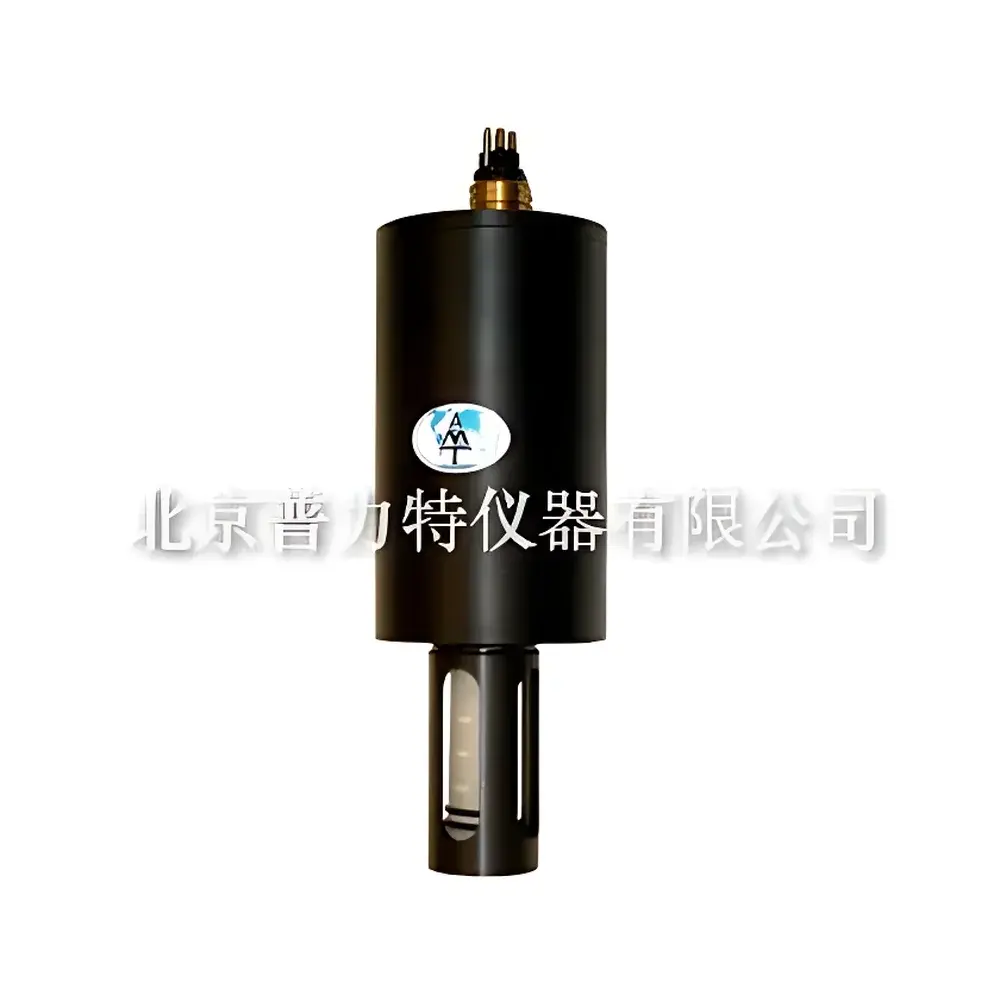
AMT-CO2 Dissolved Carbon Dioxide Optical Sensor
| Origin | Germany |
|---|---|
| Manufacturer Type | Authorized Distributor |
| Origin Category | Imported |
| Model | AMT-CO2 |
| Pricing | Upon Request |
Overview
The AMT-CO2 Dissolved Carbon Dioxide Optical Sensor is a high-precision, membrane-covered optical instrument engineered for continuous, real-time measurement of aqueous carbon dioxide (CO₂) concentration in aquatic environments. Unlike conventional titrimetric or m-value methods—which rely on indirect pH-based calculations and are highly susceptible to interference from bicarbonate (HCO₃⁻), carbonate (CO₃²⁻), phosphate, silicate, and other alkalinity-contributing species—the AMT-CO2 employs non-dispersive infrared (NDIR) spectroscopy to directly quantify dissolved CO₂ partial pressure (pCO₂) in situ. The sensor operates on the principle of gas-permeable silicone membrane equilibration: only CO₂ molecules diffuse across the hydrophobic membrane into an internal optical measurement chamber, where a single-beam, dual-wavelength near-infrared light source interrogates the CO₂ absorption band at 4.26 µm. A reference wavelength compensates for optical drift and fouling effects. Coupled with simultaneous temperature and ambient pressure measurements, the device computes dissolved CO₂ concentration (mg/L) using the thermodynamically validated Henry’s law relationship—ensuring metrological traceability and field-deployable accuracy under dynamic aquaculture conditions.
Key Features
- Direct, interference-free detection of dissolved CO₂—exclusively responsive to CO₂ gas, with no cross-sensitivity to HCO₃⁻, CO₃²⁻, phosphates, or silicates
- Optical NDIR measurement architecture with built-in reference channel for long-term signal stability and drift compensation
- Dual environmental applicability: validated for both liquid-phase (water column) and gas-phase (headspace/air) pCO₂ monitoring
- Robust submersible design rated to 3 m water depth; housing constructed from chemically resistant Nylon 6
- Integrated temperature and barometric pressure sensors enable automatic compensation during CO₂ concentration calculation
- Low power consumption (<2.5 W) and wide input voltage range (11–20 VDC or 18–30 VDC) support integration into battery-powered or industrial SCADA systems
Sample Compatibility & Compliance
The AMT-CO2 sensor is optimized for freshwater and low-salinity recirculating aquaculture systems (RAS), hatcheries, research mesocosms, and limnological monitoring stations. Its silicone membrane ensures stable performance in turbid, organic-rich, or biofouling-prone waters without requiring chemical reagents or frequent recalibration. While not certified to ISO/IEC 17025 for accredited testing, the sensor’s measurement methodology aligns with principles referenced in ASTM D511-20 (Standard Test Methods for Calcium in Water) and ISO 14246:2017 (Water quality — Determination of dissolved carbon dioxide — Electrochemical method), particularly regarding pCO₂-based derivation of free CO₂. Data logging and configuration comply with GLP-aligned practices through timestamped output and configurable analog signal ranges.
Software & Data Management
The sensor delivers analog output signals—selectable as 0–20 mA, 4–20 mA, 0–1 V, 0–2 V, 0–2.5 V, or 0–5 V—enabling seamless integration with programmable logic controllers (PLCs), data loggers (e.g., Campbell Scientific CR1000X), and SCADA platforms. No proprietary software is required for basic operation; however, optional configuration utilities support calibration verification, zero/span adjustment, and diagnostic readouts via RS-485 (modbus RTU) when paired with compatible interface modules. All output signals include inherent temperature and pressure compensation—eliminating the need for external correction algorithms. For audit-trail compliance in regulated facilities, users may implement external data acquisition systems supporting 21 CFR Part 11–compliant electronic records.
Applications
- Real-time CO₂ monitoring in recirculating aquaculture systems (RAS) to prevent hypercapnia-induced stress in finfish and crustaceans
- Process control in aquaponics and marine larviculture tanks where CO₂ accumulation impairs oxygen transfer efficiency
- Field validation of biogeochemical models estimating CO₂ evasion fluxes in lakes and reservoirs
- Calibration reference for spectrophotometric or potentiometric CO₂ estimation methods
- Long-term ecological studies requiring stable, low-maintenance pCO₂ time-series in shallow benthic zones
FAQ
Does the AMT-CO2 sensor measure total inorganic carbon (TIC) or only free dissolved CO₂?
It measures only freely dissolved CO₂ gas—not HCO₃⁻, CO₃²⁻, or TIC—via selective diffusion through its gas-permeable membrane.
Can the sensor be used in seawater or high-salinity brackish water?
It is validated for freshwater and low-salinity applications (<5 ppt); extended use in seawater requires membrane replacement intervals per manufacturer guidelines due to osmotic stress.
What is the recommended calibration frequency under continuous operation?
Factory calibration remains stable for up to 2 years (±5% FS drift); field verification using certified CO₂-spiked standards is advised quarterly in critical RAS deployments.
Is temperature compensation applied automatically during measurement?
Yes—onboard Pt1000-grade temperature sensing enables real-time thermal correction of both pCO₂ and final CO₂ concentration output.
How does barometric pressure variation affect measurement accuracy?
The integrated barometric sensor provides continuous hPa compensation at 0.15% per hPa; no manual atmospheric correction is required.
Related Products







