
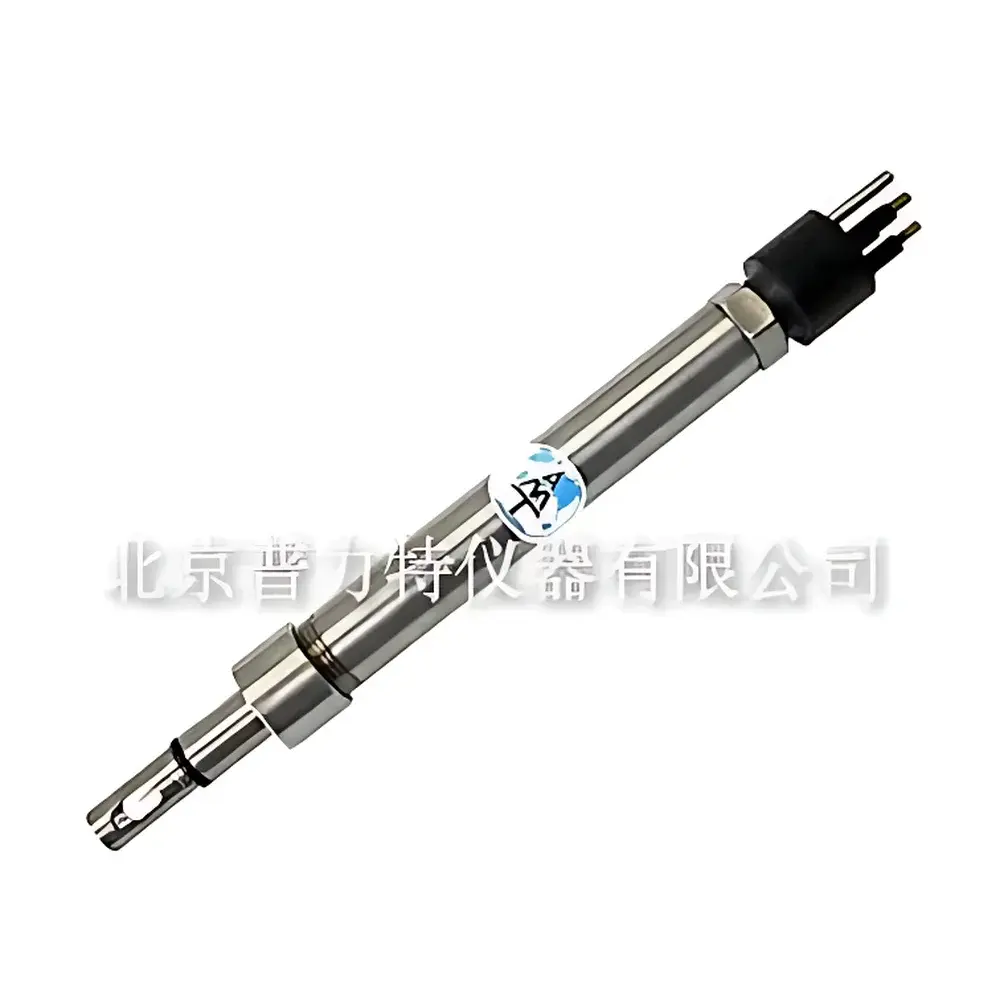
AMT-O3 Electrochemical Dissolved Ozone Sensor
| Origin | Germany |
|---|---|
| Manufacturer Type | Distributor |
| Origin Category | Imported |
| Model | AMT-O3 |
| Pricing | Upon Request |
Overview
The AMT-O3 Electrochemical Dissolved Ozone Sensor is a high-precision, submersible analytical instrument engineered for continuous, real-time measurement of dissolved ozone (O₃) concentration in aqueous environments. Based on the amperometric principle—specifically, the diffusion-controlled electrochemical oxidation of ozone at a working electrode—the sensor delivers stable, trace-level quantification across diverse water matrices. Ozone diffuses selectively through a gas-permeable membrane into an internal electrolyte chamber, where it undergoes a stoichiometric redox reaction generating electroactive species. These species migrate to the sensing electrode surface and are oxidized, producing a current linearly proportional to the partial pressure of dissolved O₃. Integrated temperature sensing enables automatic thermal compensation via embedded firmware algorithms, ensuring accuracy across operational temperature ranges (0–40 °C). Designed for deployment in demanding field conditions—including open ocean, industrial process streams, drinking water distribution systems, and wastewater disinfection basins—the AMT-O3 operates reliably up to 100 m water depth without external pressure housings.
Key Features
- Sub-second response kinetics: t90% ≤ 4.5 seconds, enabling dynamic monitoring of ozone dosing transients and rapid system feedback control
- High specificity to dissolved O₃ with negligible cross-sensitivity to chlorine, chloramines, hydrogen peroxide, or dissolved oxygen under standard operating conditions
- Optical interference immunity: unaffected by turbidity, color, suspended solids, or UV-absorbing organics—eliminating need for sample filtration or pretreatment
- Modular design: replaceable sensing head (membrane cap + electrolyte cartridge) allows field maintenance without full sensor replacement
- Integrated electronics: titanium alloy housing (ASTM B348 Grade 2) houses signal conditioning circuitry, temperature sensor (PT1000), and analog output driver—no external transmitter required
- Wide dynamic range: calibrated for 0.02–10 mg/L O₃, with resolution of 10–25 µg/L per mV output, supporting both low-dose monitoring and high-concentration process validation
Sample Compatibility & Compliance
The AMT-O3 is validated for direct immersion in natural surface waters (rivers, lakes, estuaries), seawater (up to 35 psu salinity), potable water, tertiary-treated effluents, and recirculating cooling loops. It complies with ISO 7888:2019 (water quality — determination of ozone in water — amperometric method) and meets functional requirements outlined in US EPA Method 300.1 (for ozone in drinking water) when used within specified calibration and verification protocols. The sensor’s titanium construction conforms to ASTM F136 for biomedical-grade titanium alloys, ensuring long-term corrosion resistance in chloride-rich environments. Its 100 m depth rating satisfies IEC 60529 IP68 and EN 61000-6-2 EMC standards for underwater instrumentation.
Software & Data Management
The sensor outputs a linear 0–3 V DC analog signal (scalable to 4–20 mA upon request), compatible with industry-standard PLCs (e.g., Siemens S7, Rockwell ControlLogix), SCADA systems, and data loggers (e.g., Campbell Scientific CR1000X, HOBO U12). Optional digital interface modules support Modbus RTU over RS-485 for integration into centralized environmental monitoring platforms. Calibration coefficients—including slope, zero offset, and temperature compensation polynomial—are stored internally and accessible via serial command protocol. Audit trails for calibration events, sensor diagnostics, and firmware version history align with GLP/GMP documentation requirements per FDA 21 CFR Part 11 when paired with compliant data acquisition software.
Applications
- Real-time monitoring of ozone contact chambers in municipal drinking water treatment plants
- In-line verification of ozone dose in pharmaceutical-grade purified water (PW) and water-for-injection (WFI) systems
- Marine aquaculture: dissolved O₃ control in recirculating aquaculture systems (RAS) to suppress pathogens without residual toxicity
- Food processing: validation of ozone sanitization efficacy on CIP rinse water and produce wash lines
- Environmental research: high-frequency profiling of ozone dynamics in coastal hypoxic zones and ozonation pilot studies
- Industrial cooling water management: detection of residual ozone to prevent biofilm formation while minimizing oxidative corrosion risk
FAQ
What is the recommended calibration frequency for the AMT-O3 sensor?
Calibration is advised prior to initial deployment, after membrane/electrolyte replacement, and at intervals not exceeding 30 days for critical applications—or weekly under high-ozone or high-fouling conditions. A two-point calibration (zero in deionized water + span in certified ozone standard) is required.
Can the sensor be used in seawater without performance degradation?
Yes. The titanium housing and optimized membrane chemistry provide stable operation in full-strength seawater (35 psu); however, periodic visual inspection of the membrane surface for biofouling is recommended every 7–14 days in warm, nutrient-rich marine environments.
Is temperature compensation applied automatically?
Yes. An integrated PT1000 sensor continuously measures sample temperature; compensation is performed in real time using a third-order polynomial algorithm stored in non-volatile memory.
What maintenance is required beyond membrane and electrolyte replacement?
No routine mechanical or optical maintenance is needed. Users should verify electrical connections annually and confirm output linearity against a reference standard during scheduled QA/QC audits.
Does the sensor meet regulatory requirements for pharmaceutical water systems?
While the AMT-O3 itself is not certified as GMP-compliant hardware, its metrological performance, traceable calibration, and audit-ready output protocols support compliance with EU Annex 1, USP , and ISPE Water and Steam Baseline Guides when deployed within a validated monitoring system architecture.







