
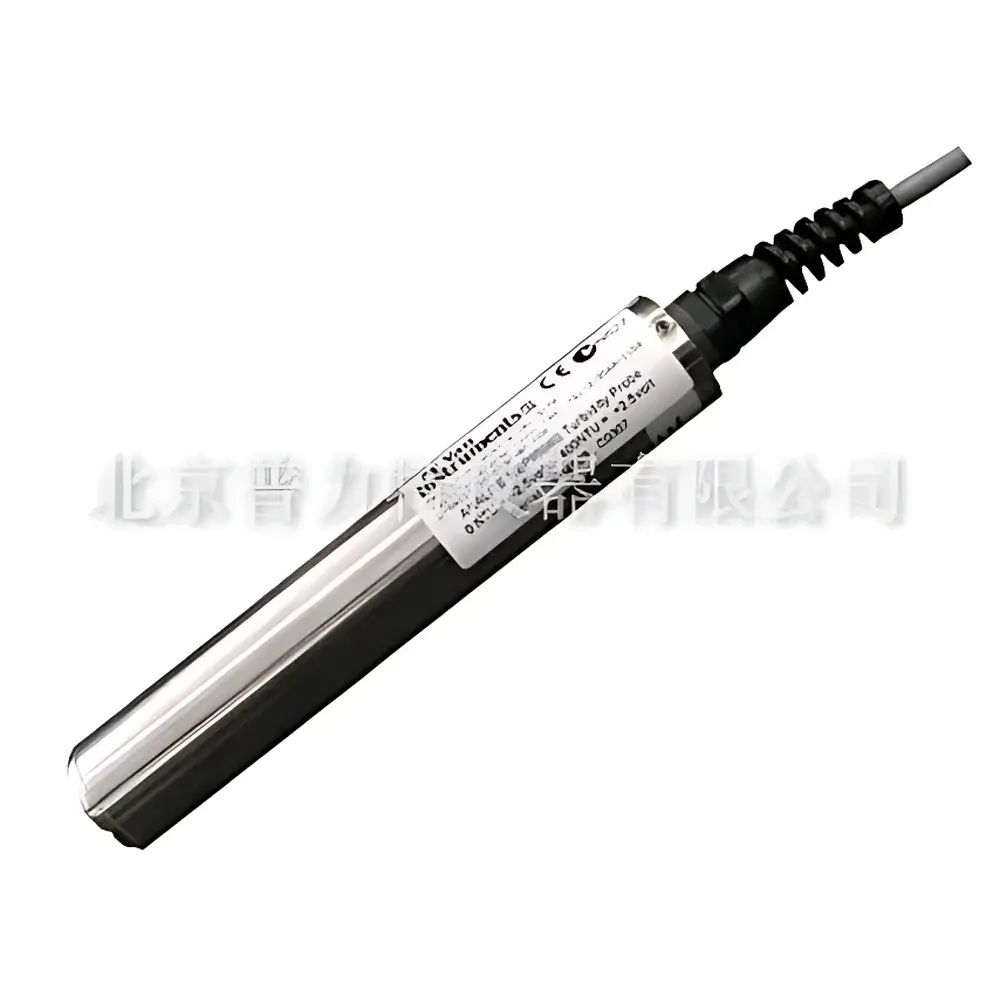
ANALITE NEP180 In-Line Turbidity Sensor
| Origin | Australia |
|---|---|
| Manufacturer Type | Authorized Distributor |
| Origin Category | Imported |
| Model | NEP180 |
| Price Range | USD 2,700 – 6,800 (FOB) |
| Product Type | In-Line Sensor |
| Measurement Range | 0–30,000 NTU |
| Resolution | 10 NTU |
| Operating Temperature | −10 °C (non-frozen) to 40 °C |
| Accuracy | ±2% |
Overview
The ANALITE NEP180 is a high-performance, submersible in-line turbidity sensor engineered for continuous, real-time monitoring of suspended particulate matter in liquid media. It operates on the principle of modulated infrared (IR) backscatter photometry—a robust optical technique that minimizes interference from ambient light, algae fluorescence, and surface reflections. Unlike conventional nephelometric sensors relying on 90° scattering geometry, the NEP180 employs an optimized inverse backscatter configuration with wavelength-stable IR LEDs (850 nm), enabling stable signal acquisition across highly variable matrices—from clear potable water to dense slurry effluents exceeding 30,000 NTU. Its design adheres to ISO 7027-1:2016 principles for turbidity measurement while extending functionality to solid suspension quantification (up to 100 g/L SS), making it suitable for both regulatory compliance and process-critical applications in water infrastructure and industrial hydrosystems.
Key Features
- Modulated IR backscatter optics with automatic ambient light rejection—eliminates diurnal drift and solar loading artifacts
- Dual-range capability: factory-configured for 0–10,000 NTU (standard) or custom-calibrated for extended range up to 30,000 NTU or 100 g/L suspended solids
- Submersible housing options: marine-grade 316 stainless steel (rated to 100 m depth) or chemically resistant PVC (30 m depth; recommended for high-chloride or low-pH environments)
- High-stability analog output: default ±2.5 V differential; optional 0–2.5 V, 0–1 V, or 4–20 mA current loop configurations for PLC/SCADA integration
- Temperature-compensated electronics with <−0.3 %/°C drift coefficient and zero-point stability <±3 mV across full operating range (−10 to 40 °C)
- Low-power operation: 9.6–28 VDC, 15 mA typical; compatible with solar-powered telemetry nodes and battery-backed remote stations
- Pre-calibrated traceably to NIST-traceable AEPA polymer standards (NTU) and ISO 1042:1998 SiO₂ suspensions (mg/L)
Sample Compatibility & Compliance
The NEP180 demonstrates broad compatibility across natural and engineered aqueous systems—including freshwater streams, stratified reservoirs, activated sludge basins, anaerobic digesters, dredge spoils, and desalination pre-filtration stages. Its optical path is insensitive to color interference and exhibits minimal fouling susceptibility due to smooth, non-stick sensor window geometry and optional ultrasonic cleaning interface (available upon request). The device complies with key international standards including ISO 7027-1:2016 (turbidity), ASTM D6412-20 (suspended solids estimation), and EN 27027 (water quality—turbidity determination). For regulated environments, its analog output architecture supports integration into systems compliant with FDA 21 CFR Part 11 when paired with validated data loggers featuring electronic audit trails and user access controls.
Software & Data Management
While the NEP180 is a standalone analog transducer, it is fully interoperable with industry-standard SCADA platforms (e.g., Ignition, Siemens Desigo, Schneider EcoStruxure), programmable logic controllers (PLCs), and cloud-based telemetry gateways (e.g., Campbell Scientific CR1000X, Teledyne ISCO 6712). Calibration coefficients and temperature compensation parameters are stored internally and accessible via optional RS-485 Modbus RTU interface (add-on module). Raw voltage outputs map linearly to turbidity values per calibration certificate; linearity deviation remains <3% over 0–10,000 NTU and <5% over extended ranges. All calibration documentation—including uncertainty budgets, reference standard traceability, and temperature sensitivity curves—is provided digitally in PDF format compliant with GLP documentation requirements.
Applications
- Real-time turbidity profiling in riverine and estuarine hydrodynamic studies
- Reservoir thermal and sediment stratification monitoring (multi-depth profiling arrays)
- Primary clarifier, secondary treatment, and final effluent compliance verification in municipal WWTPs
- Drinking water filtration plant performance evaluation (e.g., rapid sand filter breakthrough detection)
- Sediment transport and erosion modeling in watershed-scale hydrological research
- Sludge blanket level tracking and digester feed consistency control
- Dredging operations and spoil disposal monitoring under environmental consent conditions
- Industrial process water recycling loops—e.g., pulp & paper, mining tailings, food processing
FAQ
What optical principle does the NEP180 use, and why is it preferred for high-turbidity applications?
It utilizes modulated infrared backscatter photometry, which provides superior signal-to-noise ratio in optically dense media compared to forward-scatter or 90° nephelometry—especially above 5,000 NTU.
Can the NEP180 measure suspended solids (SS) directly, and how is calibration validated?
Yes—via dual-scale factory calibration against ISO 1042 SiO₂ suspensions; correlation to gravimetric SS is established per site-specific matrix validation per ASTM D5907.
Is the sensor suitable for seawater or acidic mine drainage?
Stainless steel housings are not recommended for prolonged exposure to chloride-rich or pH <5.5 environments; PVC-housed variants are supplied for such conditions.
What is the maximum cable length supported without signal degradation?
Standard PUR-jacketed 5-conductor cable supports lengths up to 99 meters; voltage drop and noise immunity remain within specification when powered at ≥24 VDC.
Does the NEP180 require periodic recalibration in the field?
No routine recalibration is required; however, annual verification against traceable standards is recommended for ISO/IEC 17025-compliant laboratories.




