
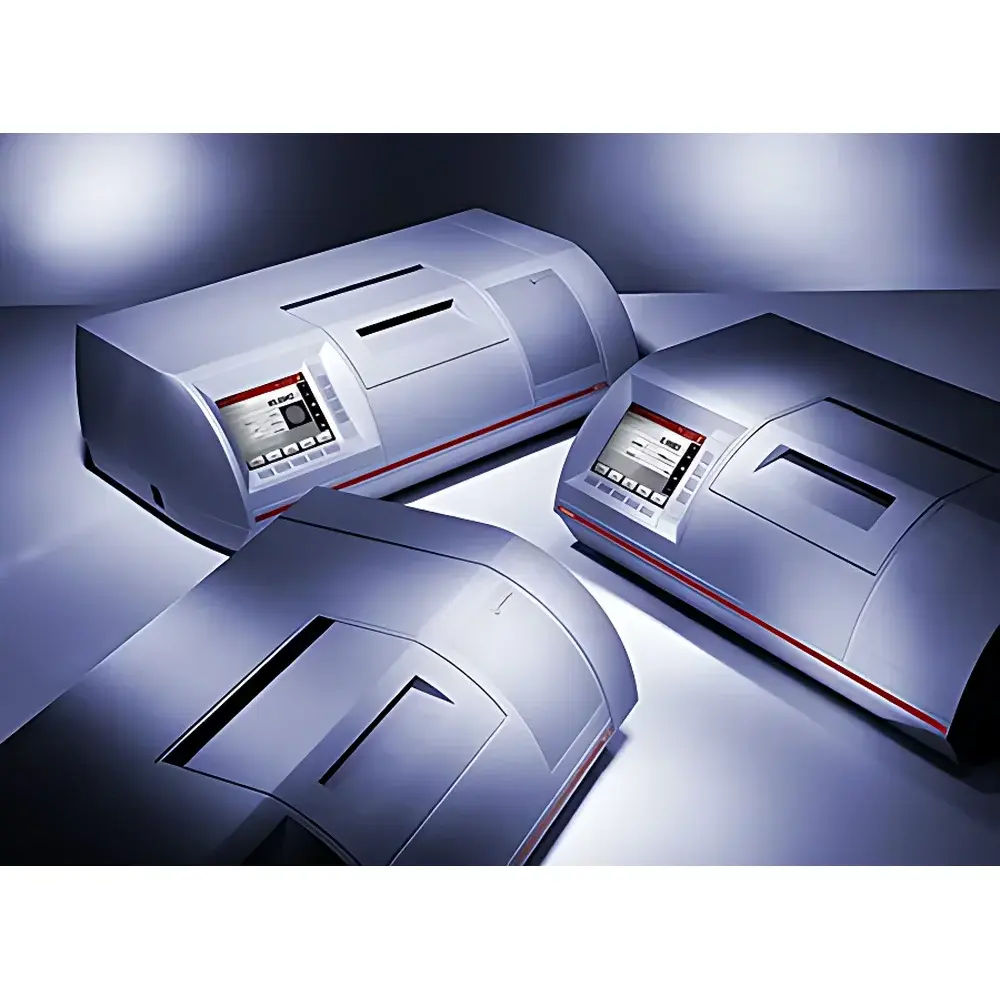
Anton Paar MCP 200/300/500 High-Precision Automated Polarimeter
| Brand | Anton Paar |
|---|---|
| Origin | Austria |
| Model | MCP 200/300/500 |
| Product Type | Automated Polarimeter |
| Temperature Control | Peltier-based, programmable (±0.1 °C stability) |
| Display | High-resolution color touchscreen |
| Light Source | Stable, narrow-band LED (589.44 nm nominal, optionally up to 8 wavelengths from UV to NIR) |
| Compliance | Fully compliant with USP <781>, EP 2.2.7, JP 2.06, ASTM E1255, OIML R 130, and FDA 21 CFR Part 11 (audit trail, electronic signatures, role-based access control) |
| Data Integrity | GLP/GMP-ready with tamper-proof audit trail, password-protected user levels (Operator, Supervisor, Administrator), and QM-certified firmware |
Overview
The Anton Paar MCP 200/300/500 is a high-precision, fully automated polarimeter engineered for quantitative measurement of optical rotation — a fundamental physical property of chiral compounds in solution. Based on the principle of plane-polarized light deflection through optically active media, the instrument determines specific rotation [α] in degrees per decimeter per gram per milliliter (°·dm⁻¹·g⁻¹·mL), enabling rigorous characterization of enantiomeric purity, concentration, and molecular conformation. Designed for regulatory-critical environments, it employs a temperature-stabilized optical path, drift-compensated LED illumination at sodium-D line equivalent (589.44 nm), and real-time angular feedback via high-resolution rotary encoder. Its modular architecture supports seamless integration into laboratory information management systems (LIMS) and quality management workflows across pharmaceutical, fine chemical, food & beverage, and academic research settings.
Key Features
- Toolmaster™ RFID Recognition: Automatic detection and calibration validation of measurement cells (e.g., 100 mm, 200 mm quartz tubes) and reference standards without manual entry — eliminating configuration errors and ensuring traceability.
- Peltier-Controlled Thermal Management: Integrated thermoelectric module maintains sample temperature within ±0.1 °C across a range of 10–40 °C; programmable ramping and hold profiles support kinetic studies and temperature-dependent chirality analysis.
- FillingCheck™ Visual Verification (MCP 300/500 standard; MCP 200 optional): Built-in CMOS camera captures real-time images during cell filling, verifying absence of bubbles, meniscus position, and optical path clarity — critical for GxP-compliant documentation.
- Multi-Wavelength Capability (Optional): Up to eight discrete wavelengths (250–1600 nm) can be selected via motorized filter wheel, enabling wavelength-resolved optical rotation dispersion (ORD) and supporting structural elucidation of complex biomolecules.
- Self-Cleaning Air Pump System (MCP 500 standard; MCP 200/300 optional): Automated purging cycle evacuates residual sample from the cell and dries the optical path using filtered ambient air — reducing cross-contamination and maintenance intervals.
- LED Light Source with >100,000 h Lifetime: Eliminates mercury-vapor lamp replacement, ensures spectral stability over time, and enables rapid warm-up (<1 s), enhancing throughput and long-term measurement reproducibility.
Sample Compatibility & Compliance
The MCP series accommodates standard quartz cells (100 mm, 200 mm, custom lengths) and microcells (e.g., 10 mm pathlength for high-concentration or precious samples). It supports aqueous, organic, and viscous solutions — including syrups, essential oils, and polymer melts — when paired with appropriate temperature and flow accessories. All firmware and software modules are validated per ICH Q2(R2) and aligned with ISO/IEC 17025 requirements for testing laboratories. Full compliance with pharmacopoeial monographs (USP , Ph. Eur. 2.2.7, JP 2.06) is ensured via built-in method templates, automatic unit conversion (° → [α]), and uncertainty calculation per GUM (Guide to the Expression of Uncertainty in Measurement). The system meets OIML R 130 metrological class A specifications for accuracy (±0.002° repeatability) and is certified for use in FDA-audited facilities under 21 CFR Part 11.
Software & Data Management
Operating on the SOP-driven OneClick™ software platform, the MCP instruments deliver intuitive workflow navigation, customizable method creation, and electronic signature support. All measurements are timestamped, logged with full contextual metadata (operator ID, cell ID, temperature, wavelength, calibration status), and stored in an encrypted SQLite database. Audit trails record every action — including parameter edits, result overrides, and user logins — with immutable hashing to prevent post-hoc alteration. Data export options include PDF reports (with digital signature), CSV, XML, and direct LIMS transmission via OPC UA or RESTful API. Firmware updates are digitally signed and validated prior to installation, maintaining integrity throughout the device lifecycle.
Applications
- Pharmaceutical QC: Enantiomeric excess (ee) determination of APIs per ICH Q5A and Q6A; batch release testing of chiral drugs (e.g., ibuprofen, levodopa, escitalopram).
- Food & Beverage: Sucrose concentration in syrups and juices (Brix correction), honey adulteration screening, and authenticity verification of essential oils (e.g., limonene, menthol).
- Chemical R&D: Reaction monitoring of asymmetric synthesis, catalyst optimization, and stereochemical assignment of novel chiral ligands.
- Academic Research: ORD and CD (circular dichroism) correlation studies, protein folding analysis, and polysaccharide conformational behavior in solution.
- Cosmetics & Fragrances: Quantification of natural vs. synthetic terpenes, quality control of chiral fragrance ingredients (e.g., linalool, citronellol).
FAQ
What is the measurement uncertainty of the MCP 200/300/500 under standard conditions?
The instrument achieves a repeatability of ±0.002° (k = 1) at 20 °C using a 100 mm quartz cell and sucrose standard; expanded uncertainty (k = 2) is ≤ ±0.005° when calibrated per ISO 17025-accredited procedures.
Can the MCP series be integrated into a networked lab environment with centralized data archiving?
Yes — all models support Ethernet connectivity, TLS-encrypted communication, and interoperability with major LIMS and ELN platforms via configurable export protocols and optional 21 CFR Part 11 server modules.
Is validation documentation available for GMP-regulated installations?
Anton Paar provides IQ/OQ/PQ protocol templates, risk assessments (per ISO 14971), and vendor-supplied test certificates traceable to NIST and PTB standards — all included in the QM Package.
How does FillingCheck™ contribute to data integrity in regulated workflows?
It generates time-stamped image records linked directly to measurement results, fulfilling ALCOA+ principles (Attributable, Legible, Contemporaneous, Original, Accurate) and providing objective evidence of proper cell handling during audit inspections.
Does the MCP support non-sodium-line measurements for specialized research applications?
Yes — the optional multi-wavelength module enables precise optical rotation measurements at user-defined wavelengths between 250 nm and 1600 nm, facilitating advanced studies in chiroptical spectroscopy and material science.




