
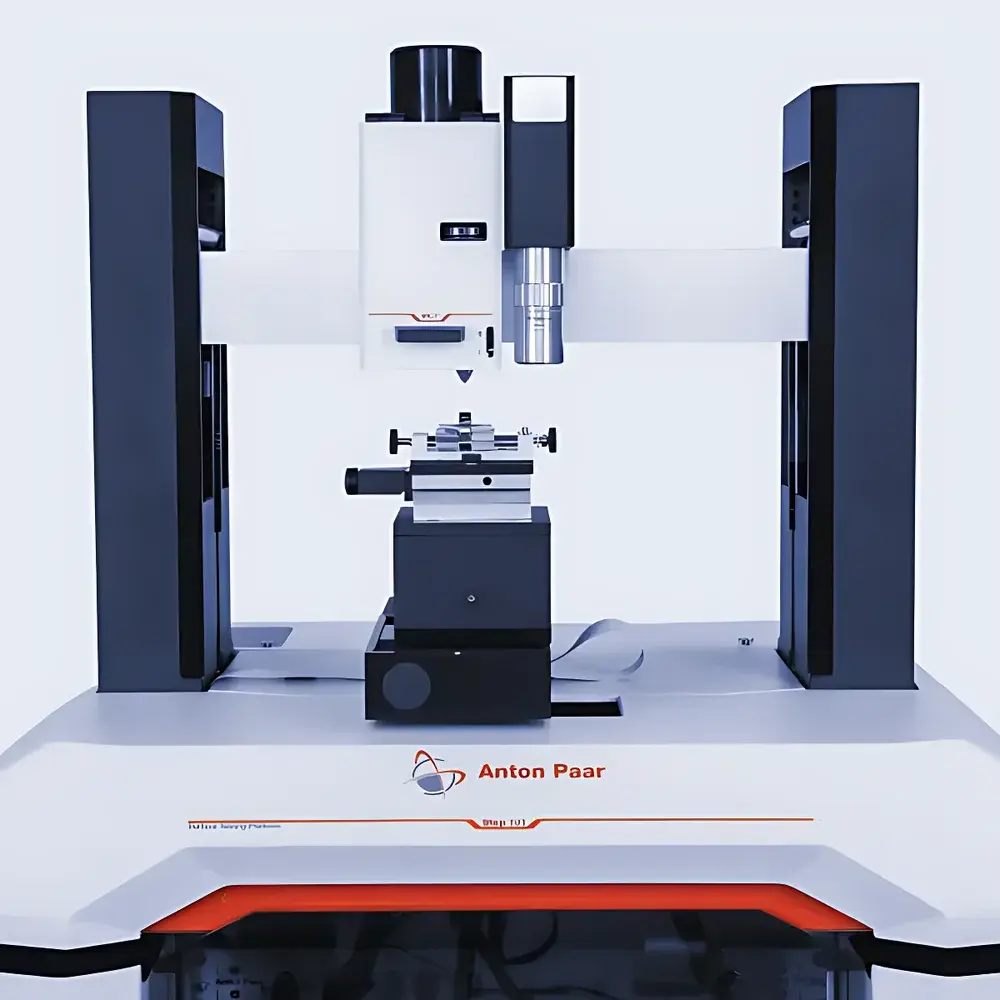

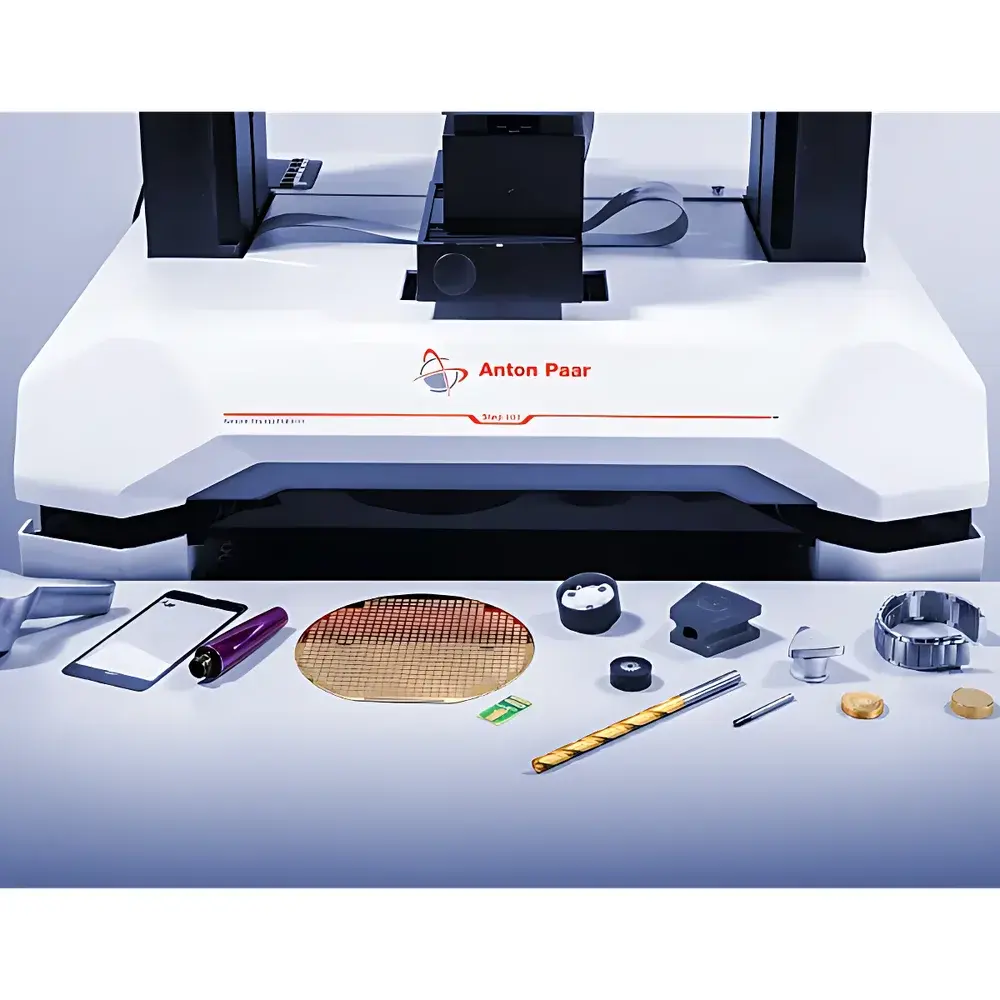
Anton Paar MCT³ Micro Combi Tester – Scratch and Nanoindentation Instrument
| Brand | Anton Paar |
|---|---|
| Origin | Switzerland |
| Manufacturer Type | Original Equipment Manufacturer (OEM) |
| Category | Imported Instrument |
| Model | MCT³ |
| Instrument Type | Micro/Nano Scratch and Indentation Tester |
| Maximum Indentation Depth | 1000 µm |
| Effective Load Range | 30 N |
| Load Resolution | 6 µN |
| Displacement Resolution | 0.05 nm |
| Load Noise (RMS) | 100 µN |
| Depth Noise (RMS) | 1.5 nm |
| Data Acquisition Rate | 192 kHz |
| Scratch Speed Range | 0.1–600 mm/min |
| Depth Measurement Range | 1000 µm |
| Depth Resolution | 0.03 nm |
| Optional Modules | Peltier Stage (−120 °C to +120 °C), Heated Stage (up to 200 °C), Liquid Environment Cell |
Overview
The Anton Paar MCT³ Micro Combi Tester is a high-precision, multi-functional surface mechanical characterization system engineered for quantitative evaluation of adhesion, scratch resistance, hardness, elastic modulus, friction, and wear behavior across a broad spectrum of materials—from ultrathin coatings (1–20 µm) to bulk solids. Operating on the principles of instrumented indentation testing (IIT), controlled normal-force scratching, tribological multi-pass sliding, and Vickers microhardness mapping, the MCT³ integrates four distinct mechanical testing modalities within a single, rigidly aligned measurement head—without compromising metrological integrity or signal fidelity. Its closed-loop piezoelectric force actuation and interferometric displacement sensing enable sub-nanometer depth resolution and micro-newton-level load control, ensuring traceable, repeatable, and operator-independent results compliant with ISO 14577 (instrumented indentation), ISO 20502 (scratch testing), and ASTM C1656 (coating adhesion). Designed for integration into Anton Paar’s STEP (Surface Testing and Evaluation Platform), the MCT³ serves as the central mechanical characterization node in multi-scale surface analysis workflows.
Key Features
- Quad-mode mechanical testing in one head: scratch testing, instrumented indentation, Vickers hardness mapping, and multi-cycle tribological testing—all performed with identical tip geometry and calibrated force/displacement transduction.
- High-fidelity real-time signal synchronization: simultaneous acquisition of normal force, friction force, acoustic emission, penetration depth, and optical scratch imaging at up to 192 kHz sampling rate.
- Active topography compensation: proprietary force-servo feedback algorithm dynamically adjusts normal load in response to surface curvature or roughness (Ra up to 5 µm), enabling reliable measurements on lenses, turbine blades, and textured substrates.
- Extended operational range: load capacity from 10 mN to 30 N; depth range from <1 nm (surface detection) to 1000 µm (deep coating failure analysis); scratch speeds adjustable from 0.1 to 600 mm/min.
- Automated critical load determination: machine-learning-enhanced algorithms analyze friction coefficient jumps, acoustic emission bursts, and depth discontinuities to objectively identify Lc1, Lc2, and Lc3 thresholds per ISO 20502.
- Modular environmental control: optional Peltier stage (−120 °C to +120 °C), high-temperature stage (up to 200 °C), and liquid cell for in situ wet-environment tribology or electrochemical-mechanical coupling studies.
Sample Compatibility & Compliance
The MCT³ accommodates diverse sample geometries—including flat wafers, curved optics, cylindrical pins, and irregular bulk specimens—via motorized XYZ positioning and tilt-compensated stage design. It supports organic (e.g., polymer films, hydrogels), inorganic (e.g., TiN, DLC, Al2O3 PVD/CVD coatings), and hybrid thin-film systems (1–20 µm thickness), as well as metals, ceramics, and composites. All test protocols are fully audit-trail enabled and support 21 CFR Part 11-compliant electronic signatures when used with Anton Paar’s NOVA software. Data export formats include ASCII, CSV, and HDF5, facilitating integration with LIMS and QA/QC reporting systems adhering to GLP and GMP requirements.
Software & Data Management
NOVA software provides unified control, real-time visualization, and automated post-processing for all MCT³ test modes. It includes ISO-compliant hardness calculation engines (Oliver–Pharr, Doerner–Nix), scratch image overlay with force-depth correlation, and statistical mapping of hardness/modulus gradients across arrays. Raw sensor data streams are timestamped and stored with full metadata (environmental conditions, calibration history, operator ID). Version-controlled method templates ensure inter-laboratory reproducibility, while raw data archiving meets ISO/IEC 17025 documentation retention standards.
Applications
- Quantitative adhesion assessment of hard coatings (e.g., TiAlN on cutting tools) via progressive-load scratch testing with acoustic emission monitoring.
- Mechanical property gradients in functionally graded materials (FGMs) using depth-sensing indentation arrays.
- Wear mechanism identification in biomedical implants (e.g., CoCrMo vs. UHMWPE) under simulated synovial fluid conditions.
- Thermo-mechanical stability evaluation of thermal barrier coatings (TBCs) during in situ heating/cooling cycles.
- Vickers hardness validation against macro-scale testers for QC release of aerospace alloys and additive-manufactured components.
- Correlation of nanoscale modulus with AFM topography when coupled via STEP platform for structure–property linkage in battery electrode layers.
FAQ
What standards does the MCT³ comply with for scratch testing?
ISO 20502 (2015) for coated products and ASTM D7027 for polymer coatings.
Can the MCT³ perform tests in liquid environments?
Yes—optional liquid test cell enables scratch, indentation, and tribology experiments under immersion, including electrolyte solutions for corrosion–mechanics coupling studies.
Is Vickers hardness testing traceable to national standards?
Yes—calibration uses certified reference blocks (e.g., NIST SRM 2820), and hardness values are reported with expanded uncertainty budgets per ISO/IEC 17025.
How does the MCT³ handle rough or curved surfaces?
Its active force-feedback loop continuously modulates applied load based on real-time topographic feedback from the displacement sensor, maintaining constant effective normal force regardless of local slope or waviness.
What is the minimum detectable scratch length for critical load identification?
Critical load events can be resolved at scratch lengths ≥5 µm, supported by 0.05 nm displacement resolution and 192 kHz synchronized data capture.



