
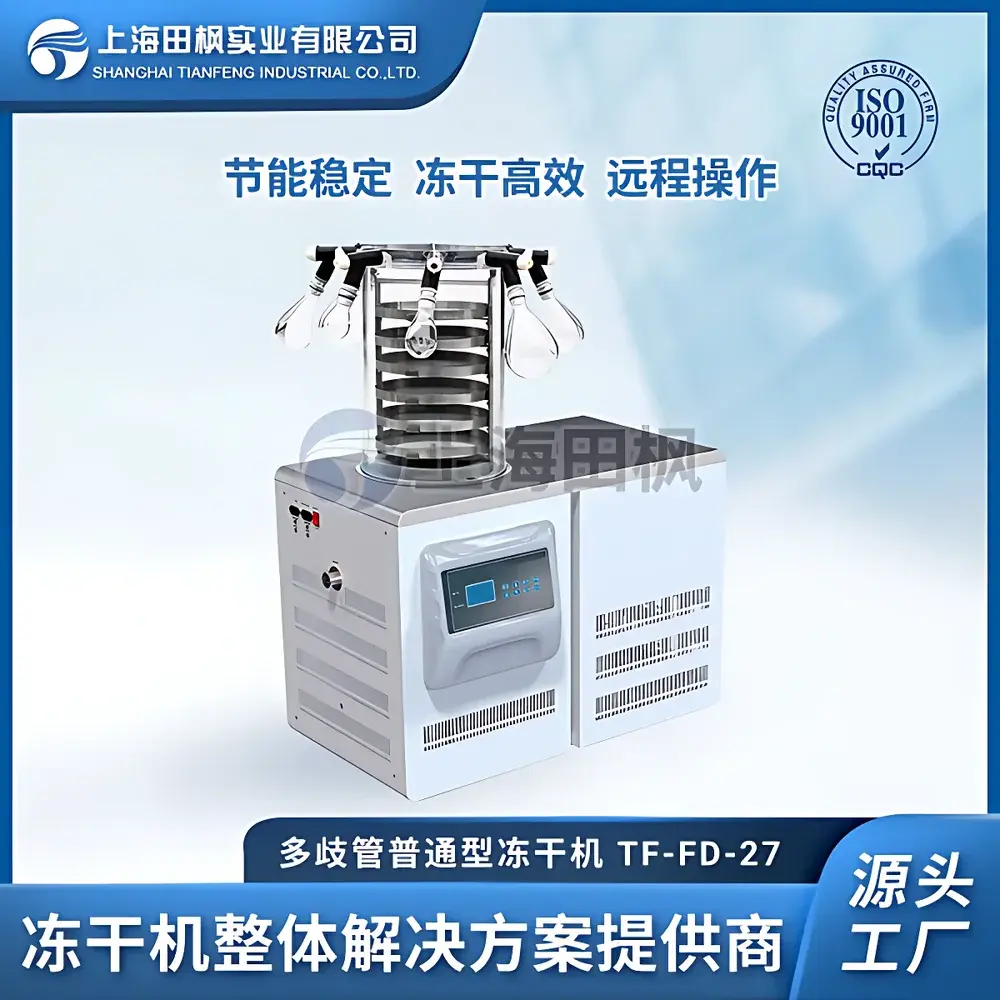
Tianfeng TF-FD-27 Manifold-Type Laboratory Freeze Dryer
| Brand | Tianfeng |
|---|---|
| Origin | Shanghai, China |
| Manufacturer Type | Direct Manufacturer |
| Product Type | Manifold-Type Freeze Dryer |
| Application Scope | Research & Development Laboratories |
| Freeze-Drying Area | 0.27 m² |
| Ultimate Vacuum (Empty Chamber) | <15 Pa |
| Condenser Capacity | 6 kg/24 h |
| Condenser Temperature | <−80 °C |
| Power Supply | 220 V, 50 Hz |
| Rated Power | 2200 W |
| Dimensions (H×W×D, excl. drying chamber) | 1200 × 550 × 870 mm |
| Sample Shelf Configuration | Stainless steel manifold with 8 ports |
| Shelf Diameter | Φ240 mm × 6 adjustable layers |
| Cooling Method | Air-cooled condenser |
| Display | LED digital readouts for condenser temperature and chamber vacuum |
| Control Interface | Dedicated tactile soft-key panel for parameter setting and process monitoring |
| Chamber Design | Transparent bell-jar type, ambient-heating configuration |
| Construction Materials | AISI 304 stainless steel cold trap and base plate |
Overview
The Tianfeng TF-FD-27 Manifold-Type Laboratory Freeze Dryer is an engineered solution for lyophilization of heat-sensitive biological, pharmaceutical, and environmental samples in controlled R&D environments. Based on the principle of sublimation under deep vacuum and cryogenic conditions, this system removes water from frozen samples without passing through the liquid phase—thereby preserving structural integrity, enzymatic activity, immunoreactivity, and biochemical stability. Designed specifically for laboratory-scale processing of ampoules, serum vials, and pre-filled tubes, the TF-FD-27 supports reproducible batch lyophilization of reagents used in water quality testing, diagnostic kit development, and microbial preservation. Its air-cooled condenser architecture eliminates dependency on external water supply, enabling flexible placement in biosafety cabinets or shared lab spaces. The unit complies with core operational requirements defined in ISO 22000 (food safety), ISO 13485 (medical device QMS), and supports traceability frameworks aligned with GLP and GMP documentation practices.
Key Features
- Air-cooled, hermetically sealed refrigeration system using high-efficiency compressors, achieving stable condenser temperatures below −80 °C—critical for efficient vapor capture during primary drying of aqueous-based test reagents.
- Manifold configuration with eight standardized KF-25 vacuum ports, each accommodating standard lyophilization vials (50–1000 mL) without adapter modification; enables parallel processing of heterogeneous sample sets.
- Transparent borosilicate glass bell-jar chamber with integrated ambient heating—provides real-time visual monitoring of ice sublimation, cake formation, and endpoint detection without compromising vacuum integrity.
- Adjustable stainless steel sample shelf assembly (Φ240 mm × 6 layers), allowing vertical spacing customization to accommodate varying vial heights and maximize surface area utilization within the 0.27 m² drying envelope.
- Digital LED interface displaying real-time condenser temperature and chamber pressure (<15 Pa at idle), supporting manual process validation and deviation logging per internal SOPs.
- Corrosion-resistant AISI 304 stainless steel cold trap and base platform—designed for compatibility with saline, phosphate-buffered, and organic solvent-containing formulations commonly used in environmental assay preparation.
Sample Compatibility & Compliance
The TF-FD-27 accommodates a broad range of aqueous and semi-aqueous matrices relevant to water quality analysis—including nutrient broth cultures, enzyme-linked immunoassay (ELISA) standards, heavy metal chelate complexes, and PCR-grade reference materials. Its −80 °C condenser ensures effective trapping of volatile components such as ethanol, acetone, or low-molecular-weight buffers often present in field-deployable test kits. While not certified for sterile manufacturing, the system meets essential design criteria referenced in USP (Sterile Product Preparation), ASTM E2500 (Good Practice in Verification of Pharmaceutical Equipment), and ISO 14644-1 (cleanroom-compatible construction surfaces). All wetted parts are non-porous and autoclavable, facilitating cleaning validation per laboratory hygiene protocols.
Software & Data Management
This model operates via embedded hardware logic without proprietary software dependency—ideal for regulated laboratories requiring deterministic control and audit-ready parameter logs. Vacuum and temperature values are continuously recorded to internal memory (non-volatile EEPROM) and exportable via USB port in CSV format. Timestamped entries include start/end times, condenser thermal profile, and final vacuum hold status—enabling correlation with analytical data from downstream QC instruments (e.g., HPLC, ICP-MS). The system supports integration into LIMS environments through RS-232 serial output, permitting automated metadata ingestion for sample tracking and batch release workflows compliant with FDA 21 CFR Part 11 (electronic records and signatures).
Applications
- Stabilization of enzymatic reagents for BOD/COD/TOC analyzers and portable photometric test kits.
- Long-term storage of reference standards for EPA Method 200.7 (ICP-OES) and Method 5210B (biological oxygen demand).
- Preparation of lyophilized calibration spheres and suspended particulate standards for turbidity and particle count instrumentation.
- Routine preservation of freshwater and wastewater microbial isolates (e.g., E. coli, Pseudomonas aeruginosa) used in method verification studies.
- Development of freeze-dried internal controls for molecular assays targeting fecal indicator genes (e.g., Bacteroides HF183, Enterococcus esp).
FAQ
What types of water quality test reagents can be processed in the TF-FD-27?
Reagents including chromogenic substrates, enzyme conjugates, buffer-stabilized antibodies, and lyophilized bacterial spore suspensions—provided total solids content remains ≤30% w/v and residual solvent volatility is compatible with −80 °C condensation.
Is the system suitable for GMP-regulated production?
No—it is classified as a laboratory R&D instrument, not a cGMP-compliant manufacturing unit. However, its design supports IQ/OQ execution and aligns with Annex 15 (Qualification and Validation) principles for equipment used in method development.
Can the manifold ports be adapted for custom vial sizes or stoppering mechanisms?
Yes—standard KF-25 flanges accept commercially available adapters for septum-sealed vials, rubber stopper crimping fixtures, and vacuum-tight syringe ports.
Does the unit include vacuum pump compatibility guidance?
It requires a two-stage oil-lubricated rotary vane pump capable of reaching ≤10 Pa base pressure; recommended models include Edwards RV8 or Agilent IDP-10, both compliant with ISO 8573-1 Class 2 compressed air purity standards.
How is cleaning validation performed on the cold trap and manifold?
Aqueous sodium hydroxide (0.5 M) followed by deionized water rinse, verified via conductivity measurement (<2.0 µS/cm) and visual inspection for residue—documented per laboratory-specific cleaning SOPs.



