
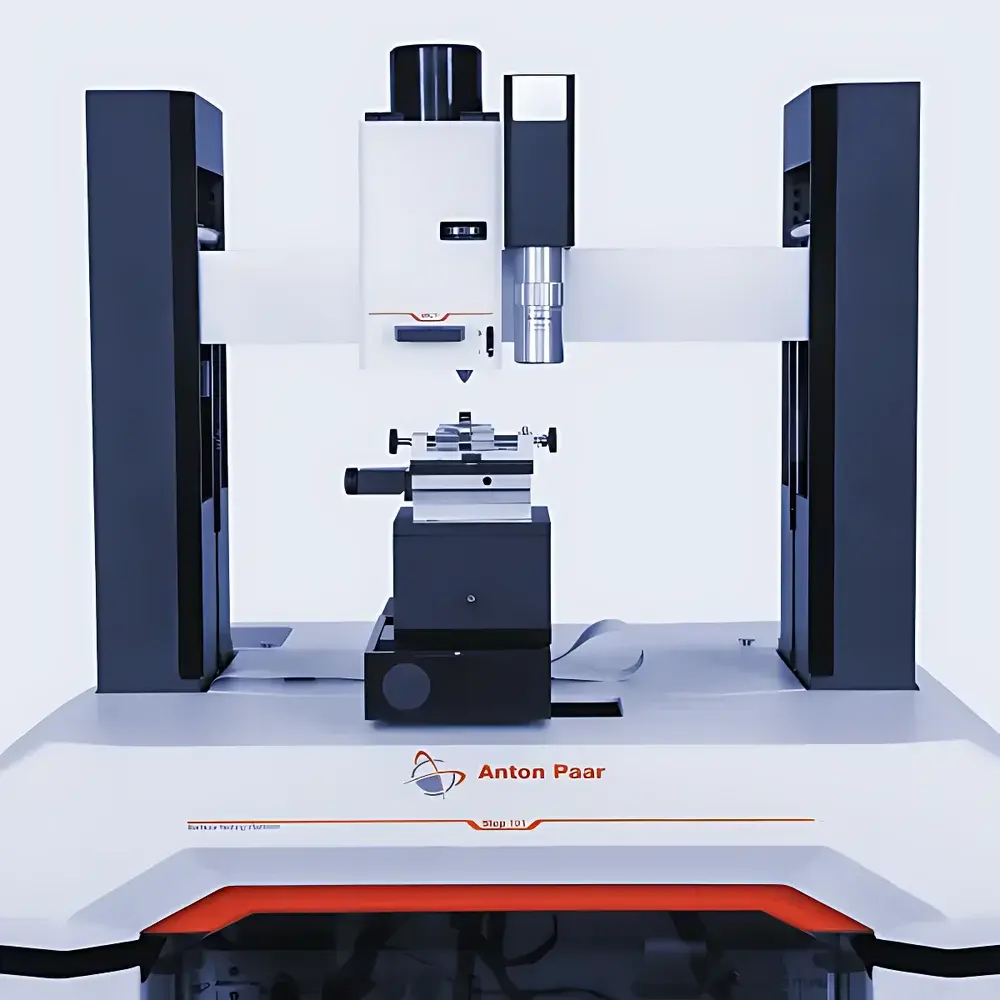


Anton Paar Micro Combi Tester MCT³
| Brand | Anton Paar |
|---|---|
| Origin | Switzerland |
| Manufacturer Type | Manufacturer |
| Origin Category | Imported |
| Model | MHT³ |
| Instrument Type | (Micro/Nano) Scratch Tester |
| Load Range | 10 mN – 30 N |
| Load Resolution | 6 µN |
| Load Noise (RMS) | 100 µN |
| Depth Range | 0–1000 µm |
| Depth Resolution | 0.03 nm |
| Depth Noise (RMS) | 1.5 nm |
| Data Acquisition Rate | 192 kHz |
| Scratch Speed | 0.1–600 mm/min |
| Maximum Heating Temperature (Peltier) | 120 °C |
| Optional Heating Stage | up to 200 °C |
| Optional Cryo Cooling | down to −120 °C |
| Liquid Environment Testing | Yes |
Overview
The Anton Paar Micro Combi Tester MCT³ is a modular, high-precision mechanical surface characterization platform engineered for quantitative, multi-modal mechanical property analysis of thin films, coatings, and bulk materials. Based on instrumented indentation testing (IIT), scratch testing, Vickers hardness measurement, and multi-channel tribological evaluation—integrated within a single, co-axial probe head—the MCT³ operates on the principle of controlled force-depth feedback with synchronized multi-sensor acquisition. Its architecture enables simultaneous real-time monitoring of normal load, tangential friction force, acoustic emission, and vertical displacement at sub-nanometer resolution. Designed for traceable, operator-independent results, the system complies with ASTM E2546 (standard practice for instrumented indentation testing), ISO 20502 (scratch testing of coatings), and ISO 14577 (instrumented indentation hardness and modulus), supporting GLP/GMP-aligned workflows through audit-trail-enabled software.
Key Features
- Quadruple-Mode Mechanical Characterization: Performs scratch adhesion, instrumented indentation (hardness & elastic modulus), Vickers microhardness, and tribological wear/friction testing—all using the same indenter tip without repositioning or recalibration.
- Active Topography Compensation: Proprietary load-sensor-based active feedback control dynamically adjusts the probe’s vertical position in real time, enabling reliable measurements on curved surfaces (e.g., optical lenses) and rough substrates (Ra > 5 µm) without loss of force fidelity.
- Critical Load Auto-Detection: Employs algorithm-driven, multi-parameter threshold analysis—based on friction coefficient jumps, acoustic emission bursts, and penetration depth discontinuities—to objectively identify critical failure loads (Lc1, Lc2, Lc3) per ISO 20502 and ASTM D7027.
- Synchronized Panoramic Imaging: Integrates high-resolution optical microscopy (up to 50× magnification) with full temporal alignment of all sensor signals (load, depth, friction, AE), allowing direct correlation between visual damage morphology and mechanical response events.
- Extended Force–Depth Dynamic Range: Covers 10 mN–30 N load range and 0.03 nm–1000 µm depth range, bridging nano-, micro-, and macro-scale mechanical behavior assessment—from ultrathin PVD/CVD coatings (1–20 µm) to bulk polymers, gels, metals, and thermally sprayed layers.
- Environmental Flexibility: Optional Peltier stage (−120 °C to +120 °C), high-temperature heating stage (up to +200 °C), and liquid cell compatibility enable in situ mechanical testing under controlled thermal or fluidic conditions.
Sample Compatibility & Compliance
The MCT³ accommodates rigid and compliant substrates—including glass, silicon wafers, metallic alloys, ceramics, elastomers, hydrogels, and organic thin films—with minimal preparation. Its adaptive surface tracking ensures valid data collection on non-planar geometries (cylindrical, spherical, or irregular profiles) and rough surfaces (e.g., plasma-sprayed thermal barrier coatings). The system supports compliance with regulatory documentation requirements: test logs include timestamped metadata, user authentication, electronic signatures, and full audit trails aligned with FDA 21 CFR Part 11 and EU Annex 11 for computerized systems used in GxP environments.
Software & Data Management
Controlled via the unified STEP Surface Testing Platform software, the MCT³ provides fully automated test sequencing, parameter scripting, and post-processing modules for scratch track segmentation, indentation pile-up correction, Oliver–Pharr modulus extraction, and Weibull statistical analysis of hardness distributions. All raw sensor data are stored in vendor-neutral HDF5 format with embedded calibration certificates. Export options include CSV, MATLAB .mat, and standardized ASTM/ISO report templates. Software updates follow IEC 62304 Class B medical device software lifecycle standards, ensuring long-term validation integrity.
Applications
- Adhesion strength evaluation of DLC, TiN, CrN, and AlTiN hard coatings on cutting tools and biomedical implants
- Quantitative wear resistance mapping of automotive clearcoats and anti-fouling marine coatings
- Mechanical gradient profiling across graded thermal barrier coatings (TBCs) and functionally graded materials (FGMs)
- Viscoelastic parameter extraction from polymer thin films and hydrogels under variable temperature and humidity
- Vickers hardness validation against reference blocks per ISO 6507-1, integrated within the same instrument platform
- Tribocorrosion studies in aqueous electrolytes for corrosion-resistant coatings in energy and chemical processing equipment
FAQ
Can the MCT³ perform both nanoindentation and macro-scale Vickers hardness testing?
Yes—using the same indenter and calibrated actuation system, it delivers instrumented indentation at loads as low as 10 mN (nanoscale regime) and standard Vickers tests up to 30 N (macro-scale), eliminating cross-instrument calibration drift.
Is surface roughness compensation validated per international standards?
Yes—the active topography tracking has been verified per ISO 20502 Annex C for scratch testing on surfaces with Sa ≥ 2.5 µm and Rz ≥ 15 µm.
Does the system support third-party AFM integration?
Yes—via the STEP platform’s modular interface, users can dock compatible atomic force microscope modules for correlative topography-mechanics mapping without sample transfer.
How is data traceability ensured for regulated industries?
All test sequences generate immutable digital records including hardware ID, calibration certificate expiry, environmental sensor logs, and operator credentials—fully compliant with 21 CFR Part 11 §11.10(a) and Annex 11 §5.2.
What is the minimum detectable acoustic emission event?
The built-in piezoelectric AE sensor achieves 65 dB signal-to-noise ratio at 1 MHz center frequency, resolving micro-fracture events corresponding to <100 pN force transients.



