
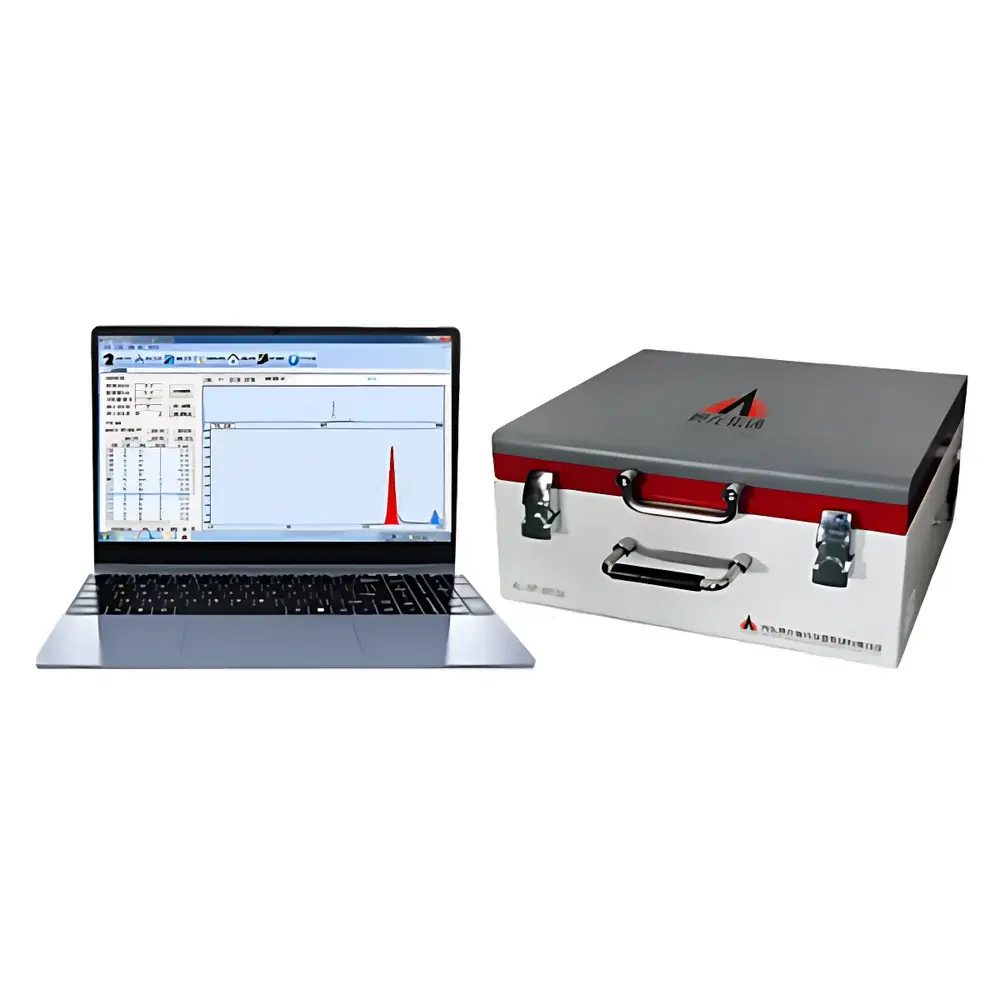
Aolong AL-NP-6010A Portable Energy-Dispersive X-ray Fluorescence (ED-XRF) Spectrometer
| Brand | Aolong |
|---|---|
| Origin | Liaoning, China |
| Manufacturer Type | Direct Manufacturer |
| Country of Origin | China |
| Model | AL-NP-6010A |
| Price Range | USD 280,000 – 425,000 |
Overview
The Aolong AL-NP-6010A is a field-deployable, bench-grade energy-dispersive X-ray fluorescence (ED-XRF) spectrometer engineered for quantitative and qualitative elemental analysis from sodium (Na) to uranium (U) in solid, powdered, and coated samples. Unlike handheld XRF analyzers constrained by geometric limitations and detector sensitivity trade-offs, or laboratory-bound benchtop systems requiring stable AC power and vibration-free environments, the AL-NP-6010A bridges this operational gap through an integrated architecture combining high-resolution silicon drift detector (SDD) technology, microfocus X-ray tube with active thermal regulation, and embedded real-time spectrum processing firmware. Its core measurement principle relies on excitation of sample atoms via primary X-ray photons, followed by detection of characteristic secondary (fluorescent) X-rays whose energies are element-specific and intensities proportional to concentration—enabling simultaneous multi-element quantification without chemical digestion or vacuum requirements. Designed for compliance with ISO 8258 (control chart principles), ASTM E1621 (standard guide for ED-XRF analysis of metals), and IEC 62321-5 (RoHS screening), the instrument supports both regulatory screening and technical-grade compositional verification across mobile and semi-permanent deployment scenarios.
Key Features
- Integrated lithium-ion battery pack enabling ≥8 hours continuous operation in field conditions without external AC supply
- Compact footprint (33% volume) and lightweight chassis (20% mass) relative to conventional benchtop ED-XRF systems
- Microfocus X-ray tube with closed-loop thermal management: automatic kV/mA derating during idle periods and real-time anode temperature monitoring to extend tube service life beyond 20,000 operating hours
- Silicon drift detector (SDD) with <135 eV Mn Kα resolution at 0°C, optimized for low-Z element detection down to Na (11) under helium purge or vacuum optional mode
- Full-spectrum calibration capability: user-definable empirical and fundamental parameter (FP) calibration curves for bulk, thin-film, and layered materials
- Dual-mode operation: direct field analysis (battery-powered) and lab-integrated mode (AC-powered with Ethernet/USB-C data streaming)
Sample Compatibility & Compliance
The AL-NP-6010A accommodates heterogeneous solid matrices—including geological cores, metal alloys, construction aggregates, electronic components, painted surfaces, and soil composites—without destructive preparation. Its collimated beam geometry (φ3 mm standard aperture) ensures reproducible spot analysis on irregular geometries such as pipes, rods, and curved artifacts. Regulatory alignment includes full support for RoHS Directive 2011/65/EU restricted substance screening (Pb, Cd, Hg, Cr⁶⁺, Br), US EPA Method 6200 (field portable XRF for soils), and EN 14385 (recycled material trace metal profiling). Data integrity meets GLP/GMP audit requirements via built-in electronic signature support, 21 CFR Part 11–compliant audit trail logging, and encrypted local database storage with timestamped spectral metadata.
Software & Data Management
The instrument runs Aolong’s proprietary SpectraLink™ v4.2 software suite, featuring intuitive touchscreen interface with guided workflow navigation—no prior spectroscopy training required. Key modules include: (1) Coating Thickness Analysis (CTA) per ISO 3497 and ASTM B568; (2) Multi-layer FP modeling for PCB solder finishes, galvanized steel, and decorative plating; (3) Batch reporting with customizable templates compliant with ISO/IEC 17025 documentation standards; (4) Historical spectral archive with SQL-based search, trend analysis, and export to CSV, PDF, or LIMS-compatible XML. All calibrations, spectra, and reports are stored locally with SHA-256 hash verification and optional cloud synchronization via TLS 1.3–secured API endpoint.
Applications
- Environmental field screening: rapid Pb/Cd/As quantification in contaminated soils and sediments per EPA Region 10 protocols
- Mining exploration: in-situ grade estimation of Cu, Zn, Ni, and REEs in drill core and outcrop samples
- Recycling stream verification: alloy sorting (Al/Mg/Ti grades), WEEE component compliance checks, and slag composition mapping
- Cultural heritage analysis: non-invasive pigment identification, bronze patina characterization, and ceramic glaze provenance studies
- Construction QA/QC: cement clinker phase ratio estimation, fly ash classification, and aggregate contaminant screening
- Manufacturing process control: electroplating bath monitoring, solder paste homogeneity assessment, and coating uniformity validation
FAQ
Does the AL-NP-6010A require vacuum or helium purging for light element analysis?
Yes—Na, Mg, Al, Si, and P quantification below 1.5 keV requires either helium flush or vacuum chamber attachment (optional accessory). Air path mode supports elements from S (16) upward.
Can it perform thickness measurements on multi-layer coatings?
Yes—the CTA module supports up to five-layer stack modeling using fundamental parameters, validated against certified reference materials (CRMs) NIST SRM 2136 and BAM B212.
Is remote diagnostics and firmware update supported?
Yes—via secure SSH tunnel over Ethernet or Wi-Fi; firmware updates retain all user calibrations and historical databases.
What safety certifications does the instrument hold?
Complies with IEC 61010-1 (electrical safety), IEC 62471 (photobiological safety), and GBZ 188-2014 (Chinese occupational radiation protection standards); includes interlocked shutter and real-time dose rate monitoring.
How is measurement reproducibility ensured across field operators?
Through standardized calibration verification using onboard check sources (Fe-55, Cd-109), automated drift correction algorithms, and operator-independent measurement protocols enforced via role-based access control.



