
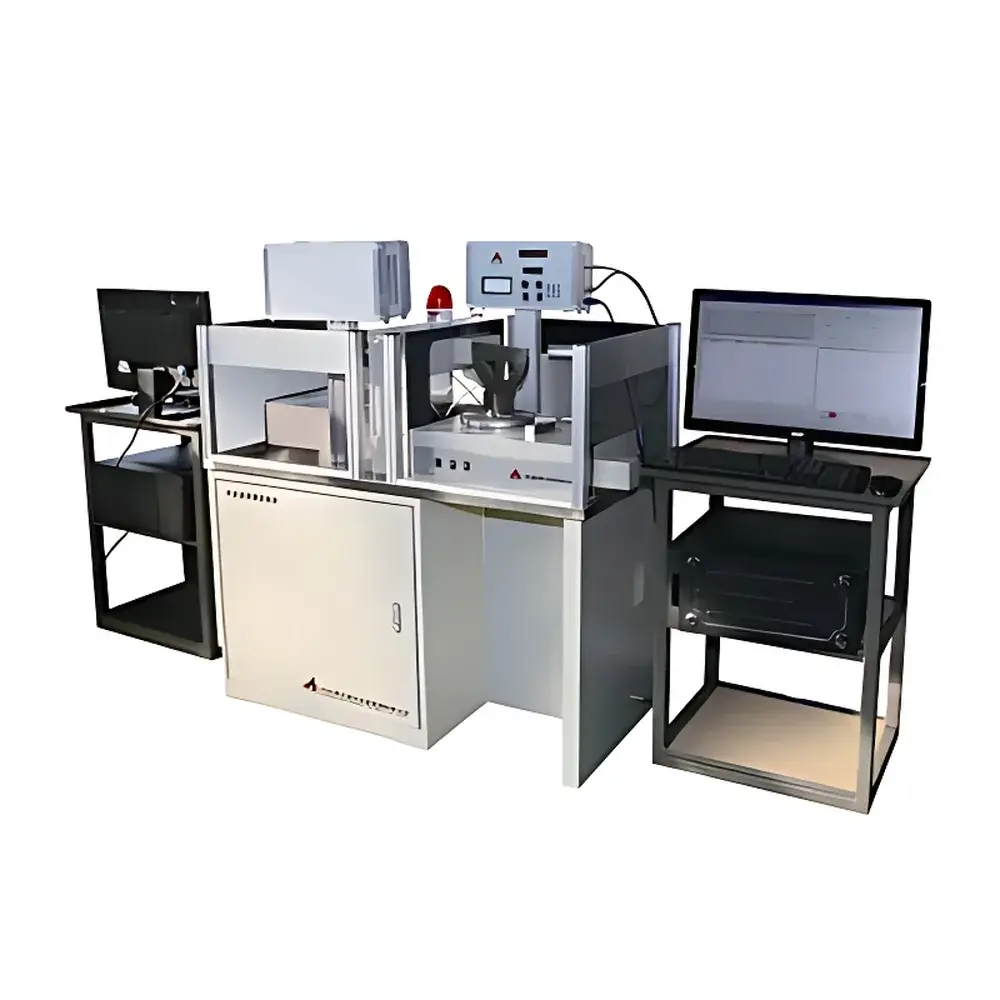
Aolong ALW-QZXD 800 Semi-Automatic Peak-Finding X-Ray Orientation Instrument
| Brand | Aolong |
|---|---|
| Origin | Liaoning, China |
| Manufacturer Type | Manufacturer |
| Product Category | Domestic |
| Model | ALW-QZXD 800 |
| Pricing | Upon Request |
| Input Power | AC 220 V, 50 Hz, 0.25 kW |
| X-Ray Tube | Cu anode, fan-cooled, grounded anode |
| Max. Tube Voltage/Current | 30 kV / 5 mA (continuously adjustable) |
| Detector | Geiger-Müller counter (DC 1000 V max) or scintillation detector (DC 1200 V max) |
| Time Constant Settings | Fast (1) / Slow (2) |
| Angular Range | 2θ = −10° to 120° |
| Angular Resolution | 1 arcsecond (″) / 0.001° (digital display) |
| Repeatability | ±3″ |
| Measurement Accuracy | ±15″ (double-diffraction mode, verified with NIST-traceable quartz reference) |
| Optical Shutter | Motorized, auto-controlled |
| Display | Dual-channel digital readout (angle + X-ray intensity) |
| Dimensions (L×W×H) | 1132 × 642 × 1460 mm |
| Weight | 300 kg |
Overview
The Aolong ALW-QZXD 800 Semi-Automatic Peak-Finding X-Ray Orientation Instrument is a precision angular metrology system engineered for crystallographic orientation determination in single-crystal materials—primarily sapphire, silicon carbide, quartz, and other industrially relevant oxides and semiconductors. It operates on the Bragg diffraction principle: monochromatic Cu-Kα radiation (λ = 1.5418 Å) impinges on a crystalline sample mounted on a goniometric stage; the diffracted intensity is measured as a function of 2θ angle using a radiation-hardened detector. The instrument implements a semi-automated peak search algorithm that scans predefined angular windows (e.g., ≤2° range), identifies local maxima in the intensity profile via centroid interpolation, and reports the Bragg angle (θB) with arcsecond-level resolution. Designed for high-throughput production environments, it delivers deterministic angular positioning without requiring full-pattern acquisition or Rietveld refinement—making it distinct from laboratory-grade X-ray diffractometers used for phase identification or structural analysis.
Key Features
- Dual independent goniometric workbenches—left and right—each accommodating wafers and ingots from 2-inch to 8-inch diameter with mechanical stability optimized for <1 µm surface flatness tolerance.
- High-repeatability angular encoder system with 1″ (0.000278°) minimum incremental resolution and ±3″ repeatability over repeated measurements under identical thermal and mechanical conditions.
- Configurable detector options: either a sealed Geiger-Müller proportional counter (rated up to DC 1000 V) or a NaI(Tl) scintillation detector (rated up to DC 1200 V), both selected for optimal signal-to-noise ratio in low-count-rate Bragg peak detection.
- Two selectable time constant modes (fast/slow) enable dynamic optimization between measurement speed (≤20 s per scan, ≤2° range) and statistical counting precision—critical when balancing throughput with angular uncertainty in QC workflows.
- Motorized main optical shutter synchronized with angular motion ensures strict radiation safety compliance (IEC 61010-1) and eliminates manual intervention during automated sequences.
- Real-time digital angular display with dual-format output: sexagesimal (° ′ ″) and decimal degree (0.001° resolution), alongside analog-integrated X-ray intensity meter for immediate beam alignment verification.
Sample Compatibility & Compliance
The ALW-QZXD 800 is validated for orientation mapping of optoelectronic and substrate-grade single crystals including but not limited to Al2O3 (sapphire), SiC, Si, GaAs, and LiNbO3. Sample mounting uses vacuum chucks compatible with standard wafer carriers and custom fixtures for irregular ingot geometries. All angular calibrations are traceable to NIST SRM 1976b (standard quartz crystal), enabling documented verification of double-diffraction accuracy at ±15″ (as specified per ASTM E975-22 Annex A2 for crystal orientation instruments). The system conforms to electromagnetic compatibility (EMC) requirements per EN 61326-1 and meets Class I laser product safety classification under IEC 60825-1 due to its fully enclosed X-ray path. No user-accessible radiation exposure exceeds 1 µSv/h at 5 cm from housing—fully compliant with national regulatory limits for industrial X-ray equipment (GBZ 138–2002).
Software & Data Management
The embedded Windows-based control software provides real-time acquisition, peak detection, and angular reporting without third-party dependencies. Raw intensity vs. 2θ data is saved in ASCII-compatible .csv format with metadata headers (timestamp, sample ID, scan parameters, detector HV, time constant). Peak-fitting algorithms implement parabolic interpolation around the maximum channel count, rejecting outliers via iterative σ-clipping. Each measurement session generates a structured report containing: peak position (θB), full width at half maximum (FWHM), integrated intensity, and deviation from nominal orientation. Audit trails—including operator ID, calibration date, and parameter change logs—are retained locally and exportable for GLP/GMP documentation. Software supports batch processing of up to 99 samples per sequence and integrates with factory MES via OPC UA (optional configuration).
Applications
- Production-line orientation verification of sapphire wafers prior to epitaxial growth or polishing—ensuring alignment within ±0.01° of C-plane or A-plane specifications.
- Quality control of boule-cut slices in LED and power electronics manufacturing, where misorientation >0.1° induces threading dislocation density increases exceeding IPC-A-610 Class 2 thresholds.
- Calibration transfer between master reference crystals and working standards in metrology labs accredited to ISO/IEC 17025.
- Process validation of crystal pulling and annealing steps by monitoring angular drift across longitudinal boule sections (e.g., top/middle/base).
- Teaching laboratories for undergraduate solid-state physics courses covering Bragg’s law, reciprocal lattice concepts, and practical X-ray diffraction metrology.
FAQ
What crystallographic planes can be measured with this instrument?
The ALW-QZXD 800 measures Bragg angles corresponding to low-order reflections (e.g., (0006) for sapphire c-plane, (101̅0) for a-plane) using Cu-Kα radiation. It does not resolve higher-order harmonics or overlapping multiplets without manual deconvolution.
Is the system compliant with FDA 21 CFR Part 11 for electronic records?
Yes—the software includes configurable user authentication, electronic signatures, and immutable audit trails for all measurement and calibration events, meeting core Part 11 requirements for closed systems.
Can the instrument be upgraded to fully automatic operation?
The current architecture supports optional integration of motorized sample rotation stages and barcode-triggered measurement protocols; full automation requires OEM firmware revision and hardware retrofitting.
What maintenance intervals are recommended for the X-ray tube?
Fan-cooled Cu tubes are rated for ≥5,000 hours at 30 kV/3 mA. Annual performance verification—including tube output stability and focal spot alignment—is advised per manufacturer service bulletin ALW-SV-2023-04.
Does the system support external trigger inputs for synchronized process control?
Yes—TTL-compatible trigger I/O ports allow synchronization with conveyor belts, robotic handlers, or PLC-controlled loading stations (pinout diagram available in Hardware Interface Manual Rev. 3.1).
Related Products





