
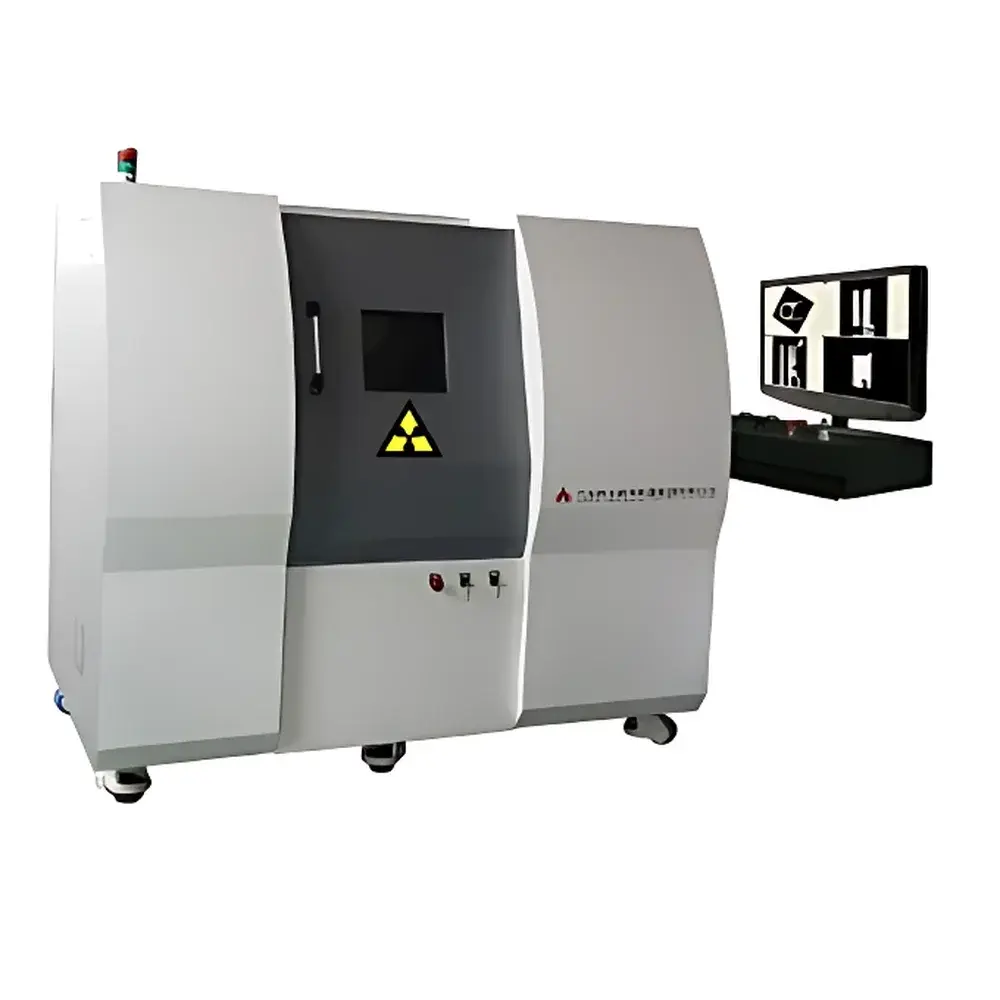
Aolong Core CT Full-Core & Long-Core Industrial Micro-CT System
| Brand | Aolong |
|---|---|
| Origin | Liaoning, China |
| Manufacturer Type | Direct Manufacturer |
| Origin Category | Domestic (China) |
| Model | Core CT |
| Pricing | Upon Request |
Overview
The Aolong Core CT is a purpose-built industrial micro-computed tomography (micro-CT) system engineered specifically for non-destructive, high-resolution 3D imaging and quantitative analysis of geological core samples. Operating on the principle of cone-beam X-ray computed tomography—complemented by optional helical scanning mode—the system enables volumetric reconstruction of intact rock cores up to several meters in length and variable diameters (e.g., 25 mm–150 mm). By leveraging a high-stability microfocus X-ray source (20–225 kV, reflective target, max. 320 W tube power), coupled with a precision flat-panel detector (100 µm pixel pitch, 325 × 325 px active area), the Core CT delivers sub-micron geometric resolution (JIMA-certified ≤2 µm) and density contrast sensitivity of 0.3–0.5%, essential for distinguishing subtle mineralogical variations, pore-throat networks, and fluid-saturated regions within heterogeneous reservoir rocks—including sandstone, carbonate, shale, and tight formations.
Key Features
- Open-type microfocus X-ray tube with extended service life, thermal stability, and consistent focal spot performance under prolonged operation.
- True 3D volumetric CT acquisition with real-time reconstruction—scan and reconstruction occur nearly concurrently, reducing total experimental turnaround time.
- Marble-based mechanical platform providing exceptional rigidity and vibration isolation, critical for maintaining sub-pixel registration accuracy across long-duration scans.
- High-precision rotary stage with programmable angular increment (≤0.01°) and linear translation axes, enabling adaptive geometry calibration for cores of varying length and diameter.
- Compact, modular mechanical architecture optimized for laboratory integration; footprint minimized without compromising mechanical repeatability or radiation shielding integrity.
- Compliant radiation safety design: surface dose rate <1 µSv/h during operation—meets GBZ 130–2020 (China), IEC 61331-1, and EU Directive 2013/59/Euratom requirements.
- Region-of-interest (ROI) scanning capability—supports targeted acquisition and localized reconstruction to accelerate throughput and reduce data storage overhead.
- Integrated motion control synchronized with X-ray pulsing, minimizing motion blur and enabling dynamic in situ experiments (e.g., fluid injection, thermal stress, mechanical loading).
Sample Compatibility & Compliance
The Core CT accommodates full-length cylindrical core plugs and whole-core segments (up to 1.5 m standard, extendable per configuration), enclosed in low-absorption plastic or aluminum sleeves to maintain sample integrity and minimize beam hardening artifacts. It supports both dry-state characterization and controlled saturation experiments using brine, oil, CO₂, or supercritical fluids. All hardware and software components comply with ISO/IEC 17025:2017 general requirements for competence of testing and calibration laboratories. Data acquisition protocols are traceable and support GLP/GMP-aligned documentation workflows. Radiation shielding and interlock systems conform to national regulatory standards (CNCA-C11-01:2020) and international best practices for occupational exposure control.
Software & Data Management
The proprietary Aolong CT Analysis Suite provides end-to-end processing—from raw projection alignment and ring artifact correction to iterative 3D reconstruction (FDK/FBP algorithms), segmentation (Otsu, watershed, machine-learning-assisted thresholding), and quantitative morphometric analysis. Key outputs include porosity distribution maps, pore-size distribution histograms, throat radius statistics, coordination number analysis, tortuosity calculation, and connectivity modeling via maximal ball and skeletonization algorithms. Software supports DICOM 3.0 import/export, ASTM E1441-compliant metadata embedding, and export of segmented volumes in STL, OBJ, and AVS UCD formats for downstream simulation (e.g., Lattice Boltzmann flow modeling, finite-element stress analysis). Audit trails, user access logs, and electronic signatures align with FDA 21 CFR Part 11 readiness for regulated environments.
Applications
- Quantitative digital rock physics: pore-network extraction, permeability prediction (via Stokes flow simulation), and capillary pressure curve derivation.
- In situ multiphase fluid displacement studies—visualizing oil/water/gas front propagation, snap-off events, and residual saturation trapping mechanisms.
- Mineralogical mapping through dual-energy or spectral CT extensions (optional), supporting clay typing (kaolinite, illite, smectite) and authigenic cement distribution analysis.
- Core damage assessment: quantifying drilling-induced fractures, mud invasion depth, and formation damage zones via density gradient profiling.
- Geomechanical characterization: correlating microstructural heterogeneity (e.g., bedding planes, natural fractures, vugs) with macro-scale mechanical response under triaxial loading.
- Reservoir simulation input generation at pore scale (µm), core scale (cm), and sub-reservoir scale (dm), facilitating multi-scale upscaling workflows.
FAQ
What core dimensions can the Core CT accommodate?
Standard configurations support cores up to 1.5 m in length and 150 mm in diameter; custom gantry extensions and detector positioning modules enable adaptation to longer or larger-diameter specimens.
Is the system compatible with dynamic in situ experiments?
Yes—the system integrates with third-party environmental cells (fluid injection, heating/cooling, triaxial stress) and supports time-resolved 4D CT acquisition with temporal resolution down to 30 seconds per volume.
Does the software support automated pore-network extraction and permeability modeling?
Yes—the analysis suite includes validated modules for pore-throat identification, network graph generation, and single-phase Darcy flow simulation using lattice Boltzmann methods.
Can the system meet regulatory requirements for QA/QC in oilfield service labs?
Yes—full audit trail logging, role-based access control, electronic signature support, and DICOM-compliant reporting ensure compliance with ISO 15189, API RP 90, and internal QA procedures.
What is the typical spatial resolution achievable for a 50-mm-diameter sandstone core?
At optimal magnification and exposure settings, isotropic voxel resolution of 5–10 µm is routinely achieved; sub-5 µm resolution is attainable with ROI targeting and extended acquisition time.



