
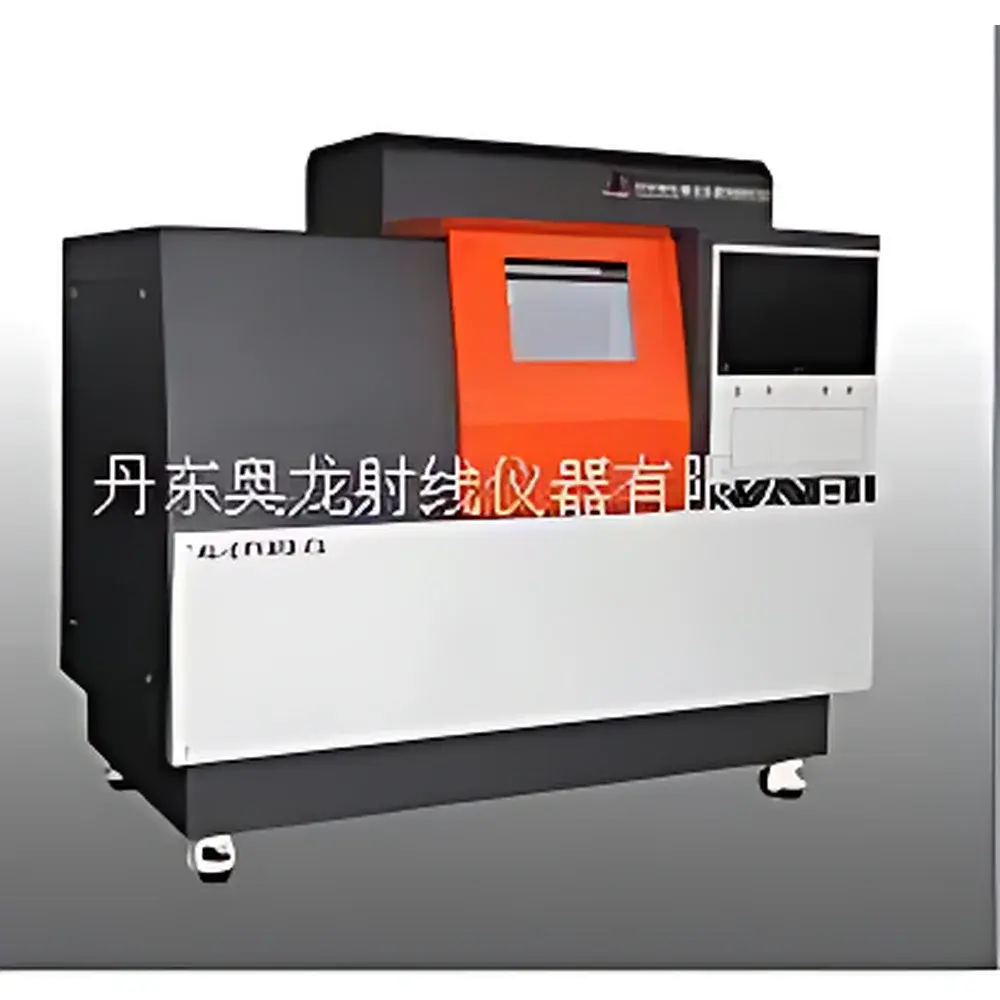
Aolong CT225 Microfocus Industrial X-ray Computed Tomography System
| Brand | Aolong |
|---|---|
| Origin | Liaoning, China |
| Manufacturer Type | Direct Manufacturer |
| Country of Origin | China |
| Model | CT225 |
| Pricing | Upon Request |
| X-ray Tube Voltage Range | 20–225 kV |
| Minimum Focal Spot Size | 1 µm |
| Detector Pixel Resolution | 100 µm |
| Maximum Sample Dimensions | Ø300 mm × H500 mm (customizable) |
| Maximum Sample Weight | 50 kg |
| Achievable 3D Spatial Resolution (Detail Detectability) | ≤0.25 µm |
| Rotational Axis Accuracy | 4-axis precision motion system |
| System Weight | 2600 kg |
| Ambient Dose Rate | <1 µSv/h (at 1 m from enclosure) |
| X-ray Source Type | Open-tube microfocus with long-life cathode architecture |
| Reconstruction Capability | Real-time iterative and filtered back-projection (FBP) CT volume reconstruction |
| Artifact Correction | Ring artifact suppression, beam hardening correction, scatter compensation |
Overview
The Aolong CT225 is a high-performance microfocus industrial X-ray computed tomography (CT) system engineered for non-destructive, quantitative 3D internal inspection of engineering components and geological specimens. Operating on the principle of cone-beam X-ray CT, it acquires hundreds to thousands of 2D projection images across a full 360° rotation, then reconstructs them into isotropic 3D volumetric datasets (voxel arrays) using proprietary algorithms compliant with ISO 15785:2016 (Non-destructive testing — Industrial computed tomography — Qualification of CT systems). Its 225 kV open-tube microfocus X-ray source delivers stable, low-drift focal spot positioning (<0.1 µm thermal drift over 8 h), enabling consistent sub-micron resolution imaging essential for pore network analysis in reservoir rock cores, dimensional metrology of turbine blades, and integrity assessment of nuclear fuel rod cladding.
Key Features
- Microfocus X-ray source with adjustable voltage (20–225 kV) and minimum focal spot size of 1 µm — optimized for high-contrast, low-noise imaging of dense and heterogeneous materials.
- High-dynamic-range flat-panel detector with native pixel pitch of 100 µm, supporting binning modes for enhanced signal-to-noise ratio in low-dose acquisitions.
- 4-axis precision manipulator (X/Y/Z translation + high-accuracy rotation) with repeatability ≤±0.5 µm and angular resolution <0.001° — critical for metrology-grade alignment and multi-angle scanning protocols.
- Real-time CT reconstruction engine capable of on-the-fly volume generation during acquisition — reducing total inspection cycle time by up to 40% compared to post-scan batch processing.
- Integrated ring artifact correction, polychromatic beam hardening compensation, and scatter estimation modules — ensuring quantitative fidelity in density-calibrated voxel values (HU-equivalent units).
- Shielded cabinet meeting IEC 61331-1:2014 radiation safety requirements; measured ambient dose rate <1 µSv/h at 1 m distance under continuous operation.
- Open-tube X-ray source architecture eliminates filament replacement cycles — rated for >10,000 h operational lifetime with no focal spot degradation or vacuum reconditioning required.
Sample Compatibility & Compliance
The CT225 accommodates samples up to Ø300 mm × 500 mm height and 50 kg mass, with mechanical fixtures supporting custom mounting of cylindrical rock cores (standard NQ/NW/BQ sizes), pressurized fuel rod segments, and assembled battery modules. It complies with ASTM E1441-22 (Standard Guide for Computed Tomography), ISO/IEC 17025:2017 (for accredited lab use), and supports audit-ready documentation per FDA 21 CFR Part 11 when paired with validated software workflows. All scan protocols are traceable to NIST-traceable reference phantoms (e.g., Gammex 76-810), and system performance verification follows AAPM TG-147 methodology.
Software & Data Management
Controlled via Aolong’s proprietary CTStudio v5.x platform, the system provides DICOM-compliant data export, Python API integration for automated QA/QC pipelines, and native support for VG Studio MAX 3.4+ and Avizo 2023 for advanced segmentation, porosity quantification, and defect classification. Raw projection data and reconstructed volumes are stored with embedded metadata (kV/mA/exposure time/detector gain/geometry calibration), enabling full GLP/GMP traceability. Software validation packages include IQ/OQ/PQ documentation templates aligned with ISO 9001 and ASME BPVC Section V Article 24.
Applications
- Geoscience: Pore-throat network characterization, fluid saturation mapping, and diagenetic feature quantification in sandstone, carbonate, and shale core plugs.
- Nuclear energy: Cladding thickness uniformity, pellet gap analysis, and hydride phase distribution in Zr-alloy fuel rods under simulated operational conditions.
- Advanced manufacturing: Porosity detection in additively manufactured Inconel 718 turbine vanes; fiber orientation analysis in carbon-fiber-reinforced polymer (CFRP) composites.
- Electronics: Solder joint void fraction measurement in BGA packages; delamination detection in multilayer ceramic capacitors (MLCCs); anode/cathode layer thickness profiling in pouch-type Li-ion cells.
- Automotive: Casting porosity mapping in aluminum cylinder heads; adhesive bondline integrity verification in structural bonding applications.
- Construction materials: Air void distribution in ultra-high-performance concrete (UHPC); aggregate interlock analysis in asphalt mixtures.
FAQ
What is the minimum resolvable feature size in 3D reconstructions?
The system achieves a practical 3D detail detectability limit of ≤0.25 µm under optimal magnification and exposure conditions — verified using line-pair test phantoms per ISO 10993-12.
Can the CT225 perform dimensional metrology certified to ISO 15530-3?
Yes — when used with calibrated reference artifacts and traceable geometry calibration routines, it meets the uncertainty budget requirements for CT-based coordinate measuring machine (CMM) applications.
Is the system compatible with third-party reconstruction software such as Dragonfly or Thermo Scientific Avizo?
All raw projections and reconstructed volumes are exported in standard HDF5 and TIFF stack formats, fully compatible with commercial and open-source reconstruction and analysis platforms.
Does the open-tube X-ray source require periodic filament replacement?
No — the thermionic cathode design operates without consumable filaments; lifetime is governed by anode thermal cycling limits, with typical service intervals exceeding 10,000 hours.
How is radiation safety ensured during routine operation?
The fully interlocked lead-shielded enclosure meets Class I radiation device requirements per IEC 61331-1, with redundant door sensors, real-time dose monitoring, and automatic beam cutoff upon any access violation.



