
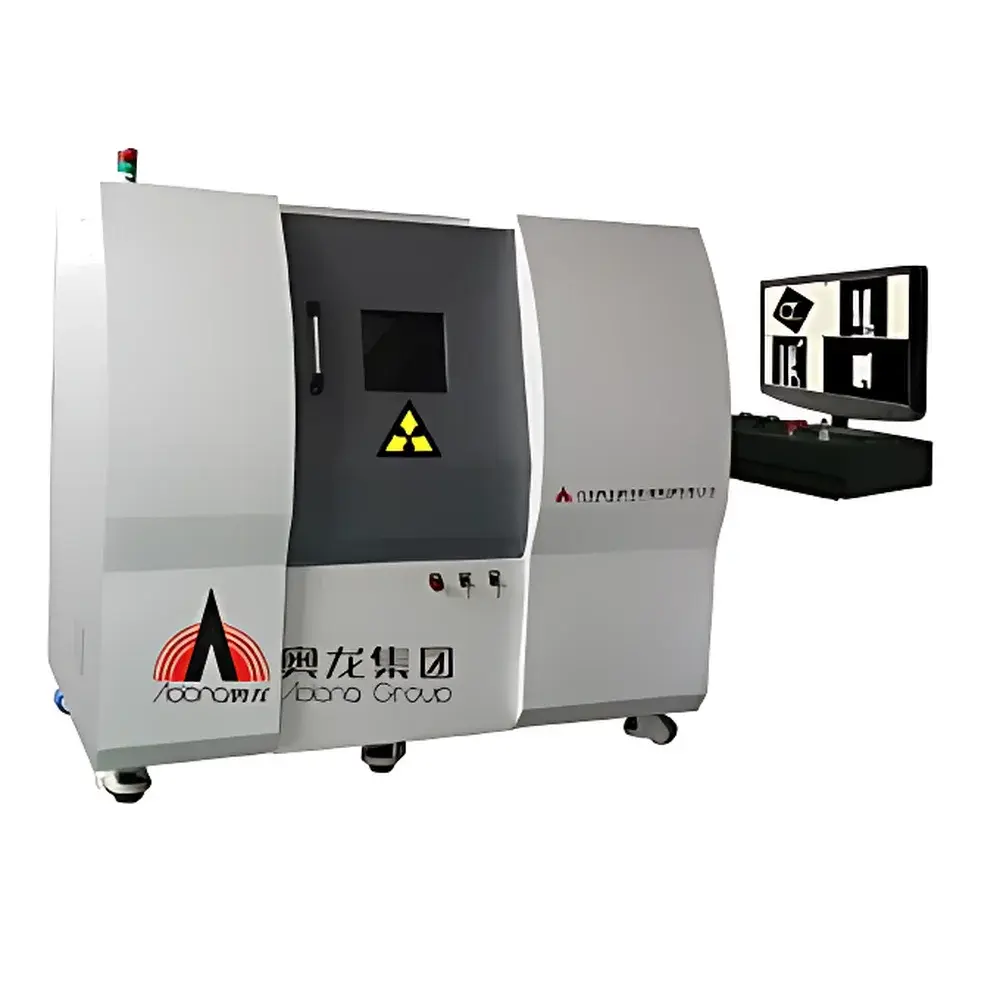
Aolong Cultural Heritage Micro-CT Scanning & Analysis System
| Brand | Aolong |
|---|---|
| Origin | Liaoning, China |
| Manufacturer Type | OEM Manufacturer |
| Product Category | Domestic |
| Model | Cultural Heritage CT Scanning & Analysis System |
| Pricing | Upon Request |
Overview
The Aolong Cultural Heritage Micro-CT Scanning & Analysis System is a purpose-built industrial micro-computed tomography (micro-CT) platform engineered for non-destructive, high-fidelity 3D volumetric imaging of archaeological artifacts, museum collections, and historically significant objects. Leveraging cone-beam X-ray computed tomography principles, the system reconstructs internal and external morphology through hundreds to thousands of angular projections acquired during rotational sample scanning. Unlike conventional radiography, this technique delivers isotropic voxel resolution—enabling quantitative analysis of subsurface features without physical sectioning or surface preparation. The system operates across two configurable modalities: high-energy CT for dense metallic or stone artifacts (e.g., bronze vessels, iron tools), and micro-focus CT for fine-detail visualization of organic materials, composite layers, or delicate ceramics. Its core function is to generate metrologically traceable 3D datasets compliant with ISO/IEC 17025 requirements for scientific documentation in conservation science and archaeological research.
Key Features
- Open-type micro-focus X-ray source with adjustable kV/mA settings, enabling tunable penetration depth and optimized contrast-to-noise ratio for heterogeneous artifact composition.
- High-precision rotary stage with sub-micron angular repeatability and integrated laser-based center-of-rotation calibration for geometric fidelity in reconstructed volumes.
- Real-time projection acquisition and GPU-accelerated FDK (Feldkamp-Davis-Kress) reconstruction engine, supporting full-volume reconstruction in under 5 minutes for standard scan protocols.
- Modular detector configuration—including flat-panel amorphous silicon (a-Si) and scintillator-coupled CMOS options—to balance spatial resolution (down to 5 µm effective voxel size) and dynamic range (16-bit grayscale output).
- Integrated radiation shielding cabinet meeting IEC 61000-6-4 electromagnetic compatibility standards and classified as Class I radiation equipment per national regulatory guidelines.
- Thermal-stabilized mechanical architecture with active vibration damping, ensuring long-duration scans (>8 hours) maintain dimensional stability within ±0.5 µm over time.
Sample Compatibility & Compliance
The system accommodates specimens up to Ø300 mm × H400 mm (customizable to Ø500 mm), including fragile, irregularly shaped, or multi-material objects such as lacquered wood, gilded bronze, ceramic shards, bone carvings, and textile-wrapped relics. Sample mounting uses non-contact vacuum chucks and low-force carbon-fiber cradles to prevent mechanical stress. All scanning workflows adhere to best practices defined in ASTM E1441 (Standard Guide for Computed Tomography Imaging) and support data provenance required for GLP-compliant documentation. Reconstruction metadata—including exposure parameters, geometry calibration logs, and dose estimates—is embedded in DICOM-3.0 headers and archived alongside raw projections for auditability.
Software & Data Management
The proprietary Aolong CT Suite v4.x provides end-to-end processing: from acquisition planning and beam-hardening correction to segmentation, porosity quantification, and mesh generation. It supports batch-mode reconstruction, automated ring artifact suppression, and phase-contrast enhancement algorithms for low-Z material differentiation (e.g., distinguishing adhesive residues from substrate). Export formats include STL, PLY, VTK, and segmented NRRD—compatible with third-party platforms such as Avizo, Dragonfly, and Mimics. Audit trail functionality records user actions, parameter changes, and timestamped version history in accordance with FDA 21 CFR Part 11 requirements for electronic records and signatures. Raw data is stored in vendor-neutral HDF5 containers with SHA-256 checksum validation.
Applications
- Non-invasive structural assessment of corrosion extent, casting voids, solder joints, and repair interventions in metal artifacts.
- Quantitative characterization of layer stratigraphy in polychrome sculptures, including pigment distribution, ground layer thickness, and underdrawing detection.
- Morphometric analysis of tool marks, drill hole geometry, and joinery techniques to infer ancient manufacturing methods.
- Reverse engineering of fragmented objects via surface mesh registration and virtual reassembly using iterative closest point (ICP) algorithms.
- Longitudinal monitoring of conservation treatments by comparing baseline and post-intervention scans for dimensional drift or micro-crack propagation.
- Creation of FAIR-aligned digital twins for museum archives, scholarly publication, and public-facing interactive visualization.
FAQ
What is the minimum detectable feature size under standard operating conditions?
Feature resolution depends on object size, magnification, and scan duration; typical effective isotropic voxel sizes range from 5 µm to 50 µm, validated per ISO 15739 using line-pair phantoms.
Does the system support phase-contrast imaging?
Yes—via propagation-based phase retrieval implemented in post-processing, enhancing edge contrast for low-absorption interfaces such as organic-inorganic boundaries.
Can the software generate measurement reports compliant with ISO/IEC 17025?
Yes—the reporting module includes uncertainty budgeting per GUM (Guide to the Expression of Uncertainty in Measurement) and embeds calibration certificate references directly into PDF outputs.
Is remote operation supported for collaborative research projects?
Remote acquisition and real-time reconstruction monitoring are enabled via TLS-secured web interface; however, raw data transfer requires local network access or encrypted SFTP handoff.
How is radiation safety managed during routine use?
The system incorporates interlocked lead-shielded enclosure, dose-rate monitoring sensors, and automatic beam cutoff upon door opening—certified to GBZ 130-2020 (Chinese regulation equivalent to IEC 61331-1).



