
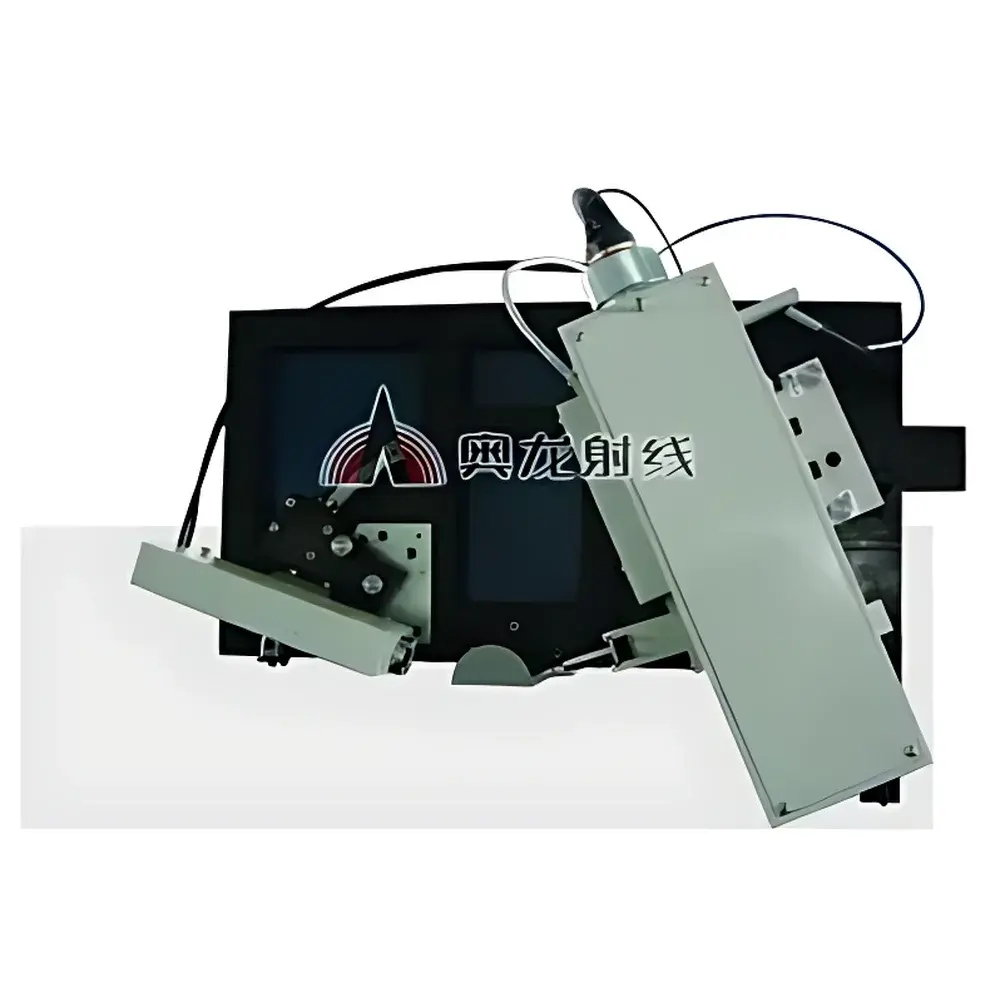
Aolong Sapphire Four-Axis X-Ray Orientation Instrument
| Brand | Aolong |
|---|---|
| Origin | Liaoning, China |
| Manufacturer Type | OEM Manufacturer |
| Origin Category | Domestic (China) |
| Model | Sapphire Four-Axis |
| Input Power | 220 V AC, 50 Hz, 0.3 kW |
| X-ray Tube | Cu anode, air-cooled, 30 kV, 0–5 mA |
| Time Constants | 0.1 s / 0.4 s / 3 s |
| Slit Apertures | 4′ / 5′ / 6′ |
| Optical Shutter | Motorized |
| Control Unit Dimensions | 550 × 350 × 1700 mm (L×W×H) |
| Measurement Unit Dimensions | 750 × 550 × 1800 mm (L×W×H) |
| Weight | 180 kg |
Overview
The Aolong Sapphire Four-Axis X-Ray Orientation Instrument is a dedicated crystallographic alignment system engineered for precise angular orientation of large-diameter sapphire ingots and boules. Based on Bragg’s law and monochromatic X-ray diffraction principles, the instrument determines crystallographic orientation by detecting the angular position of characteristic diffraction peaks from specific lattice planes—namely the A, C, R, and M planes of the hexagonal α-Al₂O₃ crystal structure. Unlike general-purpose X-ray diffractometers, this system integrates a high-stability mechanical architecture with imported synchronous linear motion guides, enabling reproducible goniometric positioning across four independent angular degrees of freedom. It is purpose-built for industrial sapphire fabrication workflows where rapid, operator-independent orientation verification is required prior to slicing, lapping, or epitaxial substrate preparation.
Key Features
- Four-axis angular adjustment mechanism optimized for sapphire’s anisotropic lattice symmetry—supports concurrent alignment to A (11̅02), C (0001), R (10̅12), and M (10̅10) reference planes.
- High-rigidity gantry with precision-machined aluminum alloy frame and imported synchronous timing belt drive system, ensuring sub-arcminute repeatability over extended operational cycles.
- Dedicated Cu-target X-ray tube (30 kV, 0–5 mA) with air cooling and integrated beam collimation; optimized for strong Kα emission at 1.5418 Å to maximize signal-to-noise ratio for sapphire’s low-absorption, high-symmetry structure.
- Motorized optical shutter with fail-safe interlock logic compliant with IEC 61000-6-2/6-4 EMC standards and Class 1 radiation safety requirements per IEC 61010-1.
- Three selectable time constants (0.1 s, 0.4 s, 3 s) for pulse integration, allowing adaptive signal averaging depending on crystal quality, surface finish, and ambient vibration conditions.
- Interchangeable slit collimators (4′, 5′, 6′) enable trade-off tuning between angular resolution and intensity throughput—critical for coarse-grained as-grown boules versus polished seed crystals.
Sample Compatibility & Compliance
The instrument accommodates sapphire ingots up to Ø200 mm and 500 mm in length, with optional custom stage adapters available for non-cylindrical geometries (e.g., rectangular slabs or tapered boules). Sample mounting utilizes vacuum chucks with adjustable tilt compensation to minimize misorientation error from curvature or off-axis growth. All mechanical and electrical subsystems conform to ISO 9001-certified manufacturing protocols. Radiation shielding meets national GBZ 117–2020 and international IEC 62495 standards for cabinet-type X-ray equipment. The system supports GLP-compliant operation through hardware-enforced access control and audit-ready log generation for orientation records, traceable to NIST-traceable calibration artifacts.
Software & Data Management
The embedded control software provides real-time diffraction curve acquisition, peak search via centroid-based algorithm, and automatic plane indexing using preloaded sapphire lattice parameters (a = 4.759 Å, c = 12.991 Å). All measurement data—including motor positions, exposure settings, peak angles, and FWHM values—are timestamped and stored in HDF5 format for long-term archival. Export options include CSV, XML, and PDF reports compatible with LIMS integration. Software architecture adheres to FDA 21 CFR Part 11 requirements: electronic signatures, role-based user permissions, and immutable audit trails are implemented without third-party middleware.
Applications
- Pre-slicing orientation verification of sapphire boules for LED substrate manufacturing.
- Quality assurance of crystal growth direction in Verneuil or Kyropoulos processes.
- Calibration of wafer-level metrology tools (e.g., automated thickness or birefringence mappers).
- R&D validation of heteroepitaxial buffer layer alignment on sapphire templates.
- Teaching and training in solid-state physics and materials science laboratories requiring hands-on Bragg angle analysis.
FAQ
What crystallographic planes does the instrument specifically identify for sapphire?
It identifies the A (11̅02), C (0001), R (10̅12), and M (10̅10) planes—the four most industrially relevant orientations in hexagonal sapphire.
Is the system suitable for other single crystals besides sapphire?
While optimized for α-Al₂O₃, the instrument can be reconfigured for other hexagonal or rhombohedral crystals (e.g., SiC, ZnO) via lattice parameter input and recalibration; support documentation includes procedures for such adaptations.
Does the system require external water cooling or compressed air?
No—its Cu-target X-ray tube uses passive air convection with thermal cut-off protection; no auxiliary utilities are needed beyond standard 220 V AC power.
How is angular accuracy verified and maintained?
Factory calibration employs NIST-traceable silicon reference standards; users may perform routine verification using certified sapphire alignment wafers with known orientation tolerances of ±0.02°.
Can measurement data be exported to third-party analysis platforms like MATLAB or Python?
Yes—raw diffraction intensity vs. 2θ data is exportable in ASCII-compatible CSV format, preserving full metadata including slit width, time constant, and motor encoder counts.
Related Products






