
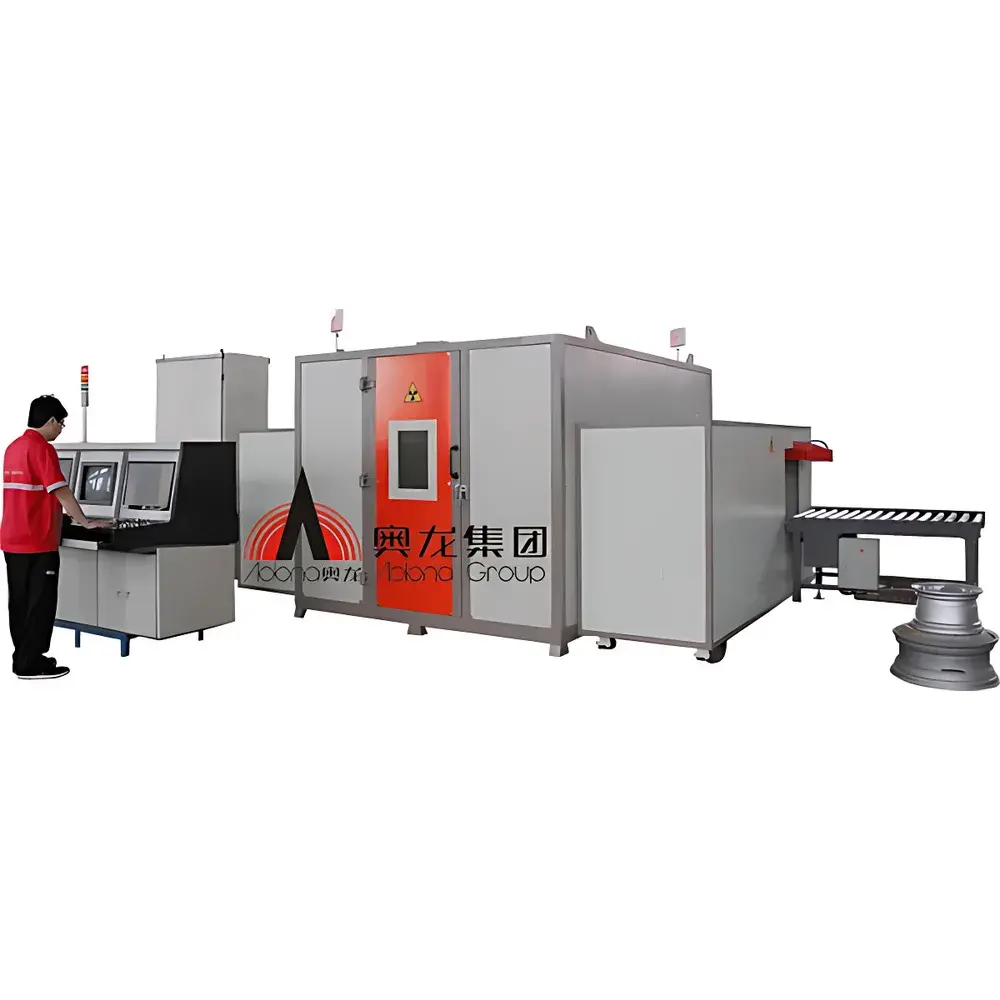
Aolong Wheel X-ray Inspection System
| Brand | Aolong |
|---|---|
| Origin | Liaoning, China |
| Manufacturer Type | OEM Manufacturer |
| Product Category | Domestic |
| Model | Wheel X-ray Inspection System |
| Pricing | Upon Request |
| Detection Range | 13–26 inch wheels |
| Inspection Speed | <30 s per 14-inch wheel |
| Operation Modes | Manual, Semi-Automatic, Fully Automatic |
| Wheel Identification | Automatic model recognition |
| Defect Classification | Automated semi-automatic defect discrimination |
| A/D Resolution | 16-bit |
| System Spatial Resolution | 30–36 LP/cm |
| System Contrast Sensitivity | 1.0–1.8% |
| Control Architecture | PLC + PC-based integrated control |
| X-ray Tube Voltage | 30–160 kV (adjustable) |
| X-ray Tube Current | 0.5–5 mA (adjustable) |
| High-Voltage Inverter Frequency | 40 kHz |
| Core Components | High-frequency X-ray generator, Digital flat-panel detector, Wheel-specific mechanical handling system, Real-time image processing workstation, Centralized control console, Lead-shielded enclosure |
Overview
The Aolong Wheel X-ray Inspection System is a purpose-built industrial digital radiography platform engineered for non-destructive evaluation (NDE) of aluminum and steel automotive wheel castings. It operates on the principle of transmission X-ray imaging—where a controlled X-ray beam penetrates the wheel component, and attenuation variations are captured by a high-sensitivity flat-panel detector to generate high-fidelity grayscale projection images. These images are processed in real time to reveal internal volumetric discontinuities—including gas porosity, micro-cracks, shrinkage cavities, and dendritic segregation—without compromising structural integrity. Designed specifically for Tier-1 foundries and OEM wheel production lines, the system integrates metrologically traceable exposure parameters, geometrically optimized beam collimation, and repeatable positioning mechanics to ensure consistent inspection fidelity across batch-manufactured parts.
Key Features
- High-frequency X-ray generator (30–160 kV / 0.5–5 mA) with 40 kHz inverter technology, enabling stable output, reduced dose variability, and extended tube life.
- Digital flat-panel detector with 16-bit A/D conversion and spatial resolution of 30–36 line pairs per centimeter (LP/cm), supporting detection of sub-millimeter defects in complex wheel geometries.
- Wheel-specific mechanical handling system featuring programmable rotation axes, vertical lift stages, and indexed positioning for precise alignment relative to the X-ray focal spot.
- Automated wheel model recognition via optical barcode/QR code scanning or pre-configured dimensional profiling, enabling adaptive parameter recall (kV, mA, exposure time, ROI definition).
- Integrated lead-shielded enclosure compliant with national radiation safety standards (GBZ 138–2002), including interlocked access doors, warning lights, and dose monitoring interfaces.
- PLC-driven motion control synchronized with image acquisition, ensuring repeatability across manual, semi-automatic, and fully automated inspection cycles.
Sample Compatibility & Compliance
The system accommodates wheel diameters from 13 to 26 inches, covering passenger car, light-truck, and commercial vehicle applications. It supports both low-density aluminum alloy (e.g., A356, A380) and high-density steel wheel castings. All operational protocols align with ISO 17025:2017 requirements for testing laboratories, and image acquisition workflows support audit-ready documentation per IATF 16949 clause 8.5.1.2 (process validation for NDT). While not certified to ASTM E2737 or EN 1435, the system’s contrast sensitivity (1.0–1.8%) and spatial resolution meet minimum thresholds defined in ISO 5579 for industrial radiographic film equivalency. Radiation safety compliance adheres to Chinese national regulations (HJ 1157–2021) and includes built-in dose rate logging for regulatory reporting.
Software & Data Management
The proprietary inspection software provides real-time image enhancement (adaptive histogram equalization, noise suppression filtering, edge sharpening), multi-threshold defect segmentation, and customizable pass/fail logic trees based on user-defined defect size, shape, and location criteria. Image metadata—including exposure parameters, wheel ID, timestamp, operator ID, and system calibration status—is embedded in DICOM-compliant files. Audit trails record all parameter modifications, image annotations, and final disposition decisions, satisfying basic data integrity requirements under GLP frameworks. Export formats include TIFF (16-bit), PNG, and XML-based structured reports compatible with MES and QMS platforms (e.g., Siemens Opcenter, ETQ Reliance). Remote diagnostics and firmware updates are supported via secure HTTPS channel with role-based access control.
Applications
- Final quality gate inspection of gravity die-cast and low-pressure cast aluminum wheels prior to machining and finishing.
- In-process verification during foundry process qualification—e.g., correlating gating design changes with porosity distribution patterns.
- Root cause analysis of field returns involving structural failure, enabling cross-sectional correlation between radiographic anomalies and mechanical test results (e.g., fatigue life, burst pressure).
- Supplier quality assurance audits where objective, image-based evidence replaces subjective visual or ultrasonic sampling.
- Process capability studies (Cp/Cpk) using quantitative defect metrics derived from standardized ROI analysis across sequential production lots.
FAQ
What wheel materials can be inspected with this system?
Aluminum alloys (A356, A380, C380), magnesium alloys, and low-carbon steel wheels—subject to optimization of kV/mA settings and detector gain calibration.
Is the system compliant with international radiation safety standards?
It meets Chinese national radiation protection regulations (GBZ 138–2002, HJ 1157–2021); CE or FDA 510(k) compliance requires site-specific shielding validation and third-party dosimetry certification.
Can inspection data be integrated into our existing ERP or QMS?
Yes—via configurable API endpoints or scheduled file exports (XML, CSV, DICOM-SR) supporting integration with SAP QM, MasterControl, or Qualio.
What maintenance intervals are recommended for the X-ray generator and detector?
X-ray tube: 5,000 operating hours or annual recalibration; Flat-panel detector: biannual dark-current and gain uniformity verification using NIST-traceable phantoms.
Does the system support automated defect classification using AI algorithms?
Base configuration includes rule-based thresholding and morphology filters; optional AI-assisted classification modules (CNN-based) are available as licensed add-ons with separate validation documentation.



