
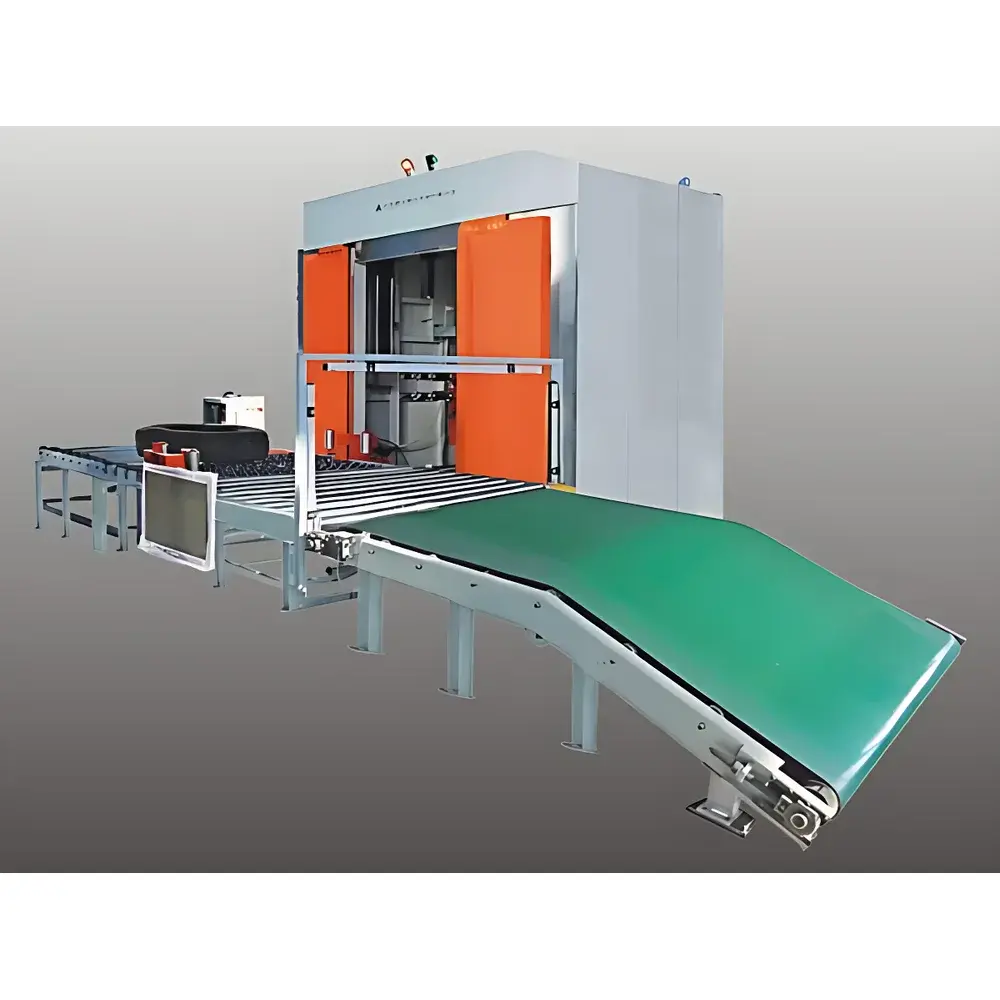
AoLong XYG-1610 Industrial Micro-CT System for Tire Non-Destructive Inspection
| Brand | AoLong |
|---|---|
| Origin | Liaoning, China |
| Manufacturer Type | Direct Manufacturer |
| Regional Classification | Domestic (China) |
| Model | XYG-1610 |
| Pricing | Upon Request |
Overview
The AoLong XYG-1610 Industrial Micro-CT System is a purpose-built non-destructive testing (NDT) platform engineered for high-resolution internal inspection of pneumatic tires across automotive, commercial, and aerospace sectors. Utilizing high-frequency X-ray generation coupled with precision rotational tomographic acquisition, the system reconstructs volumetric 3D datasets via cone-beam computed tomography (CBCT) principles. Unlike conventional 2D radiography, this micro-CT architecture enables axial, sagittal, and coronal sectioning—allowing quantitative analysis of structural integrity, layer alignment, material density distribution, and defect morphology within multi-layered rubber-composite architectures. Designed specifically for tire geometry and material attenuation characteristics, the XYG-1610 integrates synchronized mechanical rotation and detector translation to maintain consistent geometric magnification and minimize motion artifacts during data acquisition.
Key Features
- High-frequency X-ray source optimized for rubber–steel–fabric composite penetration, delivering stable output at adjustable kVp (typically 80–160 kV) and mA settings to balance contrast resolution and dose efficiency.
- Modular detector configuration supporting three validated operational modes: (1) Digital U-shaped linear array detector for continuous scanning of rotating tires; (2) Digital straight-line linear array detector for high-throughput inline inspection; (3) Image intensifier-based analog detection path for cost-sensitive legacy integration or R&D validation workflows.
- Dedicated tire handling subsystem featuring programmable clamping, centering, and angular indexing—compatible with rim diameters from 10″ to 54″, including ultra-large off-the-road (OTR) and aircraft main/tail landing gear tires.
- Lead-shielded inspection chamber compliant with GBZ 130–2020 (Chinese national standard for medical and industrial X-ray protection) and aligned with IEC 61331-1:2014 radiation safety requirements for Class II NDT enclosures.
- Robust mechanical architecture with ±0.02° angular repeatability and sub-micron positional stability over extended duty cycles—ensuring measurement traceability and inter-system reproducibility.
Sample Compatibility & Compliance
The XYG-1610 accommodates radial, bias-ply, and run-flat tire constructions—including passenger car (P-metric), light truck (LT), medium/heavy-duty truck (e.g., 22.5″, 24″, 29.5″), and aviation-grade tires (e.g., Boeing 737NG, Airbus A320 series). It detects internal anomalies such as steel cord misalignment, splice gaps, rubber voids, foreign object inclusion (e.g., metal fragments, stone chips, fabric debris), belt edge separation, and bead wire deformation. All hardware and software components are designed to support ISO/IEC 17025-compliant calibration protocols, and the system architecture permits integration into GLP- and GMP-regulated environments through configurable audit trails, user access controls, and electronic signature capability (aligned with FDA 21 CFR Part 11 Annex 11 principles).
Software & Data Management
Acquisition and reconstruction are managed via AoLong’s proprietary CTStudio v4.x software suite, which supports DICOM 3.0 export, NRecon-style iterative reconstruction algorithms (SART, FDK), and GPU-accelerated volume rendering. Quantitative analysis modules include porosity mapping, fiber orientation tensor calculation, dimensional metrology (GD&T-compliant), and automated defect classification using supervised machine learning models trained on annotated tire failure databases. Raw projection data, reconstructed volumes (.tiff, .nii), and report logs are stored in timestamped, immutable archives with SHA-256 hash verification—enabling full data lineage tracking for quality audits and regulatory submissions.
Applications
- Quality assurance in Tier-1 tire manufacturing: real-time monitoring of green tire curing uniformity and post-vulcanization structural fidelity.
- Recycled tire remanufacturing: validation of casing integrity prior to retreading, including detection of hidden ply separations or cord fatigue zones.
- Aerospace MRO (Maintenance, Repair, Overhaul): certification-level inspection of O-rings, inner liners, and carcass continuity in certified aviation tires per FAA AC 20-127B guidelines.
- R&D laboratories: correlation of microstructural features (e.g., belt angle deviation, rubber-filler dispersion) with dynamic mechanical performance metrics (e.g., rolling resistance, heat buildup).
- Third-party certification bodies: execution of ASTM E2737-22 (Standard Practice for Computed Tomography Examination of Aerospace Components) and ISO 15707:2021 (Non-destructive testing — Industrial computed tomography — Vocabulary and general principles).
FAQ
What types of defects can the XYG-1610 reliably detect in radial passenger tires?
It identifies steel belt misalignment (>0.3° angular deviation), splice voids ≥50 µm in equivalent diameter, embedded metallic contaminants ≥0.1 mm, and rubber delamination exceeding 0.2 mm thickness.
Is the system compatible with existing factory automation infrastructure?
Yes—equipped with OPC UA server interface, Modbus TCP support, and PLC-triggered acquisition mode for seamless integration into Industry 4.0 production lines.
Does the system support automated pass/fail reporting per customer-defined acceptance criteria?
Yes—custom rule engines allow definition of spatial thresholds, density ranges, and geometric tolerances; reports comply with ISO 10012:2003 measurement management requirements.
Can the XYG-1610 perform quantitative density analysis across tread compounds?
Yes—calibrated Hounsfield Unit (HU) mapping enables relative density comparison between tread cap, base, sidewall, and bead filler regions, supporting compound consistency verification.
What documentation is provided for regulatory validation?
Includes IQ/OQ/PQ protocol templates, radiation output test certificates, mechanical repeatability reports, and software validation summary per GAMP 5 guidelines.



