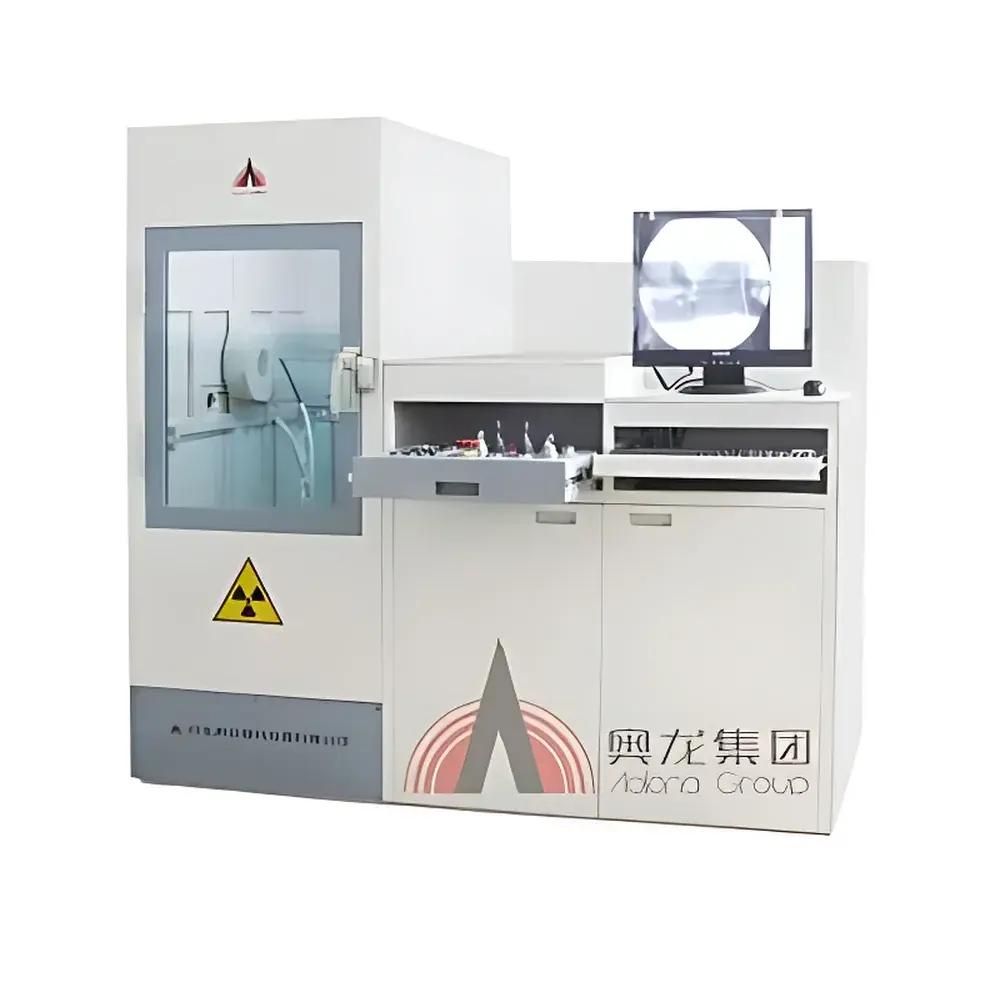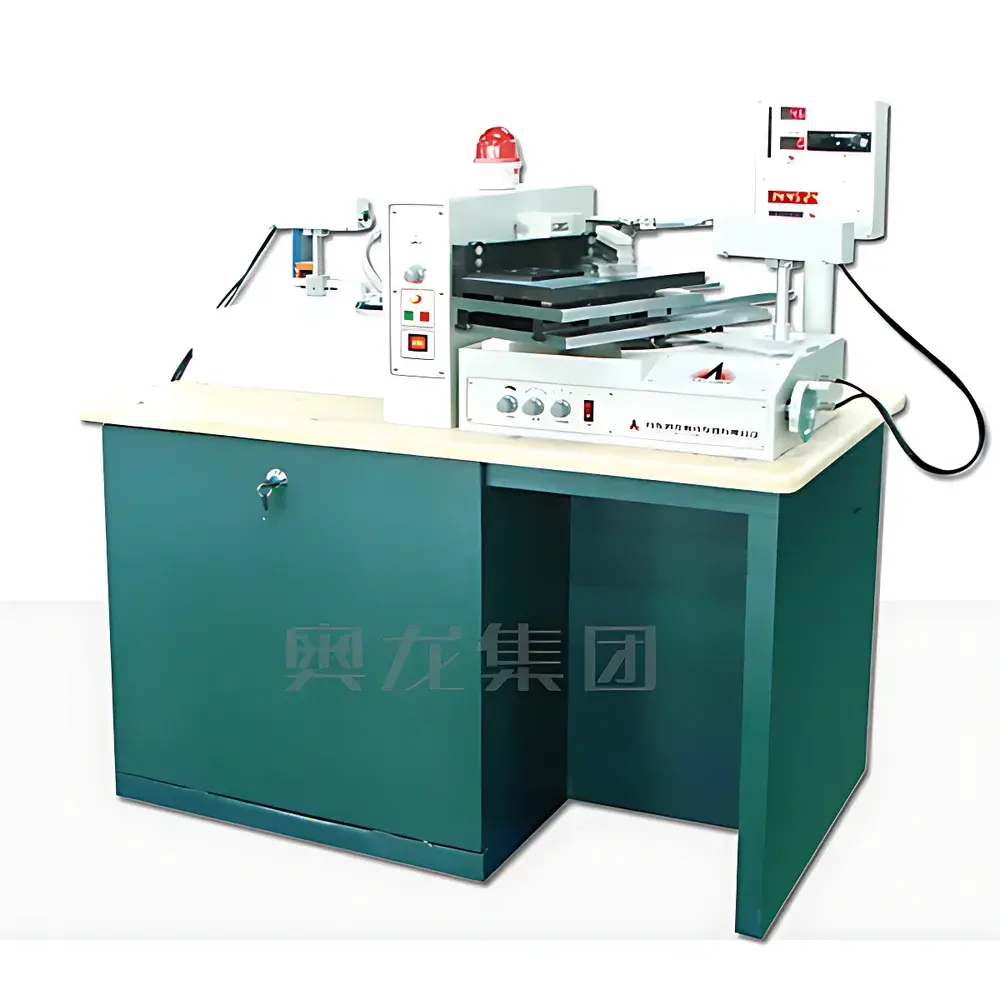
Aolong YXL-2 Crystal Adhesive X-ray Orientation Instrument

| Brand | Aolong |
|---|---|
| Origin | Liaoning, China |
| Manufacturer Type | Manufacturer |
| Model | YXL-2 |
| Power Supply | 220 V AC, 50 Hz, 0.3 kW |
| X-ray Tube | Cu anode, air-cooled |
| Detector | Geiger–Müller counter |
| Time Constants | 0.1 s, 0.4 s, 3 s |
| Angular Range | θ = −10° to +50°, 2θ = −10° to +100° |
| Angular Resolution | 1° (scale), 1″ / 3″ (digital readout) |
| Angular Accuracy | ±10″ |
| Optical Shutter | Manual |
| Display | Digital angle readout with peak-hold analog meter |
| Main Frame | YX-300 base unit |
| Sticky Board Dimensions | 330 × 200 × 20 mm or 250 × 250 × 20 mm |
| Crystal Rod Thickness Options | 7 mm, 8 mm, 9 mm, 10 mm |
| Max Adhesive Layers | 5 (standard), 6 (optional) |
| Layer Adjustment Method | Precision-matched cushion bars |
| Board Fixation | Permanent magnetic clamping |
| Board Translation Mechanism | Imported high-precision linear rail system |
| Weight | 180 kg |
| Overall Dimensions | 1140 mm (L) × 650 mm (W) × 1100 mm (H) |
Ask about pricing, availability and specifications.
Overview
The Aolong YXL-2 Crystal Adhesive X-ray Orientation Instrument is a dedicated precision alignment system engineered for the quartz crystal manufacturing industry. It employs Bragg diffraction-based X-ray orientation analysis to determine the crystallographic cut angle—specifically for AT-cut quartz wafers—by measuring the angular position of characteristic diffraction peaks from the crystal lattice. Unlike general-purpose X-ray diffractometers, the YXL-2 integrates mechanical crystal handling and adhesive mounting directly into its measurement workflow. Its dual-mode configuration supports both pre-cut crystal rod orientation (via unilateral sticky table) and post-cut wafer verification (via bilateral configuration with integrated YX-300 orientation module). The instrument operates using a copper-target, air-cooled X-ray tube and a Geiger–Müller detector, delivering stable, repeatable angular measurements traceable to fundamental crystallographic reference planes such as the R-plane. Designed for production-floor robustness and metrological consistency, it satisfies routine QC requirements in quartz resonator fabrication where angular deviation beyond ±10 arcseconds directly impacts frequency stability and temperature coefficient.
Key Features
- Dual-configurable worktable: Unilateral mode for crystal rod adhesive mounting (AT-cut orientation via large R-face referencing); bilateral mode enabling simultaneous adhesive placement on one side and post-cut wafer inspection on the other using the integrated YX-300 orientation module.
- Micrometer-driven fine angular adjustment with calibrated scale (1° resolution) and digital readout (1″/3″ selectable resolution) featuring peak-hold memory for optimal diffraction signal capture.
- Magnetically secured, interchangeable sticky boards (330 × 200 × 20 mm or 250 × 250 × 20 mm) mounted on imported high-precision linear rails for smooth, backlash-free translation during alignment.
- Layered stacking controlled via standardized cushion bars matched to crystal rod thickness (7–10 mm), ensuring consistent vertical registration across up to six adhesive layers.
- Manual optical shutter and three-step time-constant selection (0.1 s / 0.4 s / 3 s) allow optimization of signal-to-noise ratio for varying crystal quality and surface conditions.
- Integrated digital angle display synchronized with analog rate meter, providing real-time feedback during manual crystal rotation and enabling operator verification of diffraction peak stability.
Sample Compatibility & Compliance
The YXL-2 is optimized for synthetic alpha-quartz (SiO₂) crystals used in frequency control devices. It accommodates standard cylindrical crystal rods (diameters compatible with common slicing equipment) and finished wafers up to 25 mm in diameter. The “+X” upward adhesive orientation protocol aligns with industry-standard AT-cut fabrication workflows defined in IEC 60122-1 and GB/T 12467 (Chinese national standard for quartz crystal units). While not certified to ISO/IEC 17025 as a standalone calibration instrument, its ±10″ angular accuracy meets internal QC thresholds required for GMP-aligned quartz manufacturing environments. All electrical components comply with GB 4793.1 (equivalent to IEC 61010-1) for safety in laboratory and light industrial settings. No radioactive sources are employed; operation relies solely on low-power bremsstrahlung X-ray generation.
Software & Data Management
The YXL-2 operates as a hardware-integrated manual alignment platform without embedded microprocessor control or proprietary software. All measurement data—including θ and 2θ angles, exposure duration, and peak intensity—are recorded manually by the operator into standardized QC logbooks or LIMS-compatible spreadsheets. The analog/digital hybrid display provides immediate visual confirmation of diffraction alignment, supporting GLP-compliant documentation when paired with controlled forms and signature fields. For facilities requiring electronic audit trails, integration with third-party data acquisition systems is feasible via RS-232 or analog voltage output (0–10 V proportional to angle), though no native FDA 21 CFR Part 11 compliance is provided out-of-the-box. Calibration records and maintenance logs must be retained per manufacturer-recommended intervals (quarterly tube output verification, annual mechanical recalibration).
Applications
- Precision orientation of quartz crystal rods prior to AT-cut slicing, using the R-plane as primary reference for minimizing frequency-temperature hysteresis.
- Verification of cut-angle fidelity on finished quartz blanks following lapping and etching, ensuring adherence to ±0.01° tolerances specified in MIL-PRF-3099 and EIA-555 standards.
- Batch-level consistency monitoring across multi-layer adhesive stacks in high-volume resonator production lines.
- Root-cause analysis of frequency drift in prototype devices by correlating measured orientation error with post-fabrication electrical testing results.
- Training platform for crystallographic orientation fundamentals in technical vocational programs focused on piezoelectric materials processing.
FAQ
What crystallographic planes does the YXL-2 reference for AT-cut orientation?
The instrument uses the large R-plane (rhombohedral plane) as the primary physical reference surface during rod mounting, enabling calculation of the nominal AT-cut angle (35.25° from Z-axis) via established quartz orientation matrices.
Is the YXL-2 suitable for non-quartz piezoelectric materials such as lithium niobate or langasite?
No—it is mechanically and geometrically optimized for α-quartz’s specific lattice parameters, density, and diffraction geometry. Substitution would require recalibration of angular offsets and validation against material-specific Bragg angles.
Does the system include automated sample scanning or motorized goniometry?
No. All angular positioning is performed manually using micrometer drives and vernier scales. Automation requires external retrofitting and is not supported by the original design.
Can the YXL-2 perform full XRD pattern acquisition or phase identification?
No. It is a single-peak angular locator—not a diffractometer. It measures only the angular position of one selected reflection (e.g., quartz 101 or 112) for orientation verification.
What maintenance is required for long-term angular accuracy?
Annual mechanical recalibration of the goniometer axis orthogonality and quarterly verification of X-ray tube output stability using a certified reference crystal are recommended to maintain ±10″ performance.