
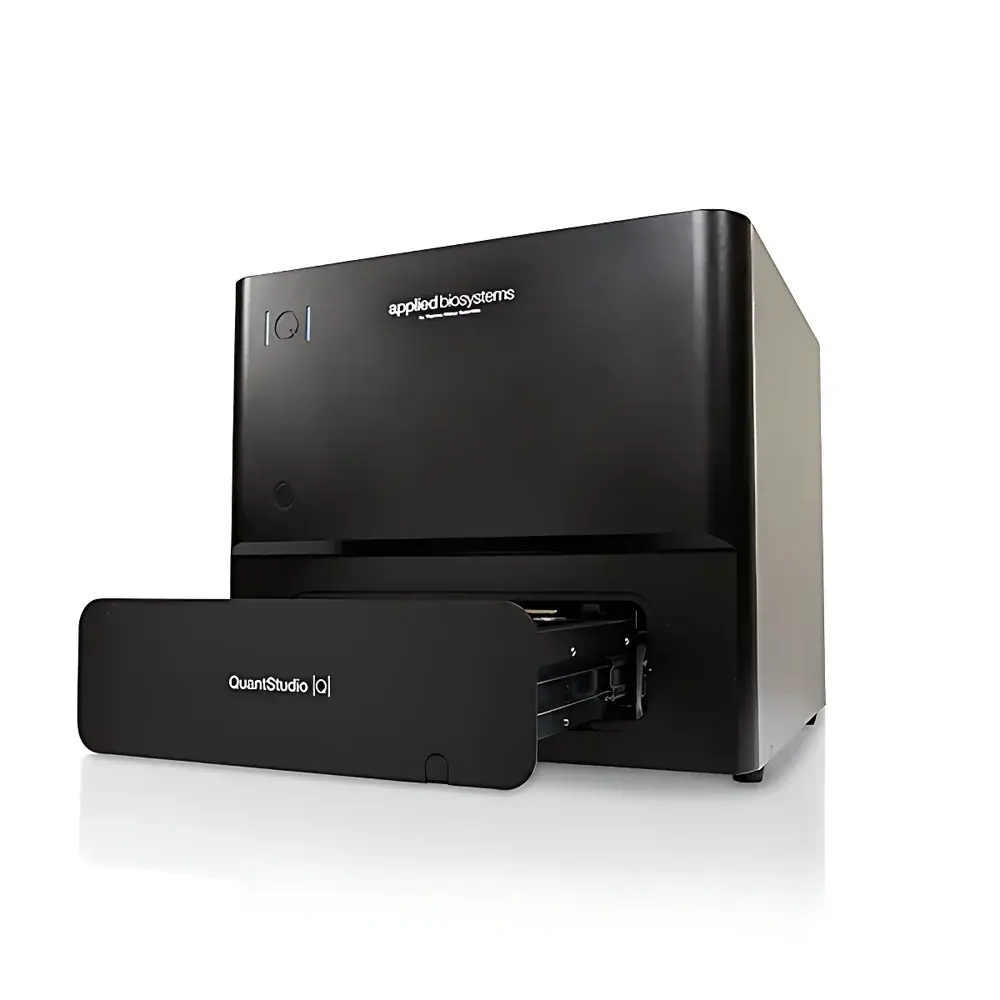
Applied Biosystems QuantStudio Absolute Q Digital PCR System
| Brand | Thermo Fisher Scientific |
|---|---|
| Origin | Singapore |
| Manufacturer | Thermo Fisher Scientific |
| Product Type | Imported Digital PCR Instrument |
| Model | QuantStudio Absolute Q |
| Sample Throughput | Up to 16 samples per run on a single MAP16 microfluidic array plate (configurable in multiples of 4: 4, 8, 12, or 16) |
| Fluorescence Channels | 5-color detection (factory-calibrated) |
| Detection Principle | Nanowell-based digital PCR using fixed-volume microfabricated wells |
| Effective Partitioning Efficiency | >95% active reaction partitions |
| Dead Volume | <5% |
| Integrated Workflow | Fully automated droplet generation, thermal cycling, fluorescence imaging, and data analysis |
| Run Time | ~90 minutes from sample loading to final quantification report |
| Software Compliance | Supports audit trail, user access control, and electronic signature per FDA 21 CFR Part 11 requirements |
Overview
The Applied Biosystems QuantStudio Absolute Q Digital PCR System is an integrated, benchtop platform engineered for absolute nucleic acid quantification at single-molecule resolution. Unlike conventional endpoint or real-time PCR methods, this system implements a solid-phase digital PCR (dPCR) architecture based on patented microfluidic array partitioning technology. Instead of generating emulsion-based droplets, it utilizes a silicon-molded MAP16 chip containing 20,480 precisely defined nanowells—each with uniform geometry and volume—to physically isolate individual template molecules prior to amplification. This deterministic partitioning approach eliminates stochastic variability associated with droplet size distribution and coalescence, thereby delivering superior precision, reproducibility, and dynamic range in absolute copy number determination. The system is designed for laboratories requiring trace-level detection, high-confidence rare-allele discrimination, and regulatory-compliant workflows in clinical research, translational diagnostics, and biopharmaceutical development.
Key Features
- Fully integrated workflow: Combines microfluidic sample partitioning, thermal cycling, multi-channel fluorescence imaging, and quantitative analysis in a single instrument—no external droplet generators, readers, or third-party software required.
- MAP16 microfluidic array plate: Manufactured via high-precision microinjection molding to ensure consistent nanowell dimensions (depth, diameter, spacing), enabling >95% effective loading efficiency and <5% dead volume across all 20,480 reaction compartments.
- Enhanced optical detection module: Equipped with three stabilized LED light sources and five factory-calibrated fluorescence detection channels (including a dedicated ROX reference channel for quality control), supporting simultaneous multiplexed target interrogation without spectral crosstalk correction.
- QuantStudio Analysis Software v2.0: A validated, GxP-ready application providing intuitive plate layout design, thermal profile configuration, real-time image acquisition monitoring, automated thresholding, and statistical confidence interval reporting. Supports role-based user permissions, electronic signatures, and full audit trail logging compliant with FDA 21 CFR Part 11 and ISO/IEC 17025 requirements.
- Rapid turnaround time: Delivers quantitative results—including Poisson-corrected absolute copy number, confidence intervals, and QC metrics—in approximately 90 minutes post-sample loading.
- Flexible throughput scalability: Supports 4-, 8-, 12-, or 16-sample runs on a single MAP16 chip, optimizing reagent utilization and reducing per-sample cost without compromising assay sensitivity or precision.
Sample Compatibility & Compliance
The QuantStudio Absolute Q system accepts standard PCR-grade reaction mixes and commercially available TaqMan assays, hydrolysis probes, and intercalating dyes compatible with digital PCR chemistry. It accommodates input DNA/RNA concentrations ranging from sub-attomolar to low picomolar levels, making it suitable for cfDNA, exosomal RNA, CRISPR editing validation, and residual host cell DNA quantification. All consumables—including MAP16 chips, sealing films, and master mix kits—are manufactured under ISO 13485-certified conditions and supplied with lot-specific certificates of analysis. The platform meets essential performance criteria outlined in ISO 20387 (biobanking), CLSI EP17-A2 (limit of detection verification), and ASTM E3169-20 (digital PCR performance standards). Instrument firmware and software are qualified for use in GLP and GMP environments, including routine IQ/OQ/PQ validation support documentation.
Software & Data Management
QuantStudio Analysis Software provides end-to-end data integrity management through built-in features including encrypted local database storage, version-controlled protocol templates, and exportable reports in PDF, CSV, and MIQE-dPCR-compliant XML formats. Raw fluorescence intensity data, well-level binary classification (positive/negative), and Poisson-adjusted concentration estimates are retained with full metadata linkage (user ID, timestamp, instrument serial number, chip lot). Audit trails record all parameter modifications, result recalculations, and user logins. Remote data backup integration with network-attached storage (NAS) or LIMS systems is supported via secure FTP/SFTP protocols. Software updates undergo rigorous regression testing and are distributed with formal release notes and impact assessments aligned with ICH GCP and FDA guidance on computerized system validation.
Applications
This system serves as a primary quantification tool in applications demanding unambiguous molecular counting and minimal measurement uncertainty. Key use cases include: detection and monitoring of low-frequency somatic mutations in liquid biopsy specimens; absolute calibration of NGS library preparation inputs; verification of gene editing efficiency (e.g., HDR/NHEJ ratios); precise copy number variation (CNV) profiling in prenatal and oncology panels; quantification of viral load in latent infections (e.g., HIV reservoirs, HBV cccDNA); and reference material certification for ISO Guide 34 accredited reference laboratories. Its robustness supports routine deployment in core facilities, contract research organizations (CROs), and diagnostic labs operating under CAP, CLIA, or CE-IVDR frameworks.
FAQ
What distinguishes the QuantStudio Absolute Q from droplet-based dPCR platforms?
It uses a solid-phase nanowell array instead of oil-water emulsions, eliminating droplet coalescence, sedimentation, and size heterogeneity—resulting in higher partitioning fidelity and lower technical CV.
Is the MAP16 chip reusable?
No. Each MAP16 chip is a single-use, sterile, pre-packaged consumable designed for one run only to ensure cross-contamination prevention and consistent performance.
Can the system perform absolute quantification without a standard curve?
Yes. Digital PCR enables direct calculation of target concentration based on the ratio of positive to negative partitions and total partition count, independent of amplification efficiency or reference standards.
Does the software support custom assay design or probe optimization?
While assay development is performed externally, the software allows flexible configuration of excitation/emission filters, background subtraction algorithms, and adaptive thresholding for novel probe chemistries.
What regulatory documentation is provided for installation qualification?
Thermo Fisher supplies comprehensive IQ/OQ documentation packages, including test scripts, acceptance criteria, and blank execution records—fully editable for site-specific validation protocols.




