
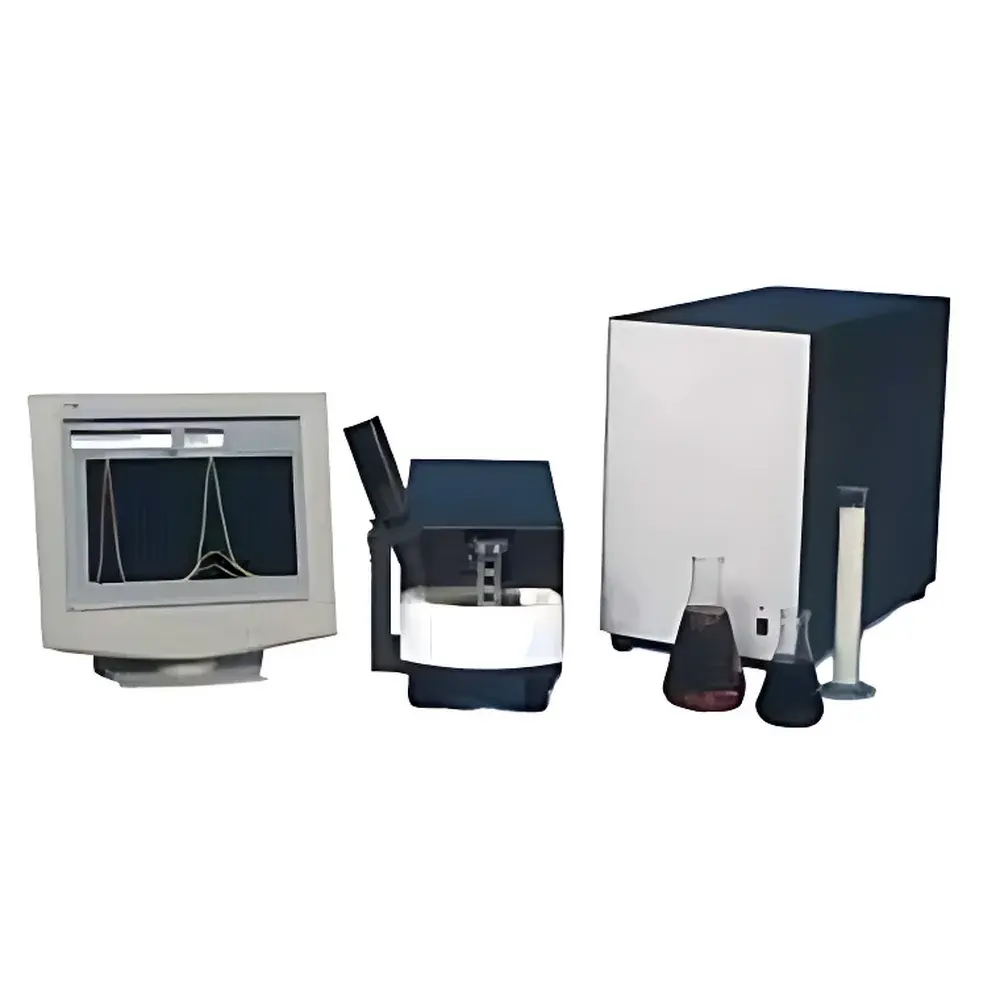
APS-100 Acoustic Nanoparticle Size Analyzer
| Origin | USA |
|---|---|
| Distribution Model | Authorized Distributor |
| Import Status | Imported |
| Model | APS-100 |
| Price Range | USD 0–15,000 |
| Dispersion Method | Dry & Wet Dispersion |
| Measurement Range | 10 nm – 100 µm |
| Reproducibility | <1% RSD |
| Measurement Time | ≤10 minutes |
Overview
The APS-100 Acoustic Nanoparticle Size Analyzer is a high-precision, non-optical particle sizing instrument engineered for direct analysis of concentrated, opaque, and undiluted colloidal dispersions and slurries. Unlike laser diffraction or dynamic light scattering (DLS) systems—which require dilution, optical transparency, and shape assumptions—the APS-100 employs broadband acoustic attenuation spectroscopy (1–100 MHz) to determine particle size distribution (PSD) based on first-principles physics. This technique measures how sound waves attenuate as they propagate through a dispersion; the frequency-dependent attenuation spectrum is mathematically inverted using robust inverse algorithms to resolve PSD without empirical calibration or prior knowledge of particle morphology. The method is intrinsically insensitive to zeta potential, refractive index, or sample color, enabling reliable characterization of high-solids formulations (e.g., CMP slurries >30 wt%), emulsions, ceramic pastes, and biological colloids where optical methods fail. Designed for laboratory R&D, QC/QA, and process monitoring environments, the APS-100 delivers traceable, model-independent PSD data compliant with ASTM E2490 and ISO 13322-2 (acoustic methods).
Key Features
- True undiluted measurement capability: Analyzes samples at native concentration—no dilution, no centrifugation, no filtration required.
- Extended dynamic range: Resolves particles from 10 nm to 100 µm in a single measurement run.
- Multi-parameter acquisition: Simultaneously records acoustic attenuation spectra, pH, electrical conductivity, temperature, and solids content (wt%) in real time.
- Shape-agnostic analysis: Eliminates reliance on assumed particle geometry (e.g., spherical, log-normal, monomodal), avoiding bias introduced by optical modeling constraints.
- Robust fluid handling: Integrated magnetic stirrer or peristaltic pump option ensures homogeneous sampling during measurement, mitigating sedimentation effects.
- Low maintenance architecture: Solid-state transducers, sealed flow cell, and absence of optical alignment reduce downtime and service intervals.
Sample Compatibility & Compliance
The APS-100 accommodates aqueous and non-aqueous systems—including polymer lattices, pigment dispersions (TiO₂, carbon black), catalyst suspensions, pharmaceutical nanosuspensions, CMP slurries, ceramic slips, and oil-in-water/water-in-oil emulsions. Its acoustic methodology satisfies regulatory expectations for method validation under ICH Q5A, USP , and FDA 21 CFR Part 11 when configured with audit-trail-enabled software. Instrument performance adheres to GLP/GMP-aligned operational protocols, with full traceability of raw attenuation spectra, inversion parameters, and environmental metadata (temperature, conductivity, pH) stored alongside each PSD report. All measurements are fully reproducible across laboratories, supporting inter-site comparability studies per ISO/IEC 17025 requirements.
Software & Data Management
The proprietary AcouSolve™ software—developed over two decades by Lucent Technologies—provides intuitive, workflow-driven operation. A single mouse click initiates automated measurement, spectral acquisition, and PSD calculation. The interface supports side-by-side PSD overlay, statistical comparison (e.g., D10/D50/D90 shifts), and export to CSV, Excel, or MATLAB-compatible formats. Raw attenuation spectra (dB/cm vs. MHz) are retained for reprocessing with updated inversion models. Batch processing, user-defined pass/fail criteria, and electronic signature support enable deployment in regulated QC environments. No reference standards are required for routine operation, as the acoustic model is grounded in fundamental physical constants (density, compressibility, viscosity). Software validation documentation (IQ/OQ/PQ templates) and 21 CFR Part 11 compliance packages are available upon request.
Applications
- Semiconductor manufacturing: Real-time PSD monitoring of CMP slurries to detect oversized particles (>100 nm) that cause wafer scratching.
- Pharmaceutical development: Quantifying nanosuspension stability and aggregation kinetics without dilution-induced artifacts.
- Coatings & inks: Correlating TiO₂ or pigment PSD with opacity, gloss, and rheology in high-solids formulations.
- Catalysis: Characterizing metal oxide nanoparticle distributions in supported catalyst precursors.
- Food & cosmetics: Assessing emulsion droplet size evolution under thermal or mechanical stress.
- Mineral processing: Measuring particle breakdown efficiency in ultrafine grinding circuits via slurry analysis.
FAQ
Does the APS-100 require calibration with NIST-traceable standards?
No. The acoustic attenuation model is derived from first principles and does not rely on empirical calibration; however, optional verification using certified latex standards is supported for user confidence.
Can it measure zeta potential?
No. The APS-100 is dedicated to acoustic PSD analysis. For zeta potential, complementary electrophoretic instruments (e.g., Malvern Zetasizer) are recommended.
Is temperature control integrated?
Yes. The flow cell includes Peltier-based thermostatic regulation (±0.1°C) with programmable ramping for temperature-dependent stability studies.
What sample volume is required per measurement?
Typical volume is 3–5 mL for batch mode; continuous-flow mode supports inline process sampling with minimal hold-up volume.
How is data integrity ensured in regulated environments?
AcouSolve™ supports role-based access control, electronic signatures, full audit trails, and immutable PDF reporting—all configurable to meet 21 CFR Part 11 and Annex 11 requirements.



