
AquapHOx RF-Series Submersible Multi-Parameter Online Monitoring System for Dissolved Oxygen, pH, and Temperature
| Origin | Germany |
|---|---|
| Manufacturer Type | Authorized Distributor |
| Origin Category | Imported |
| Model | AquapHOx RF-Series |
| Instrument Type | Online Water Quality Analyzer |
| Measured Parameters | Dissolved Oxygen (DO), pH, Temperature |
| Depth Rating | Up to 4000 m |
| Data Storage | 4 GB Industrial-Grade Flash Memory |
| Sensor Technology | RedFlash (RF) Optical Sensing |
| Compliance | Designed for ASTM D888, ISO 5814, ISO 10523, and EU Horizon 2020–validated protocols |
Overview
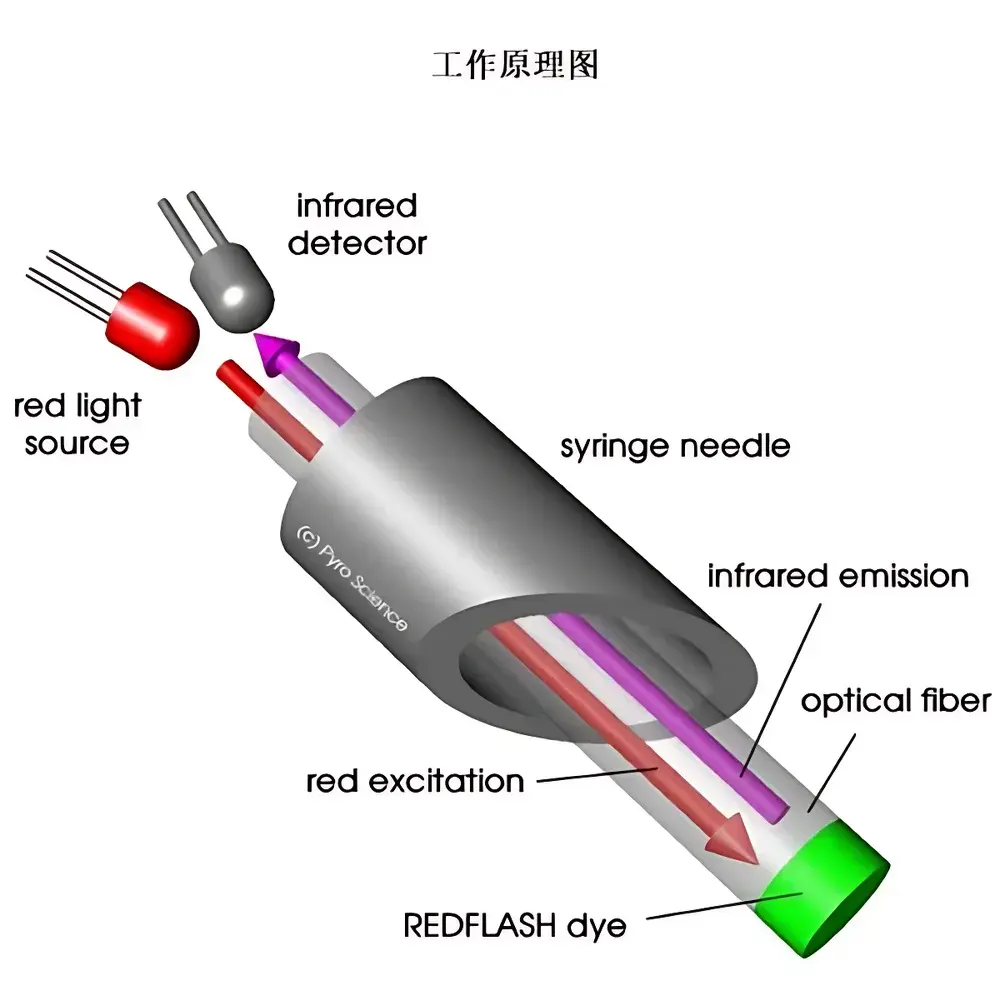
The AquapHOx RF-Series Submersible Multi-Parameter Online Monitoring System is an engineered solution for long-term, high-fidelity in situ monitoring of dissolved oxygen (DO), pH, and temperature in aquatic environments. Based on RedFlash (RF) optical sensing technology—developed and validated under the European Union’s Horizon 2020 research framework—the system eliminates electrochemical drift, membrane fouling, and electrolyte depletion common in traditional Clark-type or glass-electrode sensors. RF technology employs optically active dye layers immobilized on sensor tips, excited by narrow-band red-orange LED light (610–630 nm) and emitting near-infrared fluorescence (760–790 nm). The phase lifetime and intensity of this emission are quantitatively correlated with partial pressure of oxygen (pO₂) and proton activity (pH), while a built-in Pt100 temperature sensor enables real-time thermal compensation. This principle ensures high specificity, minimal cross-sensitivity (<0.5% DO signal shift per pH unit), low phototoxicity to biological samples, and immunity to electromagnetic interference—critical for deployments in conductive seawater, sediment porewater, or bioreactor environments.
Key Features
- Triple-parameter measurement (DO, pH, temperature) within a single, compact submersible housing (Ø63 mm × 300 mm; air weight: 1.35 kg)
- True autonomous operation: onboard lithium-polymer battery, internal 4 GB flash memory, and timestamped logging without external power or PC connection
- Depth-rated to 4000 m: pressure-compensated optical sensor head with titanium alloy housing and FKM O-rings compliant with ISO 8502-3 hydrostatic testing
- Modular sensor architecture: interchangeable optical sensor caps enable rapid reconfiguration between DO, pH, or combined DO/pH modes—no recalibration required upon cap swap
- Three DO sensor variants: Standard (0.05–23 mg/L, t₉₀ < 15 s), High-Speed (t₉₀ < 1 s), and Trace (0.0005–2.3 mg/L, LOD = 0.2 µg/L)
- Two pH sensor options: pH7 (6.0–8.0) and pH8 (7.0–9.0), both with 0.003 resolution at calibration point and t₉₀ < 60 s
- Low-power design: typical operational current draw 6 months continuous logging at 1-min intervals
Sample Compatibility & Compliance
The AquapHOx RF-Series is validated for use across marine, estuarine, freshwater, and engineered aqueous systems—including high-salinity (10–40 PSU), turbid, biofouling-prone, and low-oxygen (sub-micromolar) environments. Its optical design avoids chemical leaching and exhibits no measurable response hysteresis after exposure to H₂S, sulfides, or heavy metals up to EPA Method 1640-relevant concentrations. All sensor variants comply with ISO/IEC 17025-accredited calibration traceability via NIST-traceable reference standards. The system supports GLP-compliant data integrity through embedded audit trails, immutable timestamps, and firmware-locked calibration coefficients. Hardware and software architecture align with FDA 21 CFR Part 11 requirements for electronic records and signatures when used with optional OEM integration modules.
Software & Data Management
The AquapHOx Control Suite (v3.x) is a platform-independent desktop application for Windows, macOS, and Linux. It provides full bidirectional communication via USB or RS485/Modbus RTU, enabling remote configuration of sampling interval (1 s to 24 h), alarm thresholds, and sensor gain settings. Raw sensor outputs are stored in binary .aqx format with embedded metadata (sensor ID, calibration date, depth, battery voltage). Export options include CSV, MATLAB (.mat), and NetCDF4—preserving SI units, uncertainty annotations, and temperature-compensated DO values in both mg/L and % saturation. The software includes automated baseline correction for pH dye photobleaching and dual-wavelength ratiometric processing for oxygen signal stabilization. All calibration routines follow ISO 17025–aligned SOPs, with digital calibration certificates exportable as PDF/A-2.
Applications
- Long-term benthic observatories: deployment on moorings, seafloor landers, or autonomous underwater vehicles (AUVs) for hypoxia zone mapping and ocean deoxygenation trend analysis
- Eddy covariance flux studies: high-speed needle-type DO/pH sensors synchronized with acoustic Doppler velocimeters for turbulent oxygen exchange quantification
- Sediment–water interface profiling: micro- and mini-format sensors mounted on push-core samplers or profiling winches to resolve mm-scale redox gradients
- In situ bioreactor and aquaculture monitoring: probe-style sensors integrated into recirculating systems for real-time process control and feed optimization
- Marine biofouling research: time-series pH and DO measurements at dock pilings and submerged infrastructure to correlate microbial community dynamics with local chemistry
- Laboratory mesocosm studies: OEM modules embedded in custom-built chambers for controlled perturbation experiments under replicated environmental conditions
FAQ
What is the maximum recommended deployment duration without battery replacement?
With default 1-minute logging interval and standard lithium-polymer battery, field endurance exceeds 200 days at 15 °C. Optional extended-life battery packs support >12 months in low-power mode (10-min interval).
Can the system be integrated into existing SCADA or IoT platforms?
Yes. RS485/Modbus RTU output supports direct integration with industrial PLCs, telemetry gateways, and cloud-based platforms (e.g., AWS IoT Core, Azure IoT Hub) using standard Modbus function codes 03/04.
Is factory recalibration required annually?
No. RF optical sensors exhibit intrinsic stability; annual verification against traceable standards is sufficient. Full recalibration is only necessary after physical damage or exposure to solvents beyond IPA cleaning protocols.
How is temperature compensation applied to DO and pH readings?
The onboard Pt100 sensor (±0.1 °C accuracy, t₉₀ < 2 s) feeds real-time thermal data to proprietary algorithms that apply ISO 5814–compliant solubility corrections and Arrhenius-based pH dye response modeling.
Are sensor caps compatible across different AquapHOx generations?
Yes. All RF-Series sensor caps (including legacy Horizon 2020 prototypes) maintain mechanical and optical interface compatibility with current-generation recorders via standardized M12×0.5 optical coupling threads and I²C address mapping.
Related Products







