
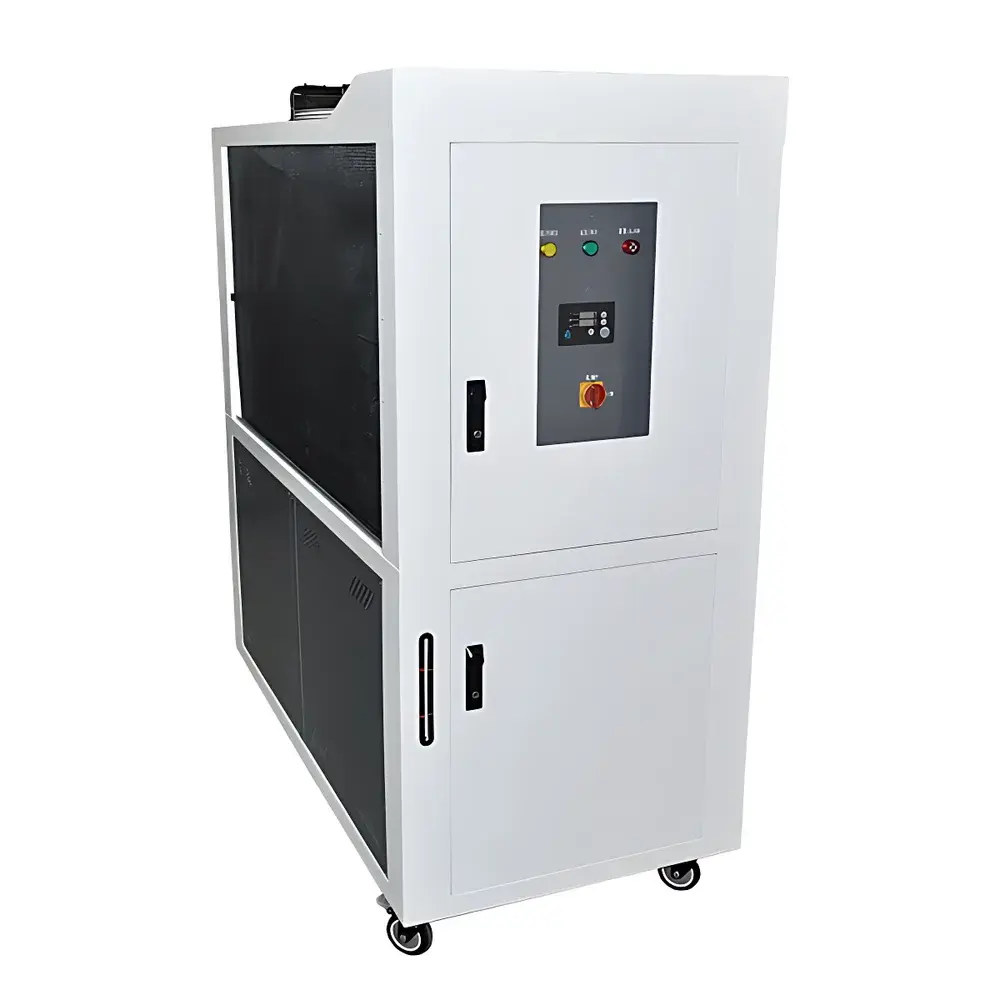
AR Series Air-Cooled Circulating Chiller
| Origin | Beijing, China |
|---|---|
| Manufacturer Type | Authorized Distributor |
| Origin Category | Domestic (China) |
| Model | AR Series |
| Price Range | USD 2,800 – 7,000 |
| Instrument Type | Integrated Unit |
| Cooling Method | Air-Cooled |
| Temperature Control Range | 5–35 °C |
| Refrigeration Capacity | 18–190 kW @ 25 °C |
| Temperature Stability | ±1 °C |
| Circulating Pump Pressure | 19–55 m head |
| Circulating Pump Flow Rate | 1–32 m³/h |
| Reservoir Volume | 150–900 L |
| Operating Principle | Phase-Change Refrigeration |
Overview
The AR Series Air-Cooled Circulating Chiller is an integrated, industrial-grade temperature control system engineered for stable, continuous cooling of high-heat-load laboratory and production equipment. It operates on a vapor-compression refrigeration cycle—utilizing environmentally compliant R-410A or R-134a refrigerant—to deliver precise thermal management across demanding applications such as laser systems, vacuum deposition chambers, CNC machining centers, and bioreactors. Unlike water-cooled chillers requiring external cooling towers or municipal water supply, the AR Series employs a dual-plate finned condenser with hydrophilic blue-coated aluminum fins, enabling efficient heat rejection via ambient air—making it ideal for facilities with limited water infrastructure or strict discharge regulations. Its compact, floor-standing architecture integrates compressor, condenser, evaporator, insulated reservoir, variable-speed circulation pump, and microprocessor-based controller in a single enclosure, minimizing footprint while maximizing service accessibility and operational reliability.
Key Features
- High-efficiency air-cooled condenser with dual-plate design and hydrophilic blue-coated aluminum fins—optimized for thermal transfer, corrosion resistance, and ease of maintenance
- Dual-mode temperature control: “Setpoint Mode” for fixed-temperature operation and “Ambient Tracking Mode” for dynamic synchronization with ambient conditions—enhancing energy efficiency during partial-load operation
- Multi-layer safety architecture including high/low pressure switches, compressor overheating protection, low-flow alarm, reservoir level monitoring, and phase-loss detection
- Modular configuration options: single- or dual-refrigeration circuits with sequential start-up and automatic redundancy switching to ensure uninterrupted cooling
- Optional integrated water filtration system (5–10 µm particulate removal) and corrosion-inhibiting additives compatibility—supporting extended coolant life and reduced maintenance intervals
- Industrial-grade circulation pump with adjustable flow (1–32 m³/h) and head capacity up to 55 m—compatible with high-pressure process loops and long-distance coolant distribution
- Standard dry-contact fault alarm outputs (normally closed) and 0–10 V / 4–20 mA analog interfaces for seamless integration into PLC-controlled environments and machine tool safety interlocks
Sample Compatibility & Compliance
The AR Series supports a wide range of heat-transfer fluids—including deionized water, 20–30% ethylene glycol/water mixtures, and certified synthetic coolants—ensuring compatibility with sensitive optical, electronic, and pharmaceutical process equipment. All models comply with IEC 61000-6-2 (EMC immunity) and IEC 61000-6-4 (EMC emissions) standards. Electrical components meet IP54 ingress protection rating for dust and splash resistance. The chiller’s control logic supports audit-ready operation under GLP and GMP frameworks when paired with optional data logging modules; full traceability—including setpoint history, alarm events, and runtime statistics—is maintained in accordance with FDA 21 CFR Part 11 requirements when used with validated software platforms.
Software & Data Management
Equipped with a 4.3-inch color touchscreen HMI, the AR Series provides intuitive local operation with real-time visualization of refrigerant pressures, inlet/outlet temperatures, flow rate, reservoir level, and system status codes. Optional Ethernet or RS485 Modbus RTU connectivity enables remote monitoring and control via SCADA systems or custom LabVIEW/Python-based dashboards. Data export (CSV format) and scheduled reporting are supported through the onboard SD card slot. For regulated environments, optional firmware upgrades provide password-protected user roles (Operator, Technician, Administrator), electronic signature capability, and tamper-evident event logs—meeting critical requirements for ISO 17025-accredited laboratories and pharmaceutical manufacturing QA/QC workflows.
Applications
- Laser material processing: CO₂, fiber, and diode laser systems requiring stable coolant temperature to maintain beam quality and optics longevity
- Advanced manufacturing: CNC machining centers, EDM wire-cut machines, and plasma cutting systems where thermal drift compromises dimensional accuracy
- Thin-film deposition: Sputtering, evaporation, and PECVD systems demanding consistent substrate cooling to control film stress and stoichiometry
- Pharmaceutical & biotech: Jacketed reactors, fermenters, and chromatography systems requiring precise thermal profiles per USP and ICH Q5C guidelines
- Materials testing: Tensile testers, rheometers, and DSC instruments requiring stable bath temperature for reproducible thermomechanical measurements
- Electronics manufacturing: Reflow ovens, AOI inspection systems, and semiconductor wafer probers with high localized heat flux
FAQ
What refrigerants are used in the AR Series chillers?
All standard configurations use R-410A (for models up to 94 kW) or R-134a (for higher-capacity units), both non-ozone-depleting and compliant with current EU F-Gas and EPA SNAP regulations.
Can the AR Series operate continuously at 5 °C ambient temperature?
Yes—the chiller maintains rated cooling capacity down to 5 °C ambient, with enhanced low-ambient control logic preventing refrigerant flood-back and ensuring stable oil return to the compressor.
Is the reservoir volume adjustable or configurable?
Reservoir size is fixed per model (150–900 L) and optimized for thermal mass stability and pump cavitation prevention; however, external expansion tanks can be added via auxiliary ports for custom loop configurations.
Does the chiller support glycol-based coolants?
Yes—up to 30% ethylene or propylene glycol by volume is supported; derating tables for capacity and flow performance are provided in the technical manual for each model.
What is the expected mean time between failures (MTBF) for the primary refrigeration circuit?
Based on field data from 2021–2023 deployments, the MTBF exceeds 12,000 operating hours under typical industrial duty cycles (85% load, 20 °C ambient), assuming routine maintenance per OEM guidelines.



