
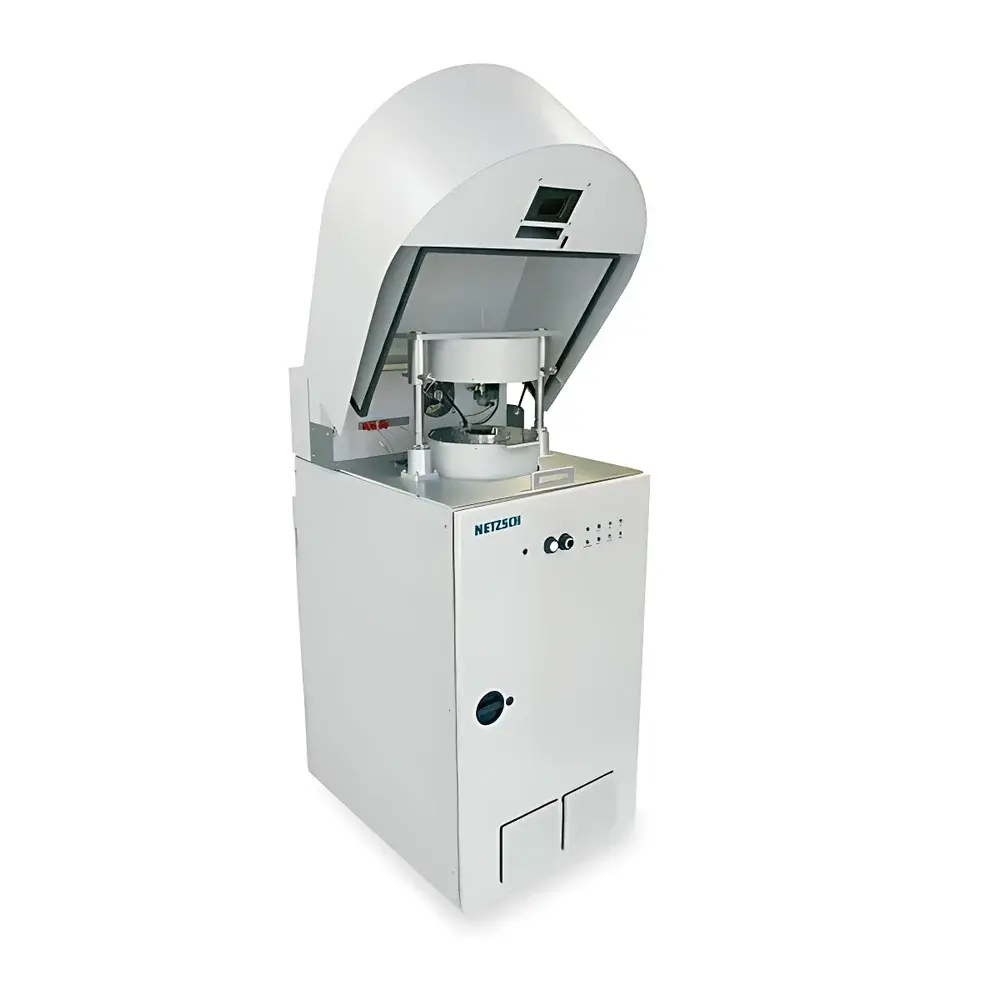
ARC 244 Adiabatic Calorimeter
| Brand | NETZSCH |
|---|---|
| Origin | Germany |
| Model | ARC 244 |
| Operating System | Windows XP-based software platform |
| Heating Element | Tubular heater with minimized heat reflux loss |
| Design | Compact benchtop unit with top-lifting furnace mechanism |
| Software Features | Guided test setup wizard, Variphi® thermal inertia compensation (optional) |
| Safety Architecture | Integrated mechanical interlocks and fail-safe containment protocols |
| Compliance Context | Designed for ASTM E1981, ISO/IEC 17025-aligned thermal hazard assessment workflows |
Overview
The NETZSCH ARC 244 Adiabatic Calorimeter is a precision-engineered benchtop instrument designed to quantify the thermokinetic behavior of reactive chemical systems under near-adiabatic conditions. Based on the classic “heat-wait-search” (HWS) protocol, the ARC 244 dynamically adjusts its furnace temperature to match the sample’s self-heating rate—thereby maintaining an adiabatic environment where heat loss is minimized and measured exothermic power reflects intrinsic reaction kinetics. This principle enables high-fidelity determination of critical safety parameters including onset temperature (Tonset), self-heating rate (dT/dt), pressure rise rate (dP/dt), time-to-maximum-rate (TMR), and adiabatic temperature rise (ΔTad). The system is widely deployed in process safety laboratories, battery R&D centers, and energetic materials evaluation facilities to support quantitative thermal hazard analysis in accordance with internationally recognized frameworks such as CCPS Guidelines, NFPA 496, and EU REACH Annex VII.
Key Features
- Compact benchtop architecture with integrated top-lifting furnace mechanism—enabling rapid sample loading and unloading while preserving thermal stability during operation.
- Tubular heating element design engineered to reduce convective and conductive heat reflux, thereby improving adiabaticity and measurement reproducibility across extended run durations.
- Windows XP–based control software featuring an intuitive guided test setup wizard that standardizes method configuration for users with varying levels of calorimetric expertise.
- Optional Variphi® thermal inertia compensation module—corrects for sample holder and sensor thermal mass effects, enhancing accuracy of kinetic parameter extraction from raw temperature and pressure traces.
- Multi-layer safety architecture including hardware-enforced mechanical interlocks, pressure-rated containment vessel, and real-time overtemperature/overpressure shutdown logic compliant with IEC 61508 SIL 2 functional safety requirements.
Sample Compatibility & Compliance
The ARC 244 accommodates solid, liquid, slurry, and paste samples in standard high-pressure crucibles (typically stainless steel or Hastelloy C-276), supporting mass ranges from 0.5 g to 10 g depending on reactivity class. It is routinely applied to assess thermal stability of lithium-ion battery cathode/anode slurries, polymerization initiators, nitrocellulose-based propellants, airbag inflator formulations, and pharmaceutical intermediates. Data generated meets technical validation criteria for regulatory submissions under FDA 21 CFR Part 11 (when paired with audit-trail-enabled software configurations), EU GMP Annex 15, and ISO/IEC 17025 accredited testing laboratories. All test reports include traceable calibration records per ISO/IEC 17025:2017 clause 6.5.3.
Software & Data Management
Control and analysis are executed via the proprietary NETZSCH ThermoKinetics™ software suite, which provides full traceability of instrument settings, environmental logs, and raw sensor outputs (temperature, pressure, time). Each test session generates timestamped binary data files with embedded metadata—including operator ID, sample ID, crucible type, and calibration coefficients. Export options include CSV, Excel, and XML formats compatible with third-party kinetic modeling platforms such as Kinetics Neo and Chemkin. When configured with optional electronic signature modules, the system supports ALCOA+ data integrity principles and satisfies audit requirements for GLP and GMP environments.
Applications
- Thermal runaway prediction in Li-ion battery cell and electrolyte formulations
- Process safety screening of nitration, oxidation, and polymerization reactions
- Energetic materials characterization for defense and aerospace applications (e.g., propellants, pyrotechnics, detonators)
- Regulatory dossier preparation for REACH, TSCA, and UN Test Series evaluations (e.g., UN H.2, H.3)
- Root cause analysis of field incidents involving exothermic decomposition or runaway reactions
FAQ
What distinguishes the ARC 244 from differential scanning calorimeters (DSC)?
Unlike DSC, which measures heat flow under controlled temperature ramps, the ARC 244 actively maintains near-adiabatic conditions by matching furnace temperature to sample self-heating—yielding kinetically relevant data for worst-case scenario modeling.
Is the Windows XP software compatible with modern network security policies?
Yes—the system operates in isolated lab network environments; data export occurs via secure file transfer protocols, and all analytical post-processing can be performed on current OS platforms using exported datasets.
Can the ARC 244 be used for low-energy reactions (e.g., enzymatic or biological systems)?
It is optimized for medium-to-high energy density systems (>10 J/g); reactions with slow onset or low enthalpy may require complementary techniques such as TAM IV or RC1e for sufficient signal-to-noise resolution.
Does NETZSCH provide calibration services traceable to NIST standards?
Yes—factory and field calibration services include temperature (ITS-90), pressure (deadweight tester), and timebase verification, with certificates issued per ISO/IEC 17025 requirements.






