
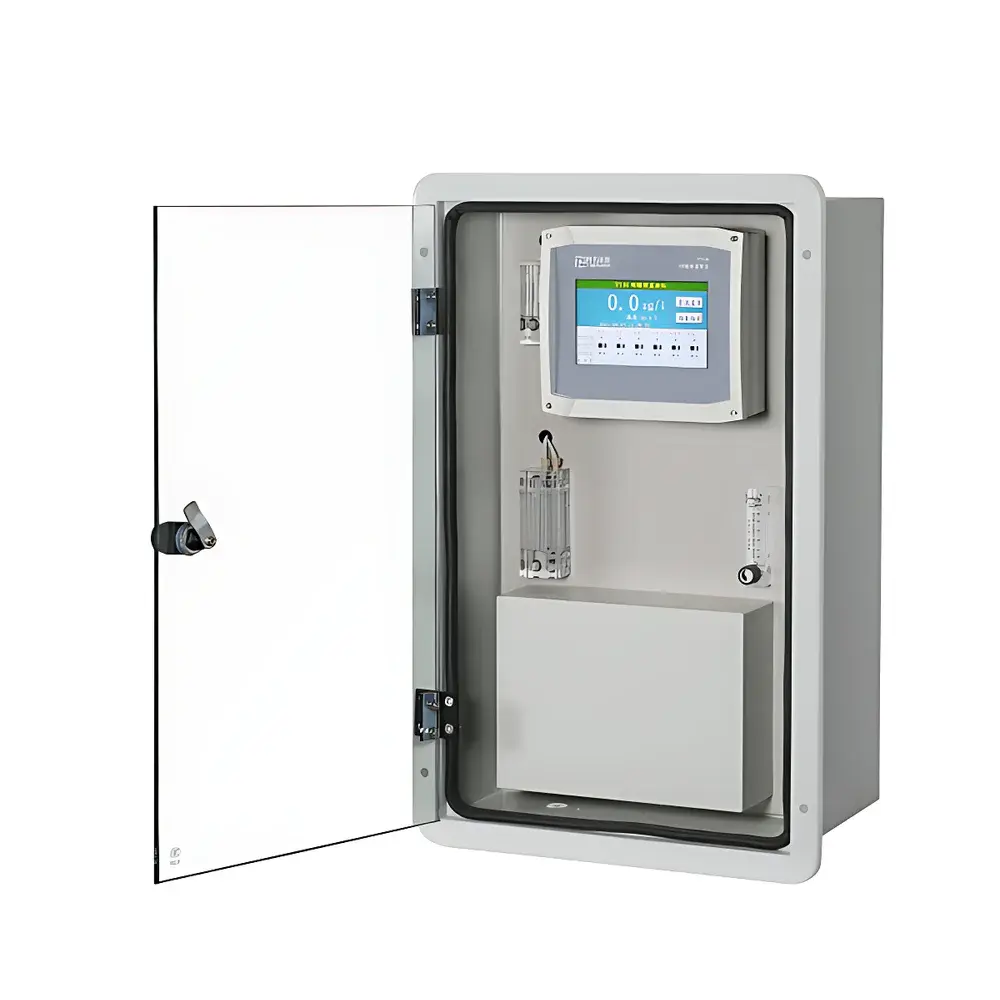
TimePower TP108 Online Hydrazine Analyzer
| Brand | TimePower |
|---|---|
| Origin | Beijing, China |
| Manufacturer Type | Manufacturer |
| Country of Origin | Domestic (China) |
| Model | TP108 |
| Price | Upon Request |
| Measurement Range | 0.0–100.0 μg/L |
| Display | 7.0-inch color LCD touchscreen, Chinese interface |
| Accuracy | ±2% F.S. |
| Repeatability | ≤±1% F.S. |
| Drift | <±1% F.S./24 h |
| Response Time | <4 min |
| Cycle Time | ~3 min per channel |
| Sample Flow Rate | 10–40 L/h |
| Sample Temperature | 5–50 °C |
| Sample Particulates | <5 µm, non-colloidal |
| Ambient Temperature | 5–45 °C |
| Ambient Humidity | ≤90% RH (non-condensing) |
| Reagent Consumption | ~3 L/month |
| Output Signals | Isolated analog current outputs (0–20 mA / 4–20 mA / 0–10 mA, user-selectable) |
| Alarm Outputs | Independent per-channel alarms (flow interruption, upper/lower limit) |
| Power Supply | AC 85–265 V, 45–65 Hz |
| Power Consumption | ≤100 W |
| Dimensions (W×H×D) | 460 × 720 × 280 mm |
| Panel Cutout | 670 × 410 mm |
| Weight | 22 kg |
| Channel Configuration | 1–6 channels selectable |
| Light Source | Monochromatic cold LED source |
| Calibration | Automated dual-point standard calibration at user-defined intervals |
| Data Storage | 30 days of historical data (per channel) |
| Compliance | Designed for continuous operation in industrial process environments per IEC 61000-6-2/6-4 EMI immunity & emission standards |
Overview
The TimePower TP108 Online Hydrazine Analyzer is a fully automated, photometric process analyzer engineered for continuous, real-time quantification of hydrazine (N₂H₄) in aqueous streams under acidic conditions. It operates on the principle of diazo-coupling chemistry: hydrazine reacts stoichiometrically with p-dimethylaminobenzaldehyde (p-DMAB) in low-pH medium to form a stable yellow azo dye, whose absorbance at 455 nm is linearly proportional to hydrazine concentration according to the Beer–Lambert law. This method delivers high selectivity for hydrazine in complex matrices—free from significant interference by common reducing agents (e.g., sulfite, hydroxylamine) or oxidants (e.g., dissolved oxygen, nitrite) when properly conditioned. The instrument is designed for unattended operation in demanding industrial settings—including boiler feedwater circuits in thermal power plants, catalyst protection loops in ammonia synthesis units, and corrosion inhibitor monitoring in petrochemical cooling systems—where sub-ppb to low-ppb level hydrazine control is critical to prevent copper alloy degradation and ensure steam purity compliance per ASTM D1066 and IAPWS guidelines.
Key Features
- Modular multi-channel architecture supporting 1–6 independent measurement paths—enabling simultaneous monitoring of multiple sample points (e.g., deaerator outlet, economizer inlet, condensate polishing effluent) without hardware duplication.
- High-reliability fluidic system incorporating imported solenoid valves rated for >1 million actuation cycles, ensuring precise reagent dosing, sample aspiration, and waste discharge over extended service intervals.
- Stable monochromatic cold LED light source with optical path length optimized for 0.0–100.0 μg/L range—eliminating lamp aging drift and thermal noise associated with tungsten-halogen sources.
- Automated two-point calibration using certified hydrazine reference standards (e.g., 10 μg/mL traceable to NIST SRM), scheduled at user-defined intervals (e.g., every 6 or 24 hours) to maintain long-term accuracy without manual intervention.
- Integrated data logging with timestamped storage of raw absorbance values, calculated concentrations, calibration events, and alarm triggers—retained locally for ≥30 days with cyclic overwrite protection.
- Ruggedized panel-mount enclosure (IP54-rated front panel) with 7-inch capacitive touchscreen interface supporting bilingual navigation (English/Chinese), real-time multi-channel trend visualization, and intuitive parameter configuration.
Sample Compatibility & Compliance
The TP108 accepts filtered, non-colloidal water samples with suspended solids <5 μm and temperature between 5–50 °C. It is compatible with typical pretreatment configurations including stainless-steel inline filtration (5 μm mesh), pressure-regulated flow control (10–40 L/h), and optional temperature stabilization loops. The analyzer meets electromagnetic compatibility requirements per IEC 61000-6-2 (immunity) and IEC 61000-6-4 (emission), and its analog output circuitry complies with IEC 61000-4-5 surge immunity (2 kV line-to-earth). While not certified to SIL or ATEX standards, its design supports integration into safety-instrumented systems (SIS) via external logic solvers. For regulated environments, audit trails, electronic signatures, and data export functionality can be configured to align with FDA 21 CFR Part 11 and EU Annex 11 expectations when deployed with validated software protocols.
Software & Data Management
The embedded firmware provides local HMI-based configuration of measurement cycles, alarm thresholds, calibration schedules, and output scaling. All operational parameters—including valve timing sequences, photodiode gain settings, and baseline correction algorithms—are accessible via password-protected engineering menus. Historical data export is supported via USB 2.0 port (CSV format), enabling offline statistical process control (SPC) analysis. Optional Modbus TCP or RS-485 RTU communication modules allow seamless integration with DCS, SCADA, or MES platforms for centralized data aggregation and predictive maintenance analytics. Firmware updates are performed via secure signed packages to ensure integrity and version traceability.
Applications
- Thermal power generation: Continuous monitoring of hydrazine residual in boiler feedwater to verify oxygen scavenging efficiency and prevent flow-accelerated corrosion (FAC) in carbon steel piping.
- Fertilizer production: Control of hydrazine dosage in ammonia synthesis gas purification trains to protect nickel-based catalysts from oxidation.
- Pharmaceutical water systems: Verification of hydrazine removal during WFI (Water for Injection) polishing, supporting USP and EP 2.2.48 water quality specifications.
- Municipal drinking water treatment: Detection of hydrazine carryover from industrial discharges where hydrazine is used as a corrosion inhibitor in closed-loop heating systems.
- Chemical manufacturing: Process endpoint detection in hydrazine-mediated reductions (e.g., nitro-to-amine conversions) and wastewater pretreatment verification prior to biological treatment.
FAQ
What is the minimum detectable hydrazine concentration?
The lower limit of quantitation (LLOQ) is 0.5 μg/L, determined under routine operating conditions with 3-minute cycle time and standard 10 μg/mL calibration stock.
Can the TP108 operate without daily manual maintenance?
Yes—automated calibration, self-diagnostic routines, and robust valve actuation enable uninterrupted operation for ≥30 days between routine filter replacements and reagent refills.
Is the analyzer compatible with third-party DCS systems?
Yes—via configurable 4–20 mA analog outputs or optional Modbus TCP/RTU interfaces, supporting interoperability with Emerson DeltaV, Honeywell Experion, Siemens PCS7, and Yokogawa CENTUM VP.
How is reagent stability ensured during long-term deployment?
p-DMAB reagent is supplied in stabilized aqueous formulation with pH buffering and preservative; shelf life exceeds 12 months unopened, and onboard refrigeration is not required due to low-temperature LED optics and ambient-rated storage compartment.
Does the instrument support GLP/GMP-compliant data handling?
When operated with validated configuration and enabled audit trail logging, the TP108 satisfies core ALCOA+ principles (Attributable, Legible, Contemporaneous, Original, Accurate, Complete, Consistent, Enduring, Available); full 21 CFR Part 11 compliance requires supplementary validation documentation and role-based access control implementation.
Related Products





