
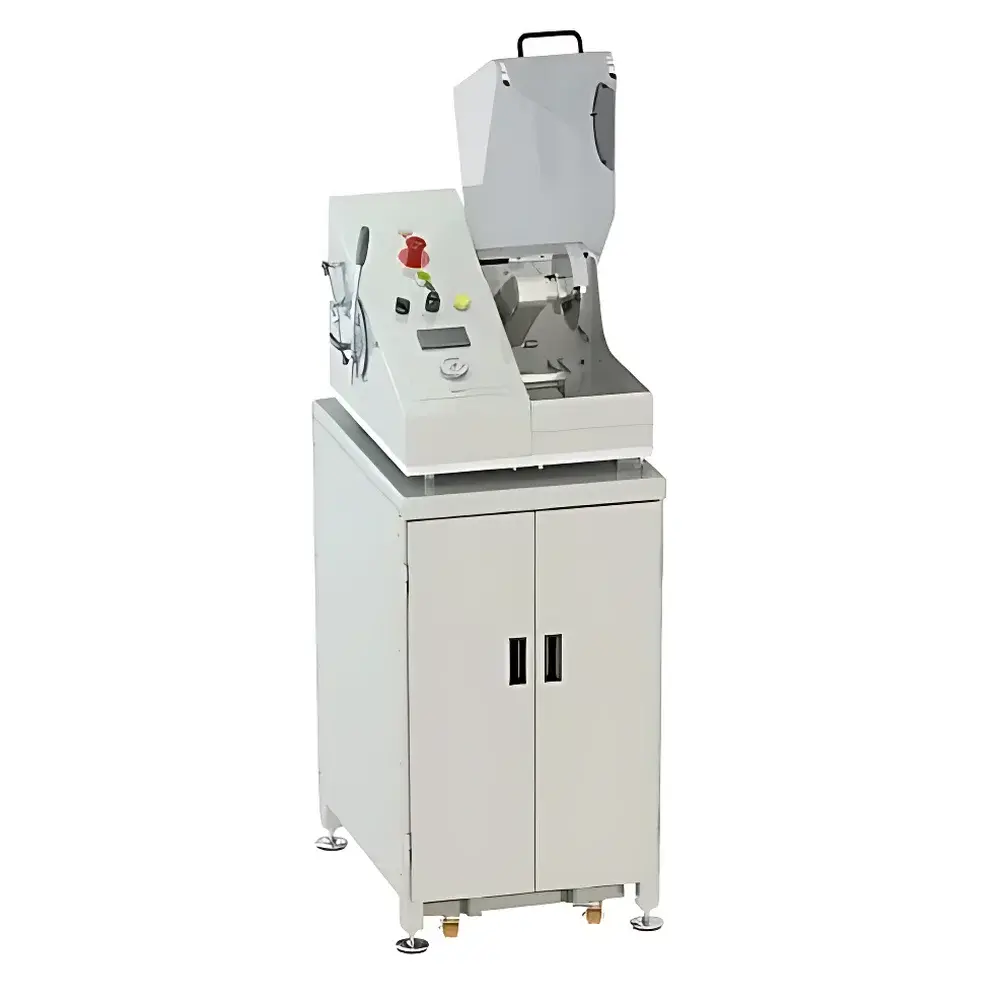
FloXLab SS 150 High-Precision Rock Thin Sectioning Saw
| Brand | FloXLab |
|---|---|
| Origin | France |
| Model | SS 150 |
| Sample Dimensions | Two 30 × 45 mm (1" × 1.5") or One 60 × 45 mm (2.4" × 1.5") Rock Specimens |
| Minimum Thin Section Thickness | 200 µm |
| Cutting Accuracy | ±5 µm |
| Blade Diameter | 150 mm |
| Blade Thickness | 1 mm |
| Spindle Speed | 4000 rpm |
| Motor Speed | 3000 rpm |
| Coolant | Water |
| Power Supply | 220 V, 50/60 Hz |
| Net Weight | 150 kg |
| Footprint | 700 × 700 × 1300 mm |
Overview
The FloXLab SS 150 is a high-precision diamond-blade rock sectioning saw engineered for the final stage of petrographic thin section preparation in geological laboratories, petroleum core analysis facilities, and upstream R&D centers. It operates on a precision-guided linear feed mechanism combined with a rigid, vibration-damped cast-iron frame to deliver consistent kerf control and dimensional repeatability essential for optical microscopy and subsequent SEM-EDS or micro-XRF characterization. Unlike general-purpose cutting systems, the SS 150 is purpose-built for brittle, heterogeneous geological materials—including silicified sandstones, carbonate reservoir cores, shale matrix samples, and igneous xenoliths—where thermal cracking, chipping, or blade deflection must be minimized to preserve textural integrity. Its design adheres to the mechanical constraints defined in ASTM D3289 (Standard Practice for Preparation of Thin Sections of Rock and Mineral Specimens) and supports workflows compliant with ISO 14688-1 for geotechnical classification and API RP 44 for core handling standards.
Key Features
- Sub-10 µm positional repeatability across full X-axis travel, achieved via ground stainless-steel guide rails and servo-controlled feed advancement;
- Dual-mode operation: manual fine-feed mode (0.1 µm increments) for critical edge alignment and automated programmable cut cycles for batch processing;
- Integrated water-based coolant delivery system with adjustable flow rate and nozzle positioning to suppress dust, dissipate frictional heat, and prevent thermal microfracturing;
- Interlocked safety enclosure with opto-electronic curtain and emergency stop circuitry meeting EN 60204-1 and CE Machinery Directive 2006/42/EC requirements;
- Modular blade mounting system compatible with standard 150 mm diamond-impregnated blades (ISO 5272-compliant flange geometry);
- Thermally stable baseplate with integrated leveling feet and anti-vibration rubber mounts to isolate operational resonance from adjacent analytical instrumentation.
Sample Compatibility & Compliance
The SS 150 accommodates both standard petrographic sample formats (30 × 45 mm double-mount blanks) and extended-length core plugs (60 × 45 mm), enabling direct integration into industry-standard thin section production lines. It accepts specimens up to 45 mm in height and 60 mm in length without re-fixturing. All clamping fixtures are fabricated from non-magnetic, corrosion-resistant stainless steel (AISI 316L) to avoid contamination during downstream geochemical analysis. The system conforms to GLP documentation requirements through traceable calibration logs (per ISO/IEC 17025 Annex A.3), and its mechanical tolerances support audit readiness for petroleum service company QA/QC programs aligned with API Q1 and ISO 9001:2015.
Software & Data Management
While the SS 150 operates as a stand-alone benchtop instrument, its motor controller and feed drive accept RS-485 Modbus RTU commands for integration into centralized lab automation platforms. Optional firmware upgrade enables timestamped cut event logging—including blade revolutions, coolant pressure, feed rate, and thermal sensor readings—exportable as CSV for LIMS ingestion. Audit trails comply with FDA 21 CFR Part 11 requirements when deployed with validated third-party SCADA software (e.g., Ignition SCADA or LabVIEW-based control modules). No proprietary cloud interface or vendor-hosted data storage is implemented—data sovereignty remains fully under laboratory IT governance.
Applications
- Preparation of 200–300 µm thick petrographic sections for transmitted light microscopy and cathodoluminescence imaging;
- Cutting of oriented core slabs for digital rock physics (DRP) workflows prior to micro-CT scanning;
- Sectioning of asphaltene-rich crude oil sediment blocks for compositional stratification analysis;
- Trimming of drill-cutting aggregates for quantitative mineralogical assays (QEMSCAN® or MLA-compatible input);
- Production of reference slices for inter-laboratory round-robin testing under ISO/IEC 17043 proficiency schemes.
FAQ
What types of rock lithologies are compatible with the SS 150?
The SS 150 is validated for clastic sediments (sandstone, siltstone), carbonates (limestone, dolomite), low-grade metamorphics (schist, phyllite), and fine-grained igneous rocks (basalt, rhyolite). Highly abrasive ultramafics (e.g., olivine-rich dunites) require specialized diamond concentration blades and reduced feed rates.
Is the machine suitable for use in explosion-proof environments?
No. The SS 150 is not ATEX-certified or rated for Class I Division 1 hazardous locations. It must be operated in ventilated, non-classified laboratory spaces per NFPA 497 guidelines.
Can blade wear be monitored in real time?
Yes—via optional integrated acoustic emission (AE) sensor module (sold separately), which detects harmonic shifts correlating with diamond grain attrition and bond degradation.
Does FloXLab provide calibration certificates with delivery?
Each unit ships with a factory-verified dimensional accuracy report (traceable to LNE, France) and spindle runout certification, valid for 12 months from commissioning date.
What maintenance intervals are recommended?
Coolant filter replacement every 200 operating hours; linear rail lubrication every 500 hours; annual verification of feed encoder linearity and blade flange concentricity by authorized FloXLab service technician.





