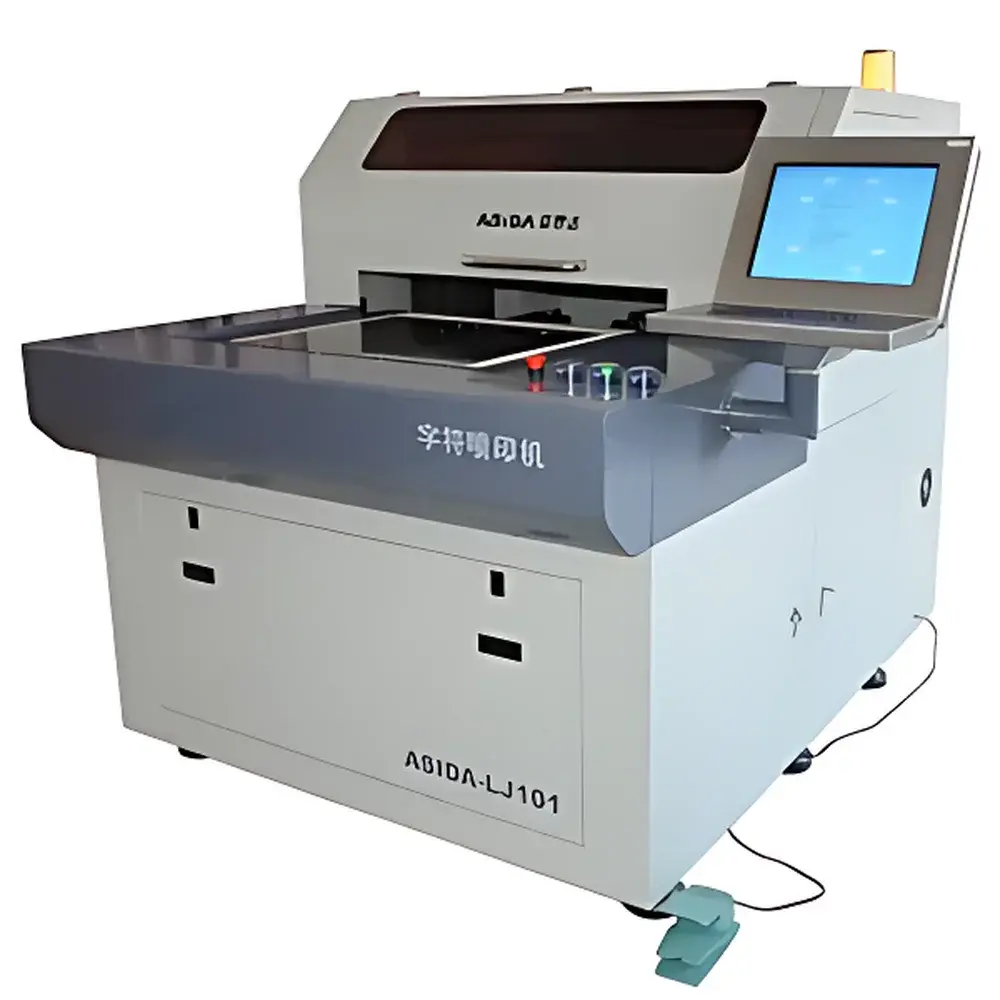
ASIDA LJ101A PCB Character Inkjet Printer
| Brand | ASIDA |
|---|---|
| Model | LJ101A |
| Printing Resolution | 720×720 dpi / 720×1440 dpi |
| PCB Size Range | 170×220 mm to 660×610 mm |
| PCB Thickness Capacity | 0.1–6 mm |
| Minimum Line Width | 70 µm |
| Minimum Character Height | 0.5 mm |
| Printhead | KM1024 (14 pL) |
| Alignment Method | CCD-based 3-point registration |
| Alignment Accuracy | ≤35 µm |
| Curing System | UV LED with active cooling |
| Print Speed | ≤70 s per side (610×457 mm / 24×18 inch) |
| Power Supply | AC 380 V, 10 A, 50 Hz |
| Air Supply | Dry compressed air, 0.5–0.8 MPa |
| Dimensions (W×D×H) | 1350×1790×1500 mm |
| Weight | 1500 kg |
Overview
The ASIDA LJ101A PCB Character Inkjet Printer is a precision-engineered industrial inkjet marking system designed specifically for permanent, high-fidelity alphanumeric and 2D barcode printing on rigid and flexible printed circuit boards (PCBs). Unlike traditional screen printing—requiring stencils, solvent-based inks, and lengthy drying or thermal curing—the LJ101A employs piezoelectric drop-on-demand (DOD) inkjet technology with UV-curable ink formulation, enabling direct-to-board digital printing without physical contact or tooling. Its core measurement and control architecture integrates real-time vision-guided positioning, closed-loop motion control, and deterministic ink deposition physics to ensure consistent character legibility, edge definition, and adhesion across heterogeneous PCB substrates—including FR-4, polyimide (PI), and metal-core laminates. The system operates within Class 10,000 cleanroom-compatible enclosures and is engineered for integration into automated SMT and AOI production lines under IPC-A-600 and IPC-6012 compliance frameworks.
Key Features
- CCD-based three-point automatic registration: Achieves sub-35 µm positional repeatability by detecting fiducial marks or board edges prior to each print cycle.
- Piezoelectric printhead (KM1024, 14 pL droplet volume): Delivers stable jetting performance at resolutions up to 720 × 1440 dpi, supporting minimum line widths of 70 µm and characters as small as 0.5 mm height.
- UV-LED curing subsystem with forced-air thermal management: Ensures immediate ink polymerization upon deposition—eliminating solvent evaporation time and preventing smearing during downstream handling.
- Fully enclosed, zero-waste ink delivery architecture: Includes sealed ink reservoirs, pressure-regulated supply lines, and automated printhead capping/cleaning sequences compliant with ISO 14001 waste minimization principles.
- Adaptive substrate handling: Accommodates PCB thicknesses from 0.1 mm (ultra-thin flex) to 6 mm (heavy copper or multilayer rigid boards) via motorized Z-axis lift and vacuum-assisted clamping.
- Intuitive HMI with recipe-driven operation: Supports batch programming of serial numbers, date/time stamps, QR codes, DataMatrix symbols, and custom fonts—all editable offline and validated via checksum verification pre-print.
Sample Compatibility & Compliance
The LJ101A supports both rigid PCBs (e.g., FR-4, high-Tg epoxy, ceramic substrates) and flexible circuits (polyimide, PET, LCP) without mechanical adaptation. It meets IPC-J-STD-020 moisture sensitivity level (MSL) handling guidelines when integrated with climate-controlled loading stations. All printed identifiers comply with IPC-A-600G Section 3.3 (Marking Requirements) and IPC-6012E Section 4.11 (Permanent Marking Durability), including resistance to solder float testing (288°C/10 s), abrasion (ASTM D3359 Tape Test), and chemical exposure (IPC TM-650 2.6.25). The UV ink formulation conforms to RoHS 2015/863/EU and REACH SVHC thresholds, and the system’s electrical safety complies with IEC 61000-6-2 (immunity) and IEC 61000-6-4 (emissions).
Software & Data Management
The embedded controller runs ASIDA’s proprietary PrintMaster v3.2 firmware, featuring audit-trail logging per FDA 21 CFR Part 11 requirements—including user authentication, electronic signatures, and immutable print job records with timestamps and operator IDs. Data exchange occurs via Ethernet/IP or OPC UA interfaces; CSV and XML export formats support traceability integration with MES platforms (e.g., Siemens Opcenter, Rockwell FactoryTalk). Firmware updates are digitally signed and verified; all configuration changes trigger versioned backups stored on redundant internal SSDs.
Applications
- Front-side and back-side component identification on HDI and IC substrate PCBs.
- Lot/batch serialization and UDI encoding for medical electronics (IEC 62304-compliant devices).
- Traceability marking for automotive PCBs subject to IATF 16949 process control requirements.
- Direct part marking (DPM) on flex-rigid hybrids used in aerospace avionics assemblies.
- Replacement of silk-screened legends in low-volume, high-mix prototyping environments—reducing setup time from hours to minutes.
FAQ
What types of PCB substrates are compatible with the LJ101A?
Rigid FR-4, high-frequency laminates (e.g., Rogers RO4000), polyimide flex circuits, metal-core boards, and ceramic substrates—with surface roughness Ra < 3.2 µm recommended for optimal ink adhesion.
Does the system support industry-standard barcode symbologies?
Yes—DataMatrix (ISO/IEC 16022), QR Code (ISO/IEC 18004), and GS1 DataBar formats are natively supported, with built-in verification against ISO/IEC 15415 and AIM DPM-1-2006 grading criteria.
Is the UV ink compatible with lead-free reflow profiles?
Yes—the cured ink layer withstands peak temperatures up to 260°C for 60 seconds without delamination, discoloration, or readability loss, satisfying J-STD-020D.3 Level 3 requirements.
Can the LJ101A be integrated into an existing SMT line?
Yes—standard SMEMA handshaking signals (Start, Ready, Busy, Fault) and optional SECS/GEM protocol support enable seamless synchronization with pick-and-place machines and AOI systems.
What maintenance intervals are required for the printhead?
Automated daily capping and weekly purge cycles are scheduled by the firmware; full printhead calibration is recommended every 500 operating hours or after ink cartridge replacement.