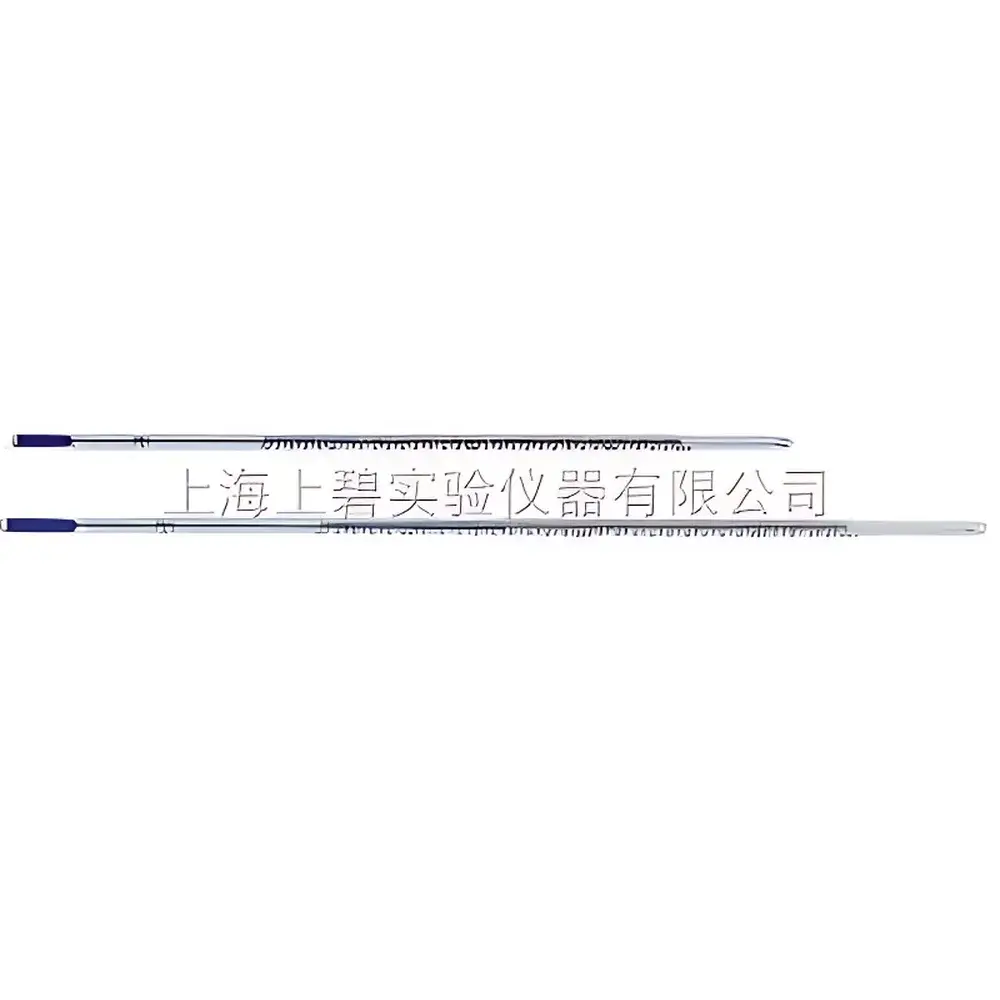
ASTM Alcohol-Filled Glass Thermometer Model 97C
| Origin | USA |
|---|---|
| Manufacturer Type | Distributor |
| Origin Category | Imported |
| Model | 97C |
| Pricing | Upon Request |
Overview
The ASTM Alcohol-Filled Glass Thermometer Model 97C is a precision-calibrated, liquid-in-glass temperature measurement instrument engineered for laboratory and industrial applications requiring traceable, NIST-traceable thermal readings across defined immersion conditions. Designed and manufactured in accordance with ASTM E1–23 Standard Specification for Liquid-in-Glass Thermometers, this thermometer utilizes dyed alcohol (ethanol-based) as the thermometric fluid—providing reliable, non-toxic, and environmentally stable expansion characteristics over its specified operating range of –18 °C to +49 °C. Unlike mercury-based alternatives, alcohol-filled thermometers eliminate hazardous material handling concerns while maintaining high linearity and repeatability under partial or total immersion protocols. The thermometer features a calibrated scale etched directly onto borosilicate glass tubing, ensuring long-term dimensional stability and resistance to thermal shock. Its design conforms to ASTM’s classification system for standardized thermometers used in petroleum, bituminous, lubricant, and chemical testing procedures—including but not limited to cloud point, pour point, flash point, softening point, distillation, and viscosity determinations.
Key Features
- Compliant with ASTM E1–23 and NIST Handbook 150–2B calibration standards for liquid-in-glass thermometers
- Alcohol-filled capillary column with blue dye for enhanced readability and UV stability
- Scale division: 0.5 °C; total scale length: 303 mm; calibrated immersion depth: full immersion
- Borosilicate glass construction (Type I, Class A) for thermal shock resistance and chemical inertness
- Calibration certificate available upon request, traceable to NIST Standard Reference Materials (SRMs)
- No external power or electronics required—fully passive, intrinsically safe operation
- Designed for use in ASTM D97 (pour point), D3941 (flash point), D36 (ring-and-ball softening point), and D1120 (ethylene glycol boiling point) test methods
Sample Compatibility & Compliance
The Model 97C is intended for use in standardized sample containers and test apparatuses where controlled immersion depth and thermal response time are critical. It is compatible with ASTM-compliant test jars, Pensky-Martens closed-cup testers, Saybolt viscometers, and distillation receivers. As a Class I thermometer per ASTM E1, it meets requirements for accuracy class ±0.2 °C at mid-scale and ±0.3 °C across the full range under specified immersion conditions. The thermometer supports GLP-compliant workflows when used with documented calibration records and controlled environmental storage (20 ± 2 °C, RH < 60%). It does not require electrical safety certification (e.g., UL/CE) due to its passive nature, but must be handled in accordance with OSHA 1910.1200 (Hazard Communication) guidelines for glassware integrity and breakage prevention.
Software & Data Management
This analog thermometer operates independently of software or digital interfaces. All measurements are manually read and recorded in accordance with ASTM-defined observation protocols (e.g., reading to nearest 0.1 °C with estimation between scale divisions). For laboratories implementing electronic lab notebooks (ELN) or LIMS systems, manual entry of temperature values must follow documented SOPs that include observer identification, ambient conditions, immersion depth verification, and calibration status reference. While no firmware or driver support is applicable, the instrument supports audit-ready documentation under FDA 21 CFR Part 11 when paired with validated paper-based or electronic recording practices—including handwritten logbooks with witness signatures or ELN entries with electronic signatures and change history tracking.
Applications
- Petroleum product testing: pour point (ASTM D97), cloud point (ASTM D2500), and congealing point (ASTM D938)
- Bituminous materials: softening point determination via ring-and-ball method (ASTM D36)
- Fuel specification testing: freezing point of aviation fuels (ASTM D5903), Reid vapor pressure (ASTM D323)
- Solvent and chemical distillation: fractional boiling range analysis (ASTM D86, D1078)
- Lubricant and grease evaluation: dropping point (ASTM D566), penetration consistency (ASTM D217)
- Vegetable oil and biofuel quality control: flash point (ASTM D92), aniline point (ASTM D611)
- Weathering and low-temperature performance testing per ASTM D789, D471, and ISO 188
FAQ
What does “full immersion” mean for Model 97C?
Full immersion requires the entire mercury/alcohol column—including the bulb, stem, and scale—to be submerged in the test medium during measurement. This ensures thermal equilibrium across all calibrated elements and eliminates stem-exposure correction errors.
Is this thermometer suitable for use in explosion-hazard areas?
Yes—its passive, non-electrical design makes it intrinsically safe for use in Class I, Division 2 environments where flammable vapors may be present, provided mechanical protection (e.g., protective sleeve or shielded mounting) is implemented per site-specific risk assessment.
How often should calibration be verified?
Per ASTM E1, calibration verification is recommended before each testing shift or daily if used continuously; formal recalibration against NIST-traceable references is required at least annually—or after any physical shock, exposure to temperatures beyond range, or visible damage.
Can this thermometer be used interchangeably with mercury-filled models in ASTM methods?
Only if the specific test method explicitly permits alcohol-filled alternatives (e.g., ASTM D97 allows either, while ASTM D36 specifies mercury for certain ranges). Always consult the latest edition of the relevant ASTM standard for fluid-type allowances.
Does the thermometer include a calibration certificate?
A factory calibration report is available upon request; NIST-traceable certification with uncertainty budget requires separate purchase and third-party accreditation (e.g., A2LA-accredited lab).